Examining the Housing and Remodeling Market Fluctuations from 2010 to COVID-19
A variety of internal and external factors form a direct impact on the housing and remodeling markets, causing them to either surge upward or plummet. Tracking the highs and lows helps determine the future trajectory. The 2010 foreclosure crisis shares similarities with the current situation caused by COVID-19, which cannot be ignored.
The housing and remodeling indexes have presently started to experience a potential dive that has left many concerned about the future of both sectors. To understand the market’s ability to rebound, historical factors must be weighed and examines. Fixr, a national service that connects consumers seeking cost estimates about local businesses, has created two graphics displaying both the house and remodeling market index trends since 2010. The graphics act as an outline of past events that could help builders and homeowners plan for the future.
HMI and RMI
The National Alliance of Home Builders (NAHB) and Wells Fargo put out a report referred to as the Housing Market Index (HMI). The HMI keeps track of all past, current, and future predictions, showing the increases and decreases. The process rates the present conditions and then extrapolates the possible six-month projections.
The Remodeling Market Index (RMI), created by the NAHB, tracks the remodeling industry. It acts in a similar fashion with the HMI index by outlining the market’s past, present, and future predictions. The industry movement is updated by the quarter and the index updated accordingly.
Overall, the RMI usually does well even if the HIMI performs poorly since many homeowners opt to invest in their current properties any time the housing market dips. When the housing market is performing well, the remodeling market also improves as homeowners work to fix up their residences prior to selling or after purchasing.
HMI vs. RMI
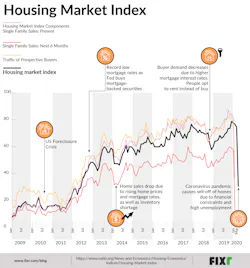
The above graphic outlines the increases and decreases of the HMI in relation to particular events such as the 2010 foreclosure crisis, record-low mortgage rates, and the decrease that occurred in buyer demand because of higher rates that spurred an interest in renting.
Displayed on the graph is the first quarter of 2020 which shows the market plunging to the levels of 2010 due to the global pandemic which caused a widespread sale of homes and no corresponding purchases because of the nationwide economic uncertainty.
Historically, prospective buyers, home sales, and future predictions stay remarkably close together and are displayed following each other up and down the scale. Currently, there is hardly any variation between them and all three have plunged together due to the current housing climate.
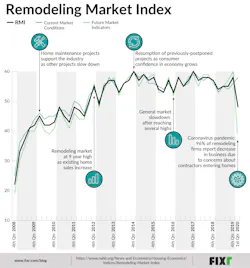
Looking at the RMI graphic above reflects the same highs and lows of the HMI. You can see that the RMI does increase slightly as the HMI falls. Although the markets are independent of each other, both are affected by the same outside forces.
The RMI reflects the current status and future predictions. When the RMI dips, its future predictions trend upward because the market remains optimistic.
Current Trends
During the first quarter of 2020, the housing and remodeling industries sustained a sharp drop as a direct reflection of the economic downturn. The housing market dipped to the same levels as that experienced during the foreclosure crisis of 2010. Typically, such a descent would reflect a rise in remodeling, but in these unique times, it does not. Perhaps people are hesitating to bring contractors into their homes due to the fear of contracting COVID-19, or maybe they are uncertain of their future income potential as many are plunged into unemployment or unique remote work situations. Undoubtedly, the historic and unprecedented times have led to the drop off in remodeling.
One phenomenon to note is that the current remodeling conditions did not drop alongside the index or with future predictions. Instead, things rose slightly in the first quarter. However, this minuscule increase probably reflects projects that were already underway when the world was hit with the pandemic. Perhaps homeowners did not want to halt the projects until things became settled so opted to finish things.
At this point, the future of both industries remains difficult to predict with any certainty because no one knows the lasting impact of the pandemic on the economy. Will the economic recovery be fast or take years? People remain uncertain of their job status and income as many governors and mayors weigh potential actions as the virus numbers increase dramatically in many states. Will certain states, counties, or cities again close businesses to curtail the spread of the virus? At this time, there is no clear path so many avoid purchasing a home or undertaking expensive home remodels, which is reflected in the graphs’ six-month forecasts.
Predictions are only possibilities of the future; the market could rebound quickly or take longer than expected. The indexes have always been a reliable predictor of what is yet to come, but the situation has become difficult to foretell with any form of accuracy.
To read the complete article, click here.