
Many homeowners can now live anywhere because of the work-at-home trend. City dwellers spooked by the coronavirus are moving to the suburbs or more rural areas — and mortgage rates are near all-time lows. No wonder the residential construction market is heating up.
Building permits are a great indicator to determine which metros will be the best bets for home construction because home builders typically don’t pull building permits unless they plan to start construction soon. Permits are also a good indicator for the overall growth potential for electrical work in a local market area because once new single-family housing developments or multi-family projects are completed, strip shopping centers and other light-commercial work typically follow.

Permits now point to solid housing market potential in many U.S. metropolitan statistical areas (MSAs), the geographic areas that include both cities and the surrounding suburbs, particularly across the Sun Belt. According to the most recent residential construction data available from the U.S. Census Bureau, home builders pulled 983,000 single-family building permits (seasonally adjusted annual rate) year-to-date through July 2020, up 17% over June 2020 and up 15.5% over July 2019. The southern region of the United States accounted for 57% of that total. The six metros with the most building permits through July were all from this region: Houston-The Woodlands-Sugar Land, Texas (25,577 permits); Dallas-Fort Worth-Arlington, Texas (23,535 permits); Phoenix-Mesa-Chandler, Ariz. (16,584 permits); Austin-Round Rock-Georgetown, Texas (11,649 permits); Charlotte-Concord-Gastonia, N.C. (10,071 permits); and Nashville-Davidson-Murfreesboro-Franklin, Tenn. (8,000 permits). Check out the Chart for the 50 MSAs with the most single-family building permits through July.
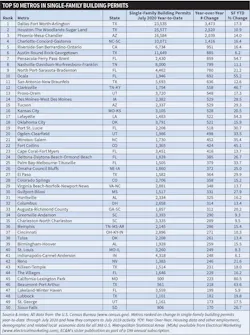
While these markets stand out when measured by seasonally adjusted single-family building permits through July, other market areas also offer plenty of opportunities for electrical contractors. In the Toll Brothers Q3 2020 earnings conference call on August 26, Douglas Yearley, Jr., chairman and CEO of the Horsham, Pa.-based luxury home builder, said because of the trend toward home offices, “Many people are now choosing to live where they want rather than where their job previously required. We've seen a significant increase in relocation traffic to our communities in Boise, Salt Lake City, Las Vegas and Reno, metro Phoenix, Denver, Austin, and, of course, Florida as people chase the sun.”
Yearley’s company builds luxury custom homes that typically sell for at least $800,000. And, like many other home builders, Toll Brothers has found that homeowners in this price bracket are willing to add extra features, such as high-end internet, home theaters, surge protection for all electrical and low-voltage circuits, elaborate outdoor living spaces, security systems, landscape lighting, top-notch interior lighting, and on-site backup power systems. All of these features are add-on business for electrical contractors wiring luxury homes.

“Now more than ever, our customers view their home as the most important place in the world, a sanctuary for their family, and a place to work remotely,” said Yearley, according to the Toll Brothers transcript of the call. “Our homes include desirable design features such as multiple high-tech home offices where family members can work efficiently in private, multi-generational suites for parents or adult kids still living at home, open floor plans with indoor/outdoor living and many other intelligent options for today's lifestyles. This quarter, our buyers added (on average) $181,000 or 23% in upgrades to the base price of their homes.”
With mortgage prices near historic lows, Yearley and others in the home building arena say buyers are more willing than ever to customize their new homes with upscale features. Robert Dietz, chief economist for the National Association of Home Builders (NAHB), Washington, D.C., said in his August analysis of residential construction data and home sales that the overall housing market is “being buoyed by historically low interest rates, a focus on the importance of housing, and a shift to the suburbs as more buyers are seeking homes in suburban communities, exurbs, and more affordable low-density markets.”
He went on to explain that new home sales are benefiting from the suburban shift, as prospective buyers seek out affordable markets in order to obtain more residential space. “Moreover, sales are increasingly coming from homes that have not started construction, with that count up 34% year-over-year,” he said. “In contrast, sales of completed, ready-to-occupy homes are down almost 24%. These measures point to continued gains for single-family construction ahead.”
In addition to all of these economic and demographic trends now intersecting in the housing market, construction economists say an additional factor is favoring the construction of new homes: As a group, millennials are in their peak home-buying years and are ready to make their first purchases. It all adds up to some prime business opportunities for residentially oriented electrical contractors in the local market areas favored by these metrics.
About the Author
 Jim Lucy
Jim Lucy
Editor-in-Chief, Electrical Wholesaling & Electrical Marketing
Over the past 40-plus years, hundreds of Jim’s articles have been published in Electrical Wholesaling, Electrical Marketing newsletter and Electrical Construction & Maintenance magazine on topics such as electric vehicles, solar and wind development, energy-efficient lighting and local market economics. In addition to his published work, Jim regularly gives presentations on these topics to C-suite executives, industry groups and investment analysts.
He launched a new subscription-based data product for Electrical Marketing that offers electrical sales potential estimates and related market data for more than 300 metropolitan areas. In 1999, he published his first book, “The Electrical Marketer’s Survival Guide” for electrical industry executives looking for an overview of key market trends.
While managing Electrical Wholesaling’s editorial operations, Jim and the publication’s staff won several Jesse H. Neal awards for editorial excellence, the highest honor in the business press, and numerous national and regional awards from the American Society of Business Press Editors. He has a master’s degree in communications and a bachelor’s degree in journalism from Glassboro State College, Glassboro, N.J. (now Rowan University) and studied electrical design at New York University and graphic design at the School for Visual Arts.