Maximizing the Benefits of Prefabrication in Electrical Contracting
Key Takeaways
- Prefabrication enhances safety, reliability, and predictability and can promote faster installation, reduced disruptions, and the ability to work in parallel.
- Effective measurement of prefabrication success involves tracking utilization, effectiveness, and cost savings through specific metrics and standardized tools.
- Tracking prefabrication percent usage, equipment utilization, and headcount data can support continuous improvement and justify investments.
- Consistent quality checks and standardized assemblies improve productivity and reduce rework, contributing to overall project efficiency.
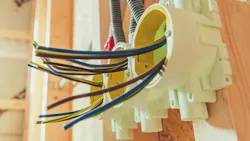
What happens when you get a dozen specialty subcontractors together to review what they have learned and turned into practice on prefabrication? You get confirmation of the purposes and a plan for a measurement system for it.
Benefits of prefabrication
There are three main categories of prefab work:
- Common among all items but unique to the type of job, like boxes, wall mounts, whips, fixture kits, etc. (see Photo above).
- Job/type of work specific items that are related, such as hospital headwalls, high-bay light assemblies, and racks.
- Build-to-order/project specific items that are one of a kind or high-risk elements of a project.
The panel of electrical contractors — part of MCA’s Agile User Group that meets virtually three times per year — recalled/remembered that they worked with their teams to set the foundation with a strong understanding of “the why” behind prefab. Clarifying its purpose will help establish a consistent mindset and set expectations, making it easier to drive adoption and expand its use across projects.
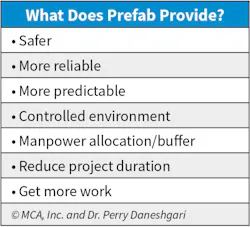
Prefabrication provides far more benefits than just faster installation, as shown in the Table 1. Since work happens in a removed environment away from the job site, it is safer, more reliable, and more predictable. The controlled environment of a prefab shop allows the work to happen with far fewer disruptions than those experienced day to day on the job site.
Without the impact of weather, other trades, working around material and equipment, the space of the prefab shop itself can offer a distraction-free space to produce efficiently. With prefab, work can happen in parallel and sooner, reducing the various peaks and dips of a typical project schedule.
Lastly, despite concerns that prefabrication might take work away from the field, it has the opposite effect. When implemented effectively, it helps contractors stay competitive and win more projects, employing more electricians.
Measuring prefabrication outcomes
In the early days of introducing prefabrication to your team, buy-in from the field can be a challenge. Having a clear message and understanding of the benefits lays the groundwork to bridge this gap.
A common misconception to overcome is that prefabrication simply means faster installation. While that can often be true, it also becomes a point of resistance when it isn’t. This causes other important benefits to be overlooked.
As your team buys into the concepts, sees the various ways to measure success, and is using it in the daily work, how do you measure/know it’s working? The electrical subcontractors got together and reviewed methods of measurement to confirm meeting their goals. The measurements that were discussed used can be categorized into
three areas:
- Utilization: the act of making use of something (how much)
- Effectiveness: how well the desired result was produced (how successful)
- Savings: if there is a financial benefit
Utilization
There were several ways the companies looked at how much prefabrication was being done. While they acknowledged that not every method may consistently apply, these approaches can still provide useful data to support and encourage teams to increase prefabrication efforts. Ideas shared were:
- Prefab percent usage (hours spent in prefab out of the total) per job, scope of work, or division. This is preferably done by reviewing the work breakdown structure and percent of projects using prefab at all/in any capacity. The focus of the discussion was on if it’s at the job site or in the workshop/another location.
- Reviewing if equipment utilization is tied to prefab. The thought with this is if subassemblies are made and brought to the site, the equipment can be on the job site for a shorter amount of time by working quickly to assemble/install the prefab versus waiting for the team to make multiple items/using the equipment sporadically.
- Headcount expected on site versus actual. Some companies do use a more “production” measurement approach.
One prefabrication manager for a large electrical contractor explained their team has established a rough estimated time for different assemblies. In the shop, they will track and monitor how long that assembly takes, if it took longer than expected, and why. This data is compiled monthly and used for production and quality goals. The top producers receive incentives to continue improving.
Effectiveness
This entails measuring how well the prefabrication is working. This is different than how fast or how much. Looking at the benefits to your entire system is important.
- A prefabrication foreman from a participating contractor explained that tracking productivity in an application that complies with the ASTM E2691 Job Productivity Measurement Standard, like JPAC® (Job Productivity Measurement and Control) allows them to see if the prefab assembled and sent to the job site was able to be installed productively. In reviewing the trends, the weeks following the prefabs arrival to the job site, his team is able to see how the prefab impacted the productivity for the overall job.
- Making common among all types of prefabrication in the workshop in an uninterrupted setting is a very good way to increase productivity on the job site by having quality checked items available for faster installation.
- Building consistent items needed for your job that can be manufactured altogether, quality checked (like those patient headwalls or luminaires or electrical panels), and sent as needed for installation will help for consistent flow and work.
Savings
While considering cost savings may seem self-explanatory, it is imperative to consider time, cost, and the increased quality.
If you have established common and consistent prefab assemblies that you use (by default) across your jobs, are using BIM to build the job more productively, but not yet practicing full simulation of building, work and information modeling — you are most likely aligned with the transitional contractor (see Table 2).

Our 2023 feature article, “Measuring the Cost Benefits of Prefab,” discussed a simple and straightforward way to quickly recognize and measure cost savings from prefab. This approach consists of measuring the total labor cost savings that result from improved productivity and reduced composite rate. These can easily be measured at the job level using the Job Productivity Measurement (ASTM Standard E2691) and Job Productivity Assurance & Control (JPAC®).
While cost savings is only one of the several benefits provided through prefab (and intentionally placed last in the discussion), this approach will allow your team to get immediate feedback on:
- Is prefab improving the overall productivity of building the job?
- Are we harnessing resources effectively with prefab to reduce the overall labor cost?
Electrical contractors in MCA’s Agile User Group forum have taken the Prefabrication Litmus Test (shown in Sidebar below). When they review the stage they’re in, have been in, and are moving to, they discussed and shared the benefits they’re realizing — and the challenges they’re encountering to push from traditional to transitional to industrialized.
While several participating contractors have measurements and prefab tracking in place, few have achieved a holistic view of the benefits and risk reduction opportunities at a larger scale. It’s worth noting that other shared approaches noted amongst this group for tracking prefab were:
- Using a prefab tracker to monitor the orders as they come in.
- Tracking hours against the job (using a prefab cost code or multiple cost codes for prefab).
- Tracking work completion, hours, productivity, and composite rate savings.
Conclusion
Whether you are just starting out or further along the prefabrication continuum, maintaining a clear understanding of its core value is essential to not losing sight of the overall goal: building in a way that optimizes time, cost, and quality. Working in a controlled environment also reduces risk and improves safety outcomes. The impacts on workers, projects, and the organization can be measured through one or more of the approaches outlined above — the key is ensuring the intent behind the process remains intact
Want to know more?
- Check out the NECA-5 NEIS Standard for Prefabrication. Prefabrication collectively refers to any kind of completion of electrical components, sub-assemblies, or modules of a construction project in a different, off-site location and performed in a controlled environment.
- Take the Prefabrication Litmus Test, introduced in MCA’s 2023 EC&M feature article, “The Evolution of Prefabrication,” to assess where your organization falls along this maturity model and look for next steps (Table 2).
About the Author
Jennifer Daneshgari
Jennifer Daneshgari is VP of Financial Services at MCA, Inc, whose mission is Making Productivity Visible to Everyone®. She is also a recent contributor for EC&M Asks on the topic of Material Management. Jennifer can be reached at [email protected]. She is also part owner of a WBENC certified company, WEM, LLC. that provides logistics and scheduling services for the construction industry.
Sydney Parvin
Sydney Parvin is associate data analyst at MCA, Inc., Grand Blanc, Mich. She can be reached at [email protected].