Recommended Practices for Creating a Book of Work
Key Takeaways
- A centralized book of work helps track formal requests, change orders, and informal job leads, reducing information loss and improving project oversight.
- Digital tools can enable quick access to project details, forecast labor needs, and support strategic decision-making.
- Capturing early project information increases chances of winning bids, managing margins, and efficiently allocating resources across multiple jobs.
- Tracking change orders and informal requests ensures all work is documented, preventing overlooked opportunities or unanticipated costs.
- Using a comprehensive system for project data supports future planning, profitability analysis, and competitive advantage in the construction industry.

Imagine that your best electrician just finished a job, and the customer couldn’t be happier. This customer owns other venues and asks the electrician if his/her company has the capacity to support an ongoing service agreement. Where would he or she store this information?
Alternatively, imagine you just wrapped up a very successful large project, very successfully. You have a few other jobs going, but are now realizing that three of your best field crews don’t have another job to go to. What are your options, and could this have been seen before now?
Here’s another example. Say you’ve just finished a project, barely making the expected margins. When you ask the PM about it, they reply, “We did a few extra change orders for them, given they’re one of our best customers.” Where would the data about these “extra change-orders” be stored?
As the situations above imply, information about your work (both current and planned) is difficult to gather and keep track of. Regardless of where the information comes from, information loss is unavoidable without a way to identify, document, and consolidate. A book of work (along with a process or tool to consolidate details about your potential, planned, and current projects) can provide a centralized and referenceable place to store that information to make decision making, project management, and budget management more straightforward and comfortable.
This article will explain what should go in your book of work, a checklist with some ideas for where, when, and how to capture the work, and ways to keep it visible. Putting these recommendations to use could save you money, gain you future work, and let you avoid having to wonder and worry about where your electricians will go for their next job.
What is a book of work?
In general, work requests can come from three categories. The first category includes formal job requests, which can include official bid solicitations, Dodge Reports, and public work requests. This is the most structured of the three categories and what many are most familiar with when asked about work requests.
The next category of work includes change-orders, including officially granted or opportunities for change orders. Clinical research done by MCA, Inc. indicates that a typical construction project will have change orders, which make up 30% of the total project. Without tracking your change orders, your book of work will be missing a large portion of the work you are actually performing or planning to perform.
The final category includes informal job requests, which include potential work mentioned in an offhand conversation with a customer on the job site, during a lunch chat, on the golf course, or at a ball game. The following checklist outlines information and sources for potential work that foremen/project managers could see or hear without recognizing:
- Potential sources:
- Emails
- Meeting notes
- Social media posts
- In conversation with customer
- Potential information:
- Timeframe (start date/end date)
- Customer
- Type of work
- General job size/support needed
- Competition/other bidders
As you work to transform these requests for work into a won job, you will naturally gather more information about the job, starting with the minimal amount and expanding throughout the bid process and work itself. However, as you receive more information — and as more people become involved in making decisions and communication — it becomes increasingly difficult to track and manage. The industry is excellent at tracking information like the estimated quantities, prices, and markups, but commonly loses the specific details of the project, such as the timing of decisions, the names of people involved, or changes made along the way. Having a centralized location or tool to store this information becomes vital, especially as companies are working to expand and do more work.
Digitalizing the pipeline & backlog
To make your book of work perform for you, you need minimal information to get started. Pipeline and backlog, a module supported by DCI Construction®, is a system specifically designed to help store and process information from your work environment. With a click of a button, and simple information like project name and customer, pipeline and backlog not only create a space to store information like the associated project team, job location, or estimated start/end dates, but also begin consolidating this information for all of your projects over time.
If you track your full book of work in a tool like pipeline and backlog, you are able to easily see your upcoming potential work alongside the jobs you’re currently working — from the project management load perspective (who is running these jobs?), the market perspective (what type of work are we doing?), and the customer perspective (who are we doing work for?).

With a few pieces of information each, pipeline and backlog is additionally able to give a quick and in-depth view of an organization’s projects individually, alongside other projects, and for multiple output types. An example of one such output, showing a company’s pending and approved project labor hours over time, is shown in Fig. 1.
The more information your team has early on in the project, the better your chance will be in pursuing, pricing, and winning the work that is best for your business, rather than having to “chase” projects to keep people busy. The crux of the issue is capturing information from the sources mentioned above.
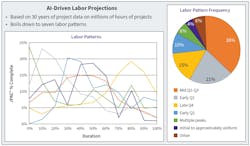
To represent your book of work as accurately as possible, pipeline and backlog compile and condense decades of MCA, Inc.’s research by including several non-linear labor loading curves (Fig. 2), to help forecast expected job and company labor needs. When forecasted over time, it becomes easy to see how many people you need working at any given time, and whether you’ll have a surplus or shortage of people to support your confirmed (and potential) jobs occurring at that time.
Another benefit of digitalizing and storing your data, outside of immediate feedback on your current projects and tracking historical information for future questions, is the ability to predict the outcome of future jobs based on historical performance. Utilizing years of research and data, MCA, Inc. has developed an AI algorithm that can predict the likelihood of winning the bid, as well as your projected profitability (or lack thereof).
The human memory can only hold so much information before details are lost. Without a place to store and reference facts about your work — and as both the construction industry and construction companies grow and support more work — answering particular questions easily and quickly becomes exponentially harder. Keeping a detailed book of work, and using tools such as pipeline and backlog, can help answer these questions, including how much work you have in the future, what work you’re bidding, your needed manpower, or what changes occurred over the course of a particular job.
About the Author
Dr. Heather Moore
Vice President of Operations
Dr. Heather Moore is VP for Customer Care and Support at MCA, Inc as well as a known researcher and author in the construction industry. Dr. Heather can be reached at [email protected]. She is also part owner of a WBENC certified company, WEM, LLC. that provides logistics and scheduling services for the and is the only licensed reseller of MCA, Inc’s software products that are focused on Making Productivity Visible to Everyone®.