Measuring Productivity vs. Production
Key Takeaways
- Production measures the amount of work completed, while productivity assesses how well that work is performed relative to effort and value transfer.
- Effective productivity management involves removing delays, reducing rework, and optimizing material handling to enhance value transfer to the customer.
- Regular monitoring of productivity trends helps identify abnormal variations and normal fluctuations, enabling proactive adjustments to stay on track.
- Field input is essential for accurate productivity measurement, serving as the bridge between project estimates and actual work performance.
- Focusing on productivity rather than just activity levels ensures that profits are driven by efficient work execution aligned with customer expectations.
You are running several jobs. Some of them make the profit expected, sometimes they don’t make the profit you expected, and other times they make much more than you planned. Assuming there’s not something unique in the scope of work/estimate, can you explain why? It may be in the way you measure productivity.
Think about what your customer pays you for — they pay for you to complete your performance obligations. Doing it as productively as possible is what will increase your profits.
Production vs. productivity
What is production? It’s the measure of construction put in place. Yes, but how?
What is productivity? It’s how well the construction was put in place. Yes, but how?
Think of it this way. On Floor 2, Section A in the medium-sized committee room, you plan to install boxes and run wire, conduit, and MC cable for the lights. You’ve installed half of the boxes and run half of the wire, conduit, and half of the MC cable. How “complete” are you?
If you’re measuring production, you’d likely say 50%. Why?
- Production tracking typically looks for linear calculations. This typically calculates percent complete based on the burn rate of units installed, or perhaps slightly different based on costs to date.
- Calculations are a typical cost-based accounting perspective, which may or may not accurately represent construction put in place.
- Production tracking is a simplistic method of dealing with a complicated environment.
If you’re measuring productivity, there’s slightly more to it than that, such as how much of the work planned is completed. It’s important to focus on the effort expended. This can be answered by reviewing these questions:
- How much of the layout is complete?
- How much of the material is purchased?
- How much prefabrication work is completed, but not yet installed?
- How much of the material handling is completed?
- How much of the testing is completed?
- Are we certain there are no rework or repairs required?
- How close are we to completing our performance obligation from the customer’s perspective?
Your contract defines what the customer expects upon completion. Your work is complete when the performance obligation is fulfilled from the customer’s perspective. Your customer doesn’t pay for activities that don’t transfer value to the completion of the project. These are the items that you pay for from your profits if your team isn’t able to be their most productive.
Getting your team to be their most productive
Keep them working on transferring value. You help them be their most productive by managing the work environment. Note that neither productivity measurements nor production tracking has any weight on whether your teams are busy and/or working hard.
So what can you work with them to do? Review what’s not transferring value at all and what’s necessary, but still not transferring value. Work on items to enable your team to be more productive, like:
- Remove their waiting time
- Remove/reduce their walking time
- Reduce/eliminate rework and repairs
- Support and plan for limited material handling
- Reduce need for material movement (including handling/transferring waste)
- Reduce time spent working around other trades
- Reduce limitations in access to areas
You do this by making a work plan and then measuring productivity periodically and continuously. Keep thinking: Is it correct, necessary, and complete from a customer perspective?
How to measure (and be able to address and improve) productivity
The standard for job productivity measurement in construction is ASTM E2691, and it is built taking all of the above into account (Fig. 1).
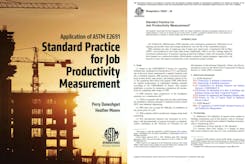
It prescribes a measure of system productivity by comparing the transfer of value to all the hours spent in total or in a few labor codes (the standard allows for six to 15).
The work needed to complete the project (the performance obligations) to the customer’s expectation is planned and then measured by the observed percent completion of that work. Productivity differential conveys whether that work is taking more or less than planned, and forecasts that rate through the project’s completion.
Productivity trends are monitored weekly on most jobs, although some jobs require more frequent measurement. They are monitored for:
- Special causes of variation (abnormal ups and downs from the expected rate) require explanation. They’re not special because we think they’re special; they are indicators that the system is not predictable, and the cause for that instability needs to be understood to see if it is going to continue or not.
- Common causes of variation (the constant noise and minor ups and downs in productivity) should also be studied — but with a different tool for categorizing them. Otherwise, you’ll be spending a lot of time chasing your tail trying to fix the day-to-day impacts to productivity that are completely normal. This can cause tampering and actually make things worse (see Fig. 2).
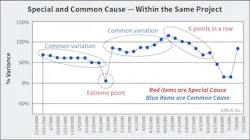
This monitoring and root cause analysis happens through a weekly job review meeting (see “Making Job Review Meetings More Effective,” which appeared in the EC&M August 2025 print issue), where the data is at hand, and the project team is reviewing it to explain the conditions.
The key is that the input for the entire process of productivity measurement must include input from the field. While the estimate and agreed-upon contract dictate the size of the checkbook and accounting represents what was spent, the field and productivity measurement are the explanation in the middle. The correct measurement and process to monitor, explain, and maintain stability are all important.
Why productivity vs. production matters
You have a contract for a performance obligation to be completed from the customer’s perspective. Your profits are determined by how productively you deliver that performance obligation. Remember: Linear calculations to calculate production make it difficult to know where your projects will end up as planned — more profitable or less profitable. Knowledge is in managing the work environment and measuring and managing productivity.
About the Author
Dr. Heather Moore
Vice President of Operations
Dr. Heather Moore is VP for Customer Care and Support at MCA, Inc as well as a known researcher and author in the construction industry. Dr. Heather can be reached at [email protected]. She is also part owner of a WBENC certified company, WEM, LLC. that provides logistics and scheduling services for the and is the only licensed reseller of MCA, Inc’s software products that are focused on Making Productivity Visible to Everyone®.
Jennifer Daneshgari
Jennifer Daneshgari is VP of Financial Services at MCA, Inc, whose mission is Making Productivity Visible to Everyone®. She is also a recent contributor for EC&M Asks on the topic of Material Management. Jennifer can be reached at [email protected]. She is also part owner of a WBENC certified company, WEM, LLC. that provides logistics and scheduling services for the construction industry.