Staying Ahead of Job-Site Changes
Key Takeaways
- Develop initial labor plans based on project scope, complexity, and field input to ensure accuracy and relevance.
- Use data-driven labor curves and Work Breakdown Structures to visualize and anticipate manpower needs over the project lifecycle.
- Regularly review and adjust labor plans at key project milestones or when triggers like schedule shifts or weather changes occur.
- Foster collaboration between field teams and office personnel to incorporate diverse perspectives into the labor planning process.
- Leverage continuous monitoring and productivity data to proactively address potential constraints and optimize resource allocation.

Every electrical contractor has seen it happen: A project looks manageable on paper with the right team between the office and the field and then… life happens! You win new work. You don’t win some work you planned on, and/or the schedule is shifting on this project (and others).
The field team is one of the most important group resources in your company, and when manpower plans have to adjust quickly, it’s good to know what flexibility you have. If projects become reactive instead of planned, that can be a challenge for the entire company. For the field, this helps identify upcoming constraints before they become emergencies. If a project needs a larger crew in four weeks, that information is much more useful today than it is three days before the need arrives.
For the office, a project-level labor plan helps the company maintain and retain manpower by seeing when one job expects to increase its manpower while another expects to decrease. When every project’s plan is combined, leadership gains a better understanding of the company’s pipeline and backlog — not only in dollars, but also in people.
The initial plan
For many, initial project labor plans often start with knowing that for this amount of time, we need a small crew to mobilize, then we will expand as the work picks up, there will be a peak for a bit (or perhaps two peaks), and then we will ramp down. This is likely repeated per job with each project’s size and schedule.
A labor plan is not just a chart with an estimate of number of people over time. It is a way to connect the estimate, schedule, field plan, company’s manpower strategy, and the project’s actual performance. For electrical contractors, that connection is critical because the work is complex, schedules are compressed, and skilled labor must be managed carefully across multiple projects.
To ensure your plan is solid, some initial items to consider are:
- Scope of work
- Project complexity
- Levels of prefabrication
- Methods of installation
- Crew experience and historical productivity
- Local labor availability
How do we go from “this many” people for “this many” weeks to a visible plan with a purpose? The Job Productivity Management standard published in ASTM E2691 suggests starting with a Work Breakdown Structure (WBS) created by the field team doing the work. This is more than breaking down the estimate into cost codes, bid items, or schedule activities. This is also not pull-planning tasks. This is a work plan created by the people performing the work.
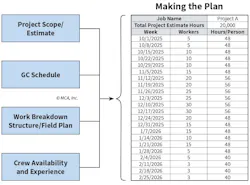
When building the plan for the work, the team should avoid treating it as an office exercise. Field input is essential. Foremen, general foremen, superintendents, project managers, and operations leaders each see different parts of the job. The field understands installation sequence, access issues, crew capabilities, and real site constraints. The office sees budget, contractual dates, other project demands, and company-wide manpower availability. A useful labor plan brings those perspectives together, as shown in Fig. 1.
Choose the best starting point – with data
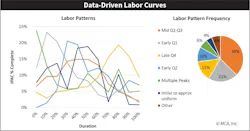
While every project feels unique, there are common trends for what quantity of work is completed when in a project and what labor is needed to complete that work. The MCA research division performed a study across 30 years of data and several million labor hours, referencing many types of work and locations, which showed that there are essentially six data-driven shapes of non-linear labor curves across all projects studied, as shown in Fig. 2. The labor plan can be developed in many ways: spreadsheets, internal templates, or software. Look for something that can display work by time, project, location, market segment, and customer.
The purpose of your labor plan is to help field and office personnel see what is coming before it becomes urgent. A strong plan helps anticipate project manpower needs and constraints, supports companywide manpower retention, improves visibility into your company’s pipeline and backlog, and gives teams a practical way to compare planned work against what is actually happening. The goal is not a perfect one-time document or just a number of people over time, but a plan rooted in data and linked to the work in the project.
Adjust the plan – it’s OK!
Projects change. Work may have been missed in the original plan, added after the plan is made, or delayed by schedule constraints, absences, weather, access issues, or other jobs the company is working on. This means it’s time to review and adjust. Adjusting the plan starts by asking three questions:
- What work is left?
- How much time is left?
- Is the job site more or less productive than expected? (Depending on productivity, the project may need more/less people than originally planned.)
These questions should be asked and adjustments made before the end of the job or key deadlines have passed. If the team waits until the project is already over budget or behind schedule, the conversation becomes a postmortem. If the labor plan functions correctly as an early warning system, the team still has time to level set expectations, remove obstacles, re-sequence work, or make informed manpower decisions.
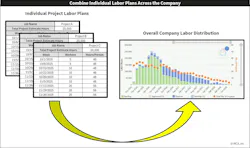
These labor plans and conversations can scale up to the entire company, as implied in Fig. 3. As all projects adjust their needed labor over time, at the company level, it’s important to confirm you have enough people to complete all of the work you have (or whether you have too many).
Taking productivity learnings (from software that complies with ASTM E2691, like JPAC®) as well as schedule adjustments into account, we suggest you minimally re-evaluate your labor plan at 25%, 50%, 75%, or every few months depending on the length of the project. However, you may also need to think about adjusting your plan if any of the following triggers/reasons are happening:
- Shifted schedules with overtime constraints.
- Material delivery sequence.
- Equipment availability.
- Learning curves of the field (and PM) teams.
- Weather and environmental issues.
- Productivity learnings identified through ASTM E2691, Standard for Job Productivity Management.
The plan for the remaining work can then be changed and updated to project more accurately through the end of the job. This is where frequent monitoring becomes important. After adjusting the plan, the project team can reevaluate how the job is looking, asking questions such as:
- Will more or fewer people be needed on site to complete the remaining work?
- Can the required work be finished in the time available?
- Will the project run over or under the hours originally planned, and what are the reasons?
These answers help the field staff make better daily and weekly decisions, and they help the office communicate more clearly with leadership and customers.
Change from on-the-fly problem solving to proactive planning
A labor plan created at the beginning of the project and never touched again will lose value quickly. A regularly reviewed labor plan, based on data, becomes a living management tool. The best visible labor plans:
- Use a Work Breakdown Structure for the starting point.
- Have system productivity input from the field.
- Connect to a schedule.
- Adjust as conditions change, referencing nonlinear labor loading curves backed by years of project data.
- Look across the group/company to the impacts to the business.
A good data-driven visible labor plan at the project level, as well as the larger team level, helps you anticipate manpower needs and constraints and understand your overall company Pipeline & Backlog. This, coupled with monitoring labor productivity and acting on the signals, will put your company in the best position possible to facilitate success and minimize issues.
About the Author
Jennifer Daneshgari
Jennifer Daneshgari is VP of Financial Services at MCA, Inc, whose mission is Making Productivity Visible to Everyone®. She is also a recent contributor for EC&M Asks on the topic of Material Management. Jennifer can be reached at [email protected]. She is also part owner of a WBENC certified company, WEM, LLC. that provides logistics and scheduling services for the construction industry.
Hannah Durant
Hannah Durant is Business Operations Analyst at MCA, Inc. Hannah can be reached at [email protected].