Maximizing Construction Efficiency with Work Breakdown Structure (WBS)
Key Takeaways
- A well-structured WBS makes work explicit, assignable, and manageable, reducing field issues like delays and rework.
- Involving all stakeholders — field, office, project managers — in WBS creation ensures comprehensive risk assessment and better coordination.
- Breaking projects into phases helps identify and mitigate business, technical, and integration risks early, leading to smoother project execution.
- Effective WBS implementation requires clear role ownership across planning, procurement, installation, and closure to maximize project success.
- Using a project WBS transforms planning into actionable intelligence, connecting work to business outcomes and enabling proactive risk management.
When you see things on the job site happening — whether it’s delayed material, unclear handoffs, waiting crews, rework, and missed information — it’s likely that the planning wasn’t explicit. MCA’s research shows that for every one hour spent planning, there are 17 hours saved in the field, according to research from Dr. Perry Daneshgari and Michelle Wilson in The Impact of Job Planning on Profits.
That incredible benefit is why planning through Work Breakdown Structure (WBS) should extend outside of the field team; it should be used as a practical tool to make the work of every project phase visible, assignable, and manageable. The WBS represents the following three things:
- Work: The actual work being performed is defined and explicit.
- Breakdown: The detail needed to plan, execute, and monitor how the work is broken down.
- Structure: The complete representation of the scope which is aligned with the 100% rule. It states that 100% of the work is captured and adds up to 100% across the hierarchy of the project.
Everyone involved in a project affects job-site performance, even if their work happens before crews arrive or after installation ends. The reality is that everyone involved in a project or your overall company needs a plan for their role, and their work is broken down to be explicit.
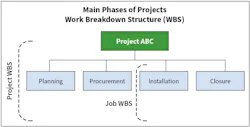
In Agile Construction® for the Electrical Contractor, Second Edition, the project WBS includes four phases: planning, procurement, installation, and closure (Fig. 1). While the job WBS focuses on the installation, the project WBS expands visibility to the broader project team and company support functions that determine whether field work starts clean, stays coordinated, and closes without avoidable delay.
Understanding construction risks
Breaking the project into phases gives contractors a straightforward way to manage risks before they impact productivity. The three types of risks that construction projects are susceptible to are business, integration, and technical risks, according to ASTM International.
Business risks include risks from the contract, financial pressures, and external factors, like the reputation of the business, and how the business responds to the market environment. Technical risks include design complexity and execution challenges for building the job. Integration risks include how well people, data, processes and technology work together to complete the project.
Having a job WBS reduces the technical risk by establishing how the physical installation work will be executed. Having a WBS for all four phases of a project reduces the other two risks — business and integration — with the integration risk being the most difficult to manage. When project teams do the WBS for each phase of a project, they are assessing and planning for how the business will support the execution of the project, identifying the external factors at play, and establishing controls to monitor the risks throughout the life of the project.
Who creates and executes the WBS?
All of these items need to be completed for the successful completion of a project. Who in your company is doing them? For some, it can include project managers, project coordinators, the field, assistant project manager, or the office team.
As discussed in our August 2026 EC&M job-site intelligence column, planning should be a shared responsibility between field leadership, project management, operations, and office support — not just PMs or coordinators. This involvement is important because:
- The field provides technical input on how the job will be built, visibility to job-site constraints and potential conflicts or missing information from the drawings.
- The office team contributes budget, contractual dates, other project demands, and company-wide resource availability.
- Project managers are included as a bridge between field planning and office/company-level visibility.
The WBS gives these contributors a common structure for seeing where their work connects to the field.
Putting the WBS into practice
Ensuring all risks are managed for a project in its full life cycle isn’t just a matter of what, but also who and how. How your company is organized and work is distributed is important to understand, explicitly. A project-level WBS turns planning into intelligence by showing what must be done, who owns it, and how each phase protects the next.
The following sections include how contractors should practice WBS for each of the four phases, based on MCA’s research and input from electrical contractors who have practiced this process and shared their learnings during MCA’s project management-focused symposiums. The key is making sure that all of the work involved in a project is handled by roles that exist in your organization.
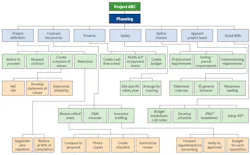
Planning: Defining the project’s objectives beyond installation.
Includes: Defining the project, confirming contracts are in place to protect the company, setting up for financial management of the project (budget creation, cash flow schedule, and retention strategy), appointing the project team, developing the WBS and schedule, define closure up front so the exit criteria exist before work starts (Fig. 2).
In practice: The planning phase, via the planning WBS, helps everyone start on “Page 1” of the project together by considering and defining the work and setting up the project for success, including assignment of the resources that will be involved in planning and executing the remaining phases of the project. This could include project sponsors, group leaders, your “preconstruction team,” project managers, or estimators.
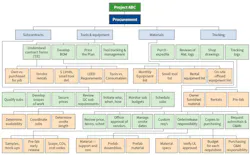
Procurement: Bringing together tools, equipment, material, and subs when and where they are needed.
Includes: Ensuring material submittals and O&M requests are put in place, pre-fab assemblies and early releases are defined; confirming subcontractors are qualified and necessary scopes of work are secured, GC sub requirements, budget monitoring and scheduling; deciding owned vs. rental decisions for tools and equipment and ensuring tool needs are planned for and on the job site when needed (Fig. 3).
In practice: Procurement is not complete when material is ordered. It is complete when the correct material is available where and when it is needed. This procurement WBS should include how the material, prefab, tools, and equipment will be tracked between order, delivery, and receipt. It may include the project manager, project coordinators, your purchasing team, anyone involved in prefabrication and BIM, plus your field team.
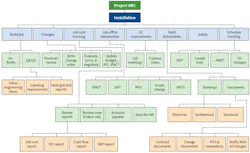
Installation: Setting up for a productive job site.
Includes: The installation phase should include a plan for the work for building the job, documenting as-builts, managing QA/QC, establishing and tracking changes to scope, handling requests from the customer, meeting job cost tracking and scheduling needs, complying with GC requirements and ultimately meeting field deliverables, and safety (Fig. 4).
In practice: When preparing for installation, the installation WBS should consider area access and readiness, trade coordination needed during execution, and tools/equipment needed on site and in the working area. This is typically a field function. The installation WBS is best owned by the field leader, which could be the superintendent, general foreman, or foreman, depending on your company.
Closure: Finishing the job and protecting the business.
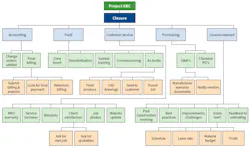
Includes: Closure isn’t just final paperwork; it splits evenly between getting paid (final billing, retention, PO closeout) and getting the next job (client satisfaction, references, quotables). The feedback-to-estimating loop is what makes closure valuable to future bids rather than a one-off administrative step (Fig. 5).
In practice: The closure WBS should capture a means for allowing lessons learned to be shared, assigned, followed up on, and used to improve future projects. Having a repository to store this is key — otherwise it’s speaking to yourselves without giving the benefits to others. A project is not complete when installation ends; capturing the work for testing, documentation, and turnover is a critical part. While the project management team typically leads this portion, it’s important to confirm that accounting, the field, the estimator, and leadership are involved. This ensures the goals for the project as well as the business are known up front (in planning) and are worked through during the life of the project.
Job-site intelligence takeaway
Make sure the work defined in the project WBS is explicitly assigned to people on your team. While the scope may be different across projects, the work for planning, procurement, installation, and closure has defined items that must be broken down to address the needs of the project. The job site is where weak planning becomes visible, but the causes often start much earlier.
A project WBS helps contractors see the full path of work across these phases, assign ownership before gaps appear, and connect each phase to the business result. When the right people help build and use the WBS, the project team gains practical intelligence it can act on before risk turns into lost time, added cost, or avoidable disruption in the field. The full team — and your entire company — wins.
About the Author
Jennifer Daneshgari
Jennifer Daneshgari is VP of Financial Services at MCA, Inc, whose mission is Making Productivity Visible to Everyone®. She is also a recent contributor for EC&M Asks on the topic of Material Management. Jennifer can be reached at [email protected]. She is also part owner of a WBENC certified company, WEM, LLC. that provides logistics and scheduling services for the construction industry.
Sydney Parvin
Sydney Parvin is associate data analyst at MCA, Inc., Grand Blanc, Mich. She can be reached at [email protected].