Assessing MEP Sector’s Path to Data-Driven Operations

MEP trades’ utilization of data and digital tools used to generate it is increasing, leading to steady operational improvements in construction work, but the industry is hardly marching forward in lockstep on that front.
Rather, according to a recent report based on a survey of 144 MEP firms State of MEP 2025, electrical, piping and plumbing, sheet metal, and multi-trade contractors are moving at varying rates of speed determined by the nature of their work, industry custom, ability to move out of their comfort zones and existing level of digital integration. (Sixty-four percent say they’re “moderate adopters.”)
Electrical is portrayed as a trade at a possible crossroads in the report, prepared by Stratus, a Colorado-based developer of digital tools for MEP contractors. The survey, which included 36 firms with electrical a primary focus, firms, placed electrical at the bottom on utilizing prefabrication, low on leveraging tools to automate fabrication, and trailing other trades on utilizing metrics for fabrication productivity, building information management (BIM), and virtual design & construction (VDC).
In the fabrication area, highlighted with its own report section, reflective of its overall importance to operational efficiency, electrical stands out as having by far the lowest report usage. Eighty-three percent of respondents reported that electrical prefab accounted for less than 20% of their total work, with 9.5% the median. By comparison, the median number for piping/plumbing, sheet metal, and multi-trade was 20-30%. Reported space dedicated to electrical prefab was comparatively low as well, ranging from less than 10,000 sq ft to 38,000 sq ft. On the high end, other trades reached 175,000 to 250,000.
Alongside low utilization of prefab, the use of automation for electrical fabrication is “underdeveloped” the report says, compared to “strong” in sheet metal and multi-trade sectors and “growing” in piping. Just 39% said they were using or planning to adopt an automated conduit bender, while 23% said single axis cutters were in use or planned, and 11% said the same for a CNC machine. Moreover, almost 60% deemed both a single axis cutter and a CNC machine as automation equipment “not applicable” to their business. Usage of this and other trade-specific automated equipment was higher for other applications.
A comparison of the findings, the report states, suggests that “electrical fabrication remains the least automated segment, driven by a lower propensity of fabrication-ready BIM models, and a historic dependence on field cutting, bending and assembly operations. These differences reflect the underlying variation in shop workflows, repeatability, and digital model depth across trades.” However, “electrical contractors are beginning to adopt automation in targeted areas — especially where model-based workflows create predictable inputs. In the area of automation, electrical, “shows strong intent to expand conduit bending, cutting and kitting capabilities.”
Greater prefab and associated automation adoption would be possible, and beneficial, Stratus CEO, Jake Olsen, tells EC&M, if more electrical contractors were to prioritize operational metrics and shed a “legacy mindset” that stems partly from the industry’s historical comfort with and relative ease of building and modifying electrical systems in the field.
“We see some incredible fabrication operations from electrical contractors — as advanced as any other trade — but overall, these are the very early adopters, and most of the industry is just starting to see peers lean into this,” he says. “As an industry that validates workflows and technology changes by talking to peers, this naturally creates a lag in adoption.”
BIM usage, he notes, is growing in the trade, Olsen says, but is being utilized mostly for coordination, “which is very different than modeling to fabricate.” More resources must be dedicated to using it in that way, he cautions, but the payoff can be large in the creation of more downstream leverage.
Highlighting both the challenges and promise of more sophisticated prefab operations in electrical, Olsen shared comments an executive with Big State Electric, Ltd., offered at MEP Innovation Conference 2026 in January.
Jared Christman, director of innovation and technology at the San Antonio contractor, told a panel audience that, “if you’re not starting with a fabrication-level model, automation becomes impossible.” Utilizing tools like CNC machines and automated cutters, he said, depends on detail built into a model.
“The equipment requires precise data. Without that, the trade will continue to see automation as optional rather than essential.”
But the survey suggests electrical contractors are seeing the big picture — at least as clearly as other trades — on using modeling, digital tools, data science, visualization and other technology. While electrical trade respondents indicated scattered use of key performance indicators and metrics to analyze operations, (See graphic) but deeper use for financial analysis, they generally saw greater potential for tools like model-base estimating; digital field installation software; and purchasing/inventory management, than did other trades.
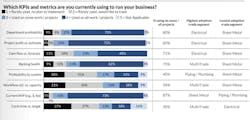
The scales, though, are clearly tipping in the direction of deeper and broader adoption by all MEP companies of a data-driven approach to operations, Olsen says. The industry has indeed thrived without fully embracing technology writ large, but “a change is clearly underway,” driven by a new generation of construction technology targeting “highly specialized and deeply integrated workflows. Electrical contractors and their MEP peers, Olsen says, are “on pace in adopting technology when it is truly ready to improve their business outcomes.”
About the Author
Tom Zind
Freelance Writer
Zind is a freelance writer based in Lee’s Summit, Mo. He can be reached at [email protected].