Decoding NEC Art. 450 for Distribution Transformers
Key Takeaways
- Distribution transformers must adhere to NEC and NFPA 70 standards, with specific requirements for overcurrent protection, grounding, and installation based on voltage levels.
- Protective devices like circuit breakers and fuses are essential, especially for transformers operating over 1,000V, to ensure safe operation and compliance with code requirements.
- Proper grounding of all non-current-carrying metal parts and the secondary side is crucial to prevent floating voltages and ensure safety in transformer operation.
- Transformers can be operated in parallel if they have matching turns ratio, kVA rating, and impedance; switching them as a unit is recommended for safety and load balancing.
- Choosing the right cooling system depends on the application size and environment, with dry-type suitable for indoor, low-voltage applications, and liquid-filled for outdoor, high-power needs.
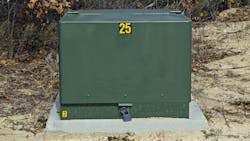
Distribution transformers are a vital component of any electrical system because they step voltage up and down to meet the requirements for power transmission and load support. For this reason, it is important — especially during design and construction — to understand the limitations and requirements for installing a distribution transformer. The National Electrical Code (NEC), along with other standards and guidelines, outlines key requirements for distribution transformers.
When transformers are included in an electrical design, it is imperative to meet Art. 450 requirements, which outline common questions regarding overcurrent protection, grounding, marking, installation, and more. While not intended as a design manual, following these requirements helps ensure safe operation. Let’s address some common questions when it comes to transformer design, installation, and troubleshooting.
Do I need protective devices for a transformer? If so, what type of protective devices are required?
Transformers operating over 1,000V on the primary side must have both primary and secondary overcurrent protection that is rated according to Table 450.5(A). Transformers operating under 1,000V on the primary side must have both primary and secondary overcurrent protection that meets the criteria in Table 450.5(B).
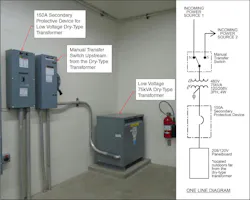
Transformers rated under 1,000V require only primary overcurrent protection without secondary protection if the protective device is rated as detailed in Table 450.5(B) and meets the requirements of Sec. 240.21(C). For indoor transformers requiring secondary overcurrent protection, not located near the secondary side loads, an overcurrent protection device is required and must be within sight, per Sec. 240.21(C).
Photo 1 provides an example of a water treatment facility where the lighting panelboard was located out in the field, but the transformer was located indoors. Depending on their parameters, circuit breakers, fuses, fuse links, and other protective devices with similar protective settings as a circuit breaker can be used as the overcurrent protective device on the primary and secondary side.
If a transformer requires an insulating fluid (e.g., ester fluid), then additional protective devices and structural requirements (for the transformers) must be compliant with Art. 450.
If fluid-insulating transformers are installed indoors, they will often require some form of liquid confinement area or vault. In such cases, requirements for ventilation and the construction of walls/floors/roof of the transformer vault or confinement area must comply with Part III of Art. 450.
If fluid-insulating transformers are installed outdoors, various additional requirements must be met. Nonflammable fluid-insulated transformers are required to be furnished with means to absorb or transfer the gases generated by the coolant during an arcing event to an environmentally safe area.
Less-flammable liquid-insulated transformer requirements are dependent on the listing of the liquid. Depending on the liquid, these requirements may also affect the size of the overcurrent protective device — Table 450.5(A) and 450.5(B) list the maximum rating required. If the liquid requirements cannot be met, less-flammable liquid-insulated transformers are required to meet the same outdoor requirements as oil-insulated transformers.
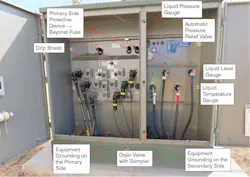
Oil-insulated transformers are required to have several safeguards, depending on the degree of hazard. The required safeguards are as follows: space separations, fire-resistant barriers, an automatic fire suppression system, and an enclosure that confines the oil from a ruptured transformer tank. Photo 2 details a pad-mounted transformer with FR3 insulating fluid, which is considered a less-flammable liquid.
Do I need to install a disconnecting means for a transformer?
All transformers, except types Class 2 and Class 3, are required to have disconnecting means in sight of the transformer, or if the disconnecting means is in a remote location, per Sec. 450.16. For clarification, Class 2 and Class 3 transformers are power-limited and are not typically distribution transformers. Rather, they serve as transformers for doorbells, garage door openers, etc., and are often labeled as such.
How do you size the primary and secondary side conductors for a transformer?
The NEC only requires minimum transformer sizes in Sec. 240.21(C), based on the length of the secondary conductors. In Art. 450, only maximum overcurrent protection sizes are provided. However, other areas of the NEC require conductors to be sized for an ampacity not less than the total of 100% of noncontinuous loads and 125% of continuous loads. Adding all the loads fed from the transformer will provide a minimum conductor size. Based on NEC requirements, it is possible to have a conductor sized for less than the transformer-rated current. The overcurrent protection device would need to be sized to protect the conductors regardless of the conductor’s chosen size. This practice should only be used when the transformer loads will never exceed the Code minimum for the overcurrent protection device and conductors — and when the requirements of Sec. 240.21(C) are met.
A common method would be to size the primary conductors based on 125% of the primary side transformer-rated current, and size the secondary conductors based on 125% of the secondary side transformer-rated current.
Does a transformer need to be grounded?
Yes, transformers must be grounded per Sec. 450.12. All exposed non-current-carrying metal parts of the transformers must be grounded and bonded, per Art. 250, regardless of the transformer configuration.
In addition to the bonding and grounding of the transformer, the secondary side of a transformer is a separately derived system. As such, the establishment of a ground in the secondary side is crucial to limit or remove floating voltages. Depending on the transformer configuration, the grounding of the secondary side needs to be established per the manufacturer’s or engineer’s design.
Can you run transformers in parallel?
Yes, transformers can be operated in parallel. To do so, the transformers must have the same turns ratio, kVA rating, nearly the same percentage impedance, and must be switched as a unit.
The turns ratio is important to ensure the primary and secondary voltages match. Otherwise, the transformers will generate circulating currents as power is fed from one transformer to the other. Having a near-identical percentage impedance is important to better balance the load on both transformers.
Per Sec. 450.7, the transformers are permitted to be switched as a unit, and the overcurrent protection for each transformer must meet the requirements in Sec. 450.5(A) or Sec. 450.5(B), depending on the voltage. Therefore, the shared overcurrent protective device cannot be larger than the maximum rating included in those tables. Paralleling transformers without switching them as a unit is not recommended because it can present dangerous back-feed situations for workers during electrical maintenance.
If installing secondary protection on a transformer with a voltage less than 1,000V and greater than 9A, then the maximum rating is 125% — whereas a secondary circuit breaker on a transformer with a voltage greater than 1,000V and impedance of 6% or less can have a maximum rating of 300%. For parallel transformers switched as a unit, the maximum rating would still be based on the transformer-rated current of one of the transformers. This can greatly limit the possible output from parallel transformers because the overcurrent protection device cannot be greatly increased. It is typically best to install a larger transformer instead of multiple smaller transformers.
What is the best cooling system for a transformer?
There are several ways to cool a transformer. The main determining factors are the location and load parameters (rated capacity, voltage ratings, and frequency) of the transformer. First, determine whether to use a dry-type transformer or a liquid-filled transformer.
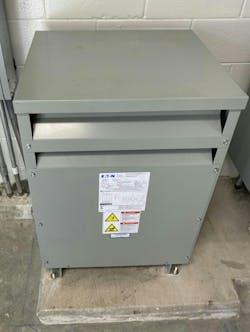
Dry-type transformers do not contain a liquid cooling system, which is advantageous for fire safety (Photo 3). These transformers rely on ambient air as the cooling source, so they require ventilation openings in the walls of the enclosure and/or heat sink cooling fins. That means dry-type transformers work best indoors; however, they can be installed within an outdoor-rated enclosure. It is generally recommended to use dry-type transformers for smaller power applications involving low voltage.
Most designs are advised to limit these transformers to low-voltage (480V-240/208/120V) applications, and to not exceed 300kVA. Article 450 outlines requirements for dry-type transformers. For instance, dry-type transformers greater than 112.5kVA must be located in a transformer room unless meeting an NEC exception, and dry-type transformers greater than 35,000V must be installed in a vault.
Liquid-filled transformers offer superior internal heat dissipation by using a fluid cooling medium, such as mineral oil or a natural ester. The transformer core is immersed in the fluid and completely sealed with no ventilation for cooling — this makes liquid-filled transformers best for outdoor installations; it is not ideal to have large quantities of flammable liquid indoors (Photo 4).
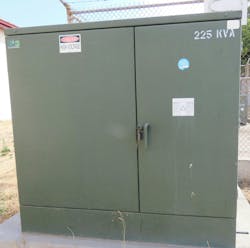
Liquid-filled transformers are recommended for larger applications involving medium-voltage and high-power requirements. For example, a 12,470V–480V, 3,000kVA pad-mounted outdoor transformer would typically work best as a liquid-filled transformer.
If needed, both types of transformers can be installed with ventilation fans to force air over the heat sink cooling fins and increase the kVA output of the transformer. Liquid-filled transformers can also utilize forced fluid cooling to obtain higher kVA outputs.
About the Author
 Lilly Vang
Lilly Vang
Lilly Vang, PE is an electrical engineer at CDM Smith. She focuses on the design and analysis of low/medium voltage electrical power systems.
 Josh Hunter
Josh Hunter
Josh Hunter, PE is an electrical engineer at CDM Smith. He has experience with low- and medium-voltage electrical power systems.