Planned National EV Charging Network Buildout Takes a Hit

Federal funding support for U.S. electric vehicle charging infrastructure is being scaled back, likely dooming many possible projects and stalling progress on building a national network of strategically spaced fast-charging stations along key, heavily traveled corridors.
In line with Congress’s recently signed FY 2026 spending bill, the U.S. Department of Transportation will be moving $876 million from three EV charging infrastructure programs to other highway programs managed by DOT’s Federal Highway Administration. Most of that – about $503 million – will come out of the $5 billion National Electric Vehicle Infrastructure (NEVI) program. Another $300 million will be redeployed from the Charging and Fueling Infrastructure Discretionary Grants (CFI) program that target community-level charging infrastructure, and $75 million will be taken from the Joint Office of Energy and Transportation, which provides critical administrative support for NEVI and CFI grantees.
Within NEVI, the flagship EV charging initiative that was part of the Infrastructure Investment and Jobs Act of 2021, the cut will come in the form of recissions to formula funding for individual states. The amount will depend on how aggressive a state was in getting that formula money deployed in some manner to projects in the IIJA’s first fiscal year.
“The more a state dragged its feet on the program the more will be taken back,” says Ingrid Malmgren, senior policy director at Plug In America, a non-profit working to accelerate the transition to affordable and accessible plug-in vehicles and charging.
States that did little to advance EV charging using NEVI formula monies out of the gate, like Florida and Wyoming, Malmgren says, will see big cuts to their remaining allocations but likely won’t be “heartbroken” to lose it. Those that were aggressive, such as Ohio, Pennsylvania and Arizona, will lose less but won’t be as impacted because their NEVI-funded projects are closer to completion.
By one estimate from Transportation for America NEVI FY26 THUD Clawback estimates - Google Sheets, half of the nation’s 50 states won’t have any formula monies rescinded. States bearing the highest burden as a percentage of the $503 million total would be Texas, Florida, Missouri, Virginia, Indiana, Tennessee, and Louisiana. Many of those states have large shares of FY 22 monies available still unobligated, some 100%.
From a big-picture perspective, DOT’s new marching orders means the contiguous network of standardized chargers crisscrossing the country at 50-mile intervals envisioned in the NEVI program might now be harder to attain, or at least slower to take shape.
“This network that’s supposed to be streamlined and consistent and meet these technical requirements across the country will be fragmented,” Malmgren says. “You might be traveling along in Ohio where there’s a great charging network and then you get into Indiana and there’s a big gap.”
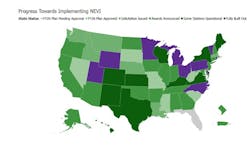
Despite the significant funding clawback the curtailed programs remain in place. As NEVI enters its fifth and final year, $3.3 billion has been allocated to states via formula funding, according to statistics from EV States Clearinghouse EV States Clearinghouse – Helping States Deploy EV Infrastructure. Roughly to date 38 states have issued awards totaling $632 million, 44 states have issued at least one solicitation, and 19 states have at least one operational station. Nine states are fully built out while the rest are in various stages of completion. (See graphic) The tally of DC fast chargers funded, but not necessarily installed, so far under NEVI is around 4,000.
Congressional action to pare back federal funding for EV charging comes after Trump administration efforts to halt NEVI entirely in 2025. DOT moved to freeze funding mid-year so it aligned with the administration’s broad opposition to federal support for climate-friendly transportation. Lawsuits from various states and other parties followed and in late January 2026 a U.S. District Court judge in Washington State ruled in favor of the plaintiffs. The ruling means DOT must continue to administer NEVI, although some changes to the program in addition to the funding recission have been instituted.
As NEVI enters its final year of formula funding, now hobbled by damaging clawbacks, questions linger about whether it will ultimately achieve its stated goal of jump-starting creation of a robust, reliable fast charging network.
Anne Blair, head of the policy team at The Electrification Coalition, a non-profit advocate for plug-in electric vehicles, senses an overall setback for the effort, saying “nothing is poised to fill this gap,” created by Congressional action that is “impeding the intent of what NEVI could deliver.” The clawbacks could be challenged on the basis that a prior Congress originally allocated the money, she says, but the defense would be the money was never obligated by the affected states, and therefore subject to recission.
While the federal role is being scaled back, Blair emphasizes that NEVI is still in place with some $3 billion obligated to states that have yet to commit the funds. That doesn’t solve the critical problem of a charging network gap in states that have resisted NEVI spending and now see funding pared back, but the overall build-out is likely to continue and a solid base of support for it in Congress might be in place.
“The funding we had through the initial layout of the program has been a great start, and not just in terms of dollars but how that has helped leverage monies from the private sector as well,” Blair says.
About the Author
Tom Zind
Freelance Writer
Zind is a freelance writer based in Lee’s Summit, Mo. He can be reached at [email protected].