Mitigating Costly Infrastructure Pitfalls with Upfront EV-Ready Site Design
Key Takeaways
- Early integration of scalable underground infrastructure prevents costly retrofits and streamlines future expansion.
- Building extra electrical headroom and reserving physical space ensures capacity for future EV charger growth without major disruptions.
- Coordinating civil work with equipment delivery minimizes delays and reduces site rework, saving time and money.
- Proper sizing of electrical components, including conductors and panels, is critical to accommodate future load increases and avoid service overhauls.
- Verifying CTEP and NTEP certifications before procurement ensures compliance with metrological standards for commercial billing, preventing project delays.
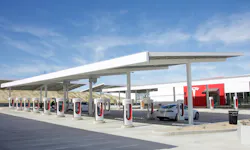
Ask any electrical contractor working on commercial or multi-family projects, and they'll tell you that outdoor power configurations look different than they did five years ago. Facilities aren't just asking for perimeter lighting. They need outdoor power platforms built to handle digital connectivity, event power, and high-demand electric vehicle (EV) charging. Among these platforms, EV infrastructure represents the single largest driver of this outdoor power demand. However, for most commercial developments, the physical charger represents only a fraction of the total investment. Civil site work, including excavation, underground conduit placement, and repaving, represents the bulk of the project's labor and financial footprint.
Since civil work represents such a heavy share of the budget, timing is everything. Trenching a site after asphalt is already poured creates a financial penalty: retrofit installations cost 20% to 35% more than new construction due to off-hours overtime labor, utility shutoffs, core drilling, and surface remediation. But by recommending scalable, EV-ready underground infrastructure during initial site work, electrical contractors eliminate these penalties, protecting site owners (their customers) from expensive future retrofits, streamlining field labor, and capturing higher-margin project scopes.

Electrical capacity sizing and lead-time traps
Sizing a facility’s service strictly for initial loads can be an expensive mistake. A site starting with two or four chargers can easily double or triple that demand within a few years. Contractors should think about how they can guide clients to plan for a 3x to 5x growth curve over five to 10 years.
This expansion planning is critical under NEC Art. 625, which classifies EV chargers as continuous loads requiring conductors and overcurrent protection to be sized at 125% of the rated load. For example, a standard 48A Level 2 charger cannot be served by a standard 50A breaker; it requires a 60A branch circuit (48A x 1.25 = 60A) rather than a standard 50A breaker. Failing to calculate main distribution panels and feeder drops with this mandatory 125% multiplier across multiple ports quickly exhausts available panel capacity and leads to unexpected service overhauls when expanding the system.
Navigating this growth is made harder by persistent supply chain delays. Custom distribution panels carry lead times of two to six months, while electric utility-scale switchgear and transformers face delays of 12 to 18+ months. If an initial build uses all available capacity, adding chargers later doesn't just mean running more wire — it means entering a multi-year utility queue for a service upgrade while paying equipment prices down the road.

To protect from supply chain stalls and costly future service overhauls, contractors should implement these four buffers:
- Build extra electrical headroom: Build a 25% to 50% capacity buffer into initial site designs while verifying allowable code limits. This includes upsizing main conduits by at least one trade size (e.g., expanding a planned 1-inch conduit to 1½- or 2-inch, or 2-inch to 3-inch), while verifying NEC Chapter 9 conductor fill limits, reserving blank spaces in distribution panels, and running capped spare raceways into future equipment areas.
- Build infrastructure in layers: Establish scalable service capacity drops and heavy underground raceways first. Add sub-panels and active charging pedestals incrementally as fleet or customer demand grows.
- Reserve physical site space: Sizing electrical headroom won’t work if there is no physical space to mount future hardware. Reserve physical pad space and parking footprints during initial site layout to ensure future charger pedestals, transformers, or sub-panels can be added without violating ADA accessibility or vehicle turning radii.
- Synchronize civil work with equipment delivery: Coordinate civil excavation and underground conduit placement to conclude as long-lead utility transformers and switchgear arrive on site. This prevents open trenches from sitting idle and eliminates uncompensated crew downtime or double-handling site work.
Premature trenching, inaccurate surveys, and cable protection risks
Errors can impact a job budget before the first charger even arrives. One of the most common is a stub-out discrepancy. This happens when underground conduits miss drawing specs by a few feet because of incorrect site surveys or last-minute layout changes. Once concrete is poured, fixing a missed stub-out means removing new slabs and rerunning conduit.
Contractors can avoid these costly re-runs by changing how they sequence underground work. Never pull wire into conduit early. If site plans change or heavy equipment damages the raceway during paving, replacing a damaged cable run can be expensive. Leaving live copper sitting in open trenches also invites job-site theft. Lay empty, capped conduits first, and wait to pull wire until all heavy paving, grading, and concrete work are finished.
Using modular underground foundation boxes makes layout shifts easy to manage. Setting heavy-duty, flush-to-grade foundation boxes with stubbed conduits allows installers to absorb reasonable layout variations without cutting or breaking concrete. When the site expands later, these pre-installed boxes save up to 2.5 hours of labor per charger compared to traditional concrete pouring and core drilling.
Finally, watch run lengths. Running long branch circuits directly from a central main panel can be expensive. As a practical engineering rule of thumb on jobs with six or more chargers or runs nearing 200 feet, specifying a local sub-panel closer to the chargers shortens branch runs, shrinks conductor sizes, and stops voltage drop before it hurts charger performance.
Regulatory and compliance oversight (CTEP vs. NTEP)
State-level EV-ready mandates are spreading nationwide, primarily targeting new commercial construction and multi-family residential developments (MDUs). Beyond standard NEC compliance and local electrical safety permits, commercial EV installations face a regulatory hurdle that catches many contractors off guard: metrological accuracy standards for energy billing.
When an EV charger bills drivers based on energy consumed (kWh), it is legally classified as a commercial fuel dispenser. If a project involves paid commercial charging, contractors should be prepared to navigate two primary compliance programs:
- CTEP (California Type Evaluation Program): Enforced by the California Department of Food and Agriculture (CDFA), CTEP sets strict weights-and-measures requirements for commercial EV chargers. It enforces strict standards for energy metering accuracy, physical tamper-proofing, and environmental durability.
- NTEP (National Type Evaluation Program): Based on NIST Handbook 44 standards, NTEP is the national counterpart to CTEP. States like Washington and Nevada already require NTEP approval for commercial billing, and adoption is increasing nationwide.
A common and costly mistake is assuming that specifying a charger with an internal revenue-grade meter automatically guarantees compliance. Weights-and-measures authorities do not certify standalone meters. They certify the entire charger assembly, including its housing, screen display, internal firmware version, and physical sealing provisions.
If you procure and install chargers that lack valid CTEP or NTEP certification for commercial billing, the local inspector will fail the installation. You will face red-tagged equipment, delayed project energization, and uncompensated labor costs to swap out non-compliant hardware. Always verify that the exact charger model number and firmware configuration hold active CTEP/NTEP certifications before issuing purchase orders.
Moving forward with smart site design in mind
Outdoor power has evolved from simple lighting to high-demand EV distribution. Forward-thinking contractors capture higher-value scopes and protect the clients’ bottom lines by executing three core strategies: adding a 25% to 50% capacity buffer under NEC Art. 625, laying empty raceways in modular foundation boxes, and verifying CTEP/NTEP compliance before procurement. Together, these steps eliminate costly trenching retrofits and ensure smooth municipal inspection sign-offs.
About the Author
 Aaron Vigliotti
Aaron Vigliotti leads EV charging strategy for Legrand, driving product development, market innovation, and go-to-market execution across the company's EV charging portfolio. Before joining Legrand, Aaron held roles at EVCS and ChargePoint, where he gained extensive experience in EV infrastructure and charging solutions. Aaron earned bachelor's degrees in Information Management & Technology, Entrepreneurship & Emerging Enterprises, and Finance from Syracuse University. An avid outdoorsman and early adopter of electric vehicle technology, he is personally passionate about advancing transportation electrification and helping shape the future of EV charging.