Harnessing the Power of Connected Lighting Systems and IoT
Key Takeaways
- Connected lighting systems utilize sensors, communication networks, and centralized platforms to provide real-time data and automation capabilities across building environments.
- Integration of occupancy, daylight, and environmental sensors enables dynamic lighting adjustments that save energy and enhance occupant comfort and health.
- Effective deployment requires careful consideration of system architecture, interoperability standards, compliance, cybersecurity, and stakeholder collaboration.
- Predictive maintenance and space utilization analytics help reduce operational costs and optimize real estate resources.
- Future innovations with AI and machine learning will further personalize lighting experiences and improve building efficiency.

Lighting systems have evolved far beyond their traditional role of simply providing illumination to become intelligent ecosystems that enhance functionality and user experience. Through sensors, connectivity, and software, modern lighting systems can optimize lighting conditions across spaces, reduce energy consumption, track movement, and improve occupant health and productivity. Lighting infrastructure already exists in virtually every building, powered at the ceiling level and positioned for visibility, coverage, and a clear line of sight. When connected to centralized software platforms, connected lighting systems can function as a distributed data-collection network that supports a wide range of operational and experiential use cases.
The rise of connected lighting systems represents a major step forward in how we perceive and utilize lighting within our environments. Harnessing their full potential in today’s data-driven world requires moving beyond standalone lighting capabilities and vendor-specific ecosystems by focusing on how lighting data is integrated, contextualized, and acted upon across building systems. Beyond their core capabilities, connected lighting systems should be viewed as a valuable data source within the broader building ecosystem, enabling cross-system outcomes and intelligent building operations.
Connected lighting: a powerful IoT ecosystem
A connected lighting system is an intelligent network where fixtures, sensors, switches, and control devices communicate seamlessly over a digital infrastructure. At its core, a connected lighting system consists of five key components: lighting fixtures and switches that provide illumination; sensors that monitor environmental conditions; control devices that manage how fixtures operate; a communication network that enables device-to-device interaction; and a centralized platform that collects data, performs analytics, and generates actionable insights. The Figure below illustrates the key components and high-level architecture of a connected lighting system.
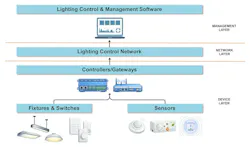
Conceptually, this three-layer connected lighting architecture aligns with the Open Systems Interconnection (OSI) networking model. The device layer corresponds to the physical and data link layers, where fixtures, sensors, and controllers communicate over wired or wireless media. The network layer supports the addressing, routing, and transport of lighting data, while the management layer operates at the application level and provides visualization, analytics, system integration, and control.
For years, commercial building lighting systems have incorporated occupancy and daylight sensors to automatically shut off and adjust artificial lighting to save energy. However, the integration of additional sensors, such as indoor environmental quality (IEQ) sensors and Bluetooth Low Energy (BLE) beacons, has unlocked a broader range of use cases. This has transformed the lighting infrastructure into a powerful Internet of Things (IoT) ecosystem and a data collection network. By integrating embedded or standalone sensors, these systems do far more than just capture lighting metrics.
- Daylighting and occupancy sensors allow artificial lighting to adapt dynamically to available natural light and occupancy. Based on motion, time of day, or ambient light level, sensors can trigger preprogrammed lighting settings to turn on, shut off, dim, or change the color or intensity of lighting. These automated responses help to reduce energy use and improve the occupant experience while maintaining appropriate lighting levels for different activities and environments.
- Indoor Environmental Quality (IEQ) sensors provide real-time insights into temperature, humidity, CO₂, TVOCs, and air quality index, helping occupants to understand and engage with their environment. This promotes occupant health, comfort, and productivity while enhancing the overall workplace experience.
- Bluetooth Low Energy (BLE) beacons, when integrated into lighting infrastructure, enable location-based services such as indoor navigation, wayfinding, asset tracking, and occupant engagement. When paired with mobile applications and workplace platforms, these capabilities support connected experiences and streamline operational workflows.
Use cases and outcomes enabled by connected lighting systems
Connected lighting systems enable a broad range of operational, analytical, and occupant-focused use cases by combining control, sensing, and connectivity within a single, distributed infrastructure. While these systems deliver significant standalone value, additional efficiencies can be realized when lighting system data is integrated with other building systems.
At a fundamental level, connected lighting systems allow facility and operations teams to remotely monitor system performance, adjust schedules, configure zones, and deploy changes across individual spaces, entire floors, or multiple buildings. This centralized management improves operational consistency, reduces manual intervention, and enables faster responses to changes in occupancy, usage, or operational requirements.
Connected lighting systems also support predictive maintenance by continuously monitoring the health and performance of fixtures. Data on power usage, lumen output, and operational cycles is collected and analyzed to identify early signs of wear or impending failure. Facility teams can receive proactive alerts before issues occur, allowing timely interventions that reduce downtime, lower replacement costs, and extend the lifespan of lighting assets.
When sensors and advanced controls are applied effectively, connected lighting systems have demonstrated measurable performance and cost benefits. By embedding occupancy sensors and analytics into the lighting infrastructure, these systems extend their value beyond traditional lighting control. Occupancy sensors support automated control while enabling space utilization analysis. Beyond simple on/off logic, granular occupancy data can reveal how frequently spaces are used, how long they are occupied, and how usage patterns change over time. By analyzing room-level occupancy data, facilities teams can identify underutilized areas and make more informed decisions related to space planning, scheduling, and real estate utilization.
For example, in a large corporate office, a connected lighting system with integrated occupancy sensors provided detailed insights into space utilization. Analytics revealed that many work areas were more underutilized than anticipated. This information allowed the facilities team to optimize layouts, reallocate underused areas, and better align real estate resources with actual demand, thereby improving overall efficiency and reducing costs.
When integrated with other building systems, this data can further inform broader operations and enable cross-system outcomes. In a large financial institution, for example, granular occupancy data was shared with the janitorial staff to enable demand-based cleaning. This shifted cleaning operations from a fixed schedule to a purpose-driven approach focused on actual space utilization. As a result, the organization improved cleaning productivity, reduced facilities-related complaints, and delivered a more consistent and positive workplace experience for occupants.
Connected lighting can also play a direct role in occupant safety and emergency response by coordinating with other building systems. In emergency scenarios like code blue events, signals from emergency response systems can trigger coordinated actions across multiple platforms. Notifications are sent to response teams while the system automatically illuminates designated pathways at full intensity, providing clear visual guidance and supporting a faster, more coordinated response.
Considerations for implementing connected lighting systems
Design for adaptability, operational needs, and compliance
Careful consideration must be given to both the technology and long-term operational goals when designing a connected lighting system. This will ensure that the system not only meets immediate demands but also remains relevant as technologies and user needs evolve.
A primary factor is the system architecture and complexity. Organizations must weigh the benefits and trade-offs of wired versus wireless solutions. Wired systems offer high reliability and predictable performance, while wireless systems provide flexibility and easier installation, especially for retrofit projects. Understanding which approach is most cost-effective and best aligns with the building’s operational needs is critical. The maturity of the technology is another important consideration, as selecting proven, reliable components reduces the risk of failure and ensures consistent performance.
Designers also face challenges in ensuring seamless interoperability across devices and platforms. Each manufacturer uses different protocols for their products (e.g., Bluetooth, Zigbee, DALI), often with proprietary extensions, which can hinder communication and data sharing between systems and devices. The lack of universal standardization can also complicate system expansion, upgrades, and long-term maintenance. Prioritizing solutions that adhere to open, widely adopted standards can help avoid vendor lock-in and maximize long-term flexibility.
Compliance with codes and regulations must also be considered. Traditional lighting systems must comply with local energy code requirements at a minimum and often aim to meet recommended energy performance standards (e.g., ASHRAE 90.1). Connected lighting and IoT systems, however, introduce additional layers of complexity with the collection, transmission, and integration of sensor data from occupancy sensors and BLE beacons. As a result, these systems must also address data protection and privacy considerations to ensure secure and responsible operations. In addition, guidance from standards such as ANSI/IES LP-12-21 can help better inform design and deployment of connected lighting and IoT systems.
Collaborate with stakeholders and validate performance
The deployment of connected lighting systems demands both technical diligence and meticulous coordination with stakeholders. Alignment between owner needs, design intent, and implementation is critical.
Overly complex systems do not automatically translate into better results and may fail to meet owners’ requirements. Conversely, cost-driven compromises during bidding or installation can dilute the original design intent, resulting in a basic solution that underperforms and fails to deliver long-term value. Differences in interpretation, installation practices, or component selection can either overcomplicate or compromise system functionality, ultimately reducing the value delivered to end users.
Setting up a pilot program or proof of concept can validate performance, measure return on investment, and identify potential challenges before full-scale deployment. Early involvement of IT teams is also essential, as connected lighting systems often intersect with network infrastructure, cybersecurity requirements, and data management practices. Security and cybersecurity considerations must be addressed in collaboration with IT teams to protect both the network and sensitive occupant data, ensuring a secure deployment.
Provide user support and training
Successful operation of a connected lighting system requires clear planning for both technical support and end-user engagement. Technical complexity is a key challenge. Advanced sensors, varied protocols, and analytics platforms require specialized skills and ongoing attention to software updates and cybersecurity. It is thus essential to determine who will maintain the system, whether internal staff or external service providers. This decision should be informed by an assessment of in-house technical expertise, IT support capacity, and overall operational responsibilities.
End-user training and change management are also critical in realizing the system’s value. Connected lighting systems offer many advanced capabilities, but their benefits can only be realized if building operators understand how to use them effectively. Providing structured training, clear documentation, and ongoing support helps maintain long-term performance, energy efficiency, and user adoption.
Shaping the future of smart buildings
Connected lighting and IoT systems are transforming buildings in exciting and promising ways. Successful implementation, however, requires more than simply installing networked lighting fixtures. It demands alignment and engagement among owners and stakeholders, critical design thinking, careful product selection to ensure performance, interoperability, and safety, and attention to commissioning and end-user training.
Looking ahead, the integration of machine learning and artificial intelligence with connected lighting platforms promises to further elevate their value. Systems will be capable of learning usage patterns, predicting maintenance needs, optimizing energy consumption, and personalizing lighting experiences in real time.
This combination of connectivity, data, and intelligent algorithms will drive greater operational efficiency, enhance occupant comfort, and enable new levels of automation within the built environment. Connected lighting is no longer just a utility; it is becoming a dynamic, data-driven platform shaping the future of smart buildings.
About the Author
 Arati Sakhalkar
Arati Sakhalkar
Arati Sakhalkar is a Project Manager and Mechanical Engineer at Affiliated Engineers, Inc. (AEI), specializing in intelligent building design, systems integration, mechanical design, and HVAC controls for commercial, institutional, healthcare, and research development facilities. Arati consults on operational and information technologies and smart building strategies to help achieve energy and operational efficiencies while enhancing occupant experience and comfort.
 Samarth Kathare
Samarth Kathare
Samarth Kathare is a Mechanical Engineer at Affiliated Engineers, Inc. (AEI), contributing to the design and optimization of intelligent building systems for healthcare and academic facilities. Samarth’s project experience includes BAS migration, controls upgrade, systems integration, alarm management, fault detection and diagnostics (FDD) system implementation, and data analytics and visualization.