Building Performance Standards: A Guide for Electrical Contractors
Key Takeaways
- BPS focus on ongoing building performance, setting measurable energy use and emissions targets that often become stricter over time.
- Understanding local BPS requirements helps electrical contractors advise clients on energy-efficient upgrades, lighting controls, and system flexibility to ensure compliance.
- Smart lighting controls, such as LED retrofits and occupancy sensors, are key tools for meeting BPS and achieving significant energy savings.
- Designing systems with adaptability and scalability reduces future compliance risks and minimizes costly rework or replacements.
- BPS compliance penalties can be substantial, making proactive planning and system design critical for long-term project success.

All new construction and major renovations are subject to state or local energy codes, which are typically based on national model energy codes such as the IECC and ASHRAE 90.1. Because they primarily apply to new construction and major renovations and do not address the ongoing performance of most existing buildings, these energy codes are limited in their ability to help achieve long-term sustainability and emissions goals. As a result, many states and local jurisdictions have developed additional requirements — Building Performance Standards (BPS) — that define energy-use and/or emissions performance thresholds for existing buildings, often with compliance deadlines that phase-in over time and impose financial penalties for noncompliance.
How building performance standards compare to model energy codes
Model energy codes are written to address design efficiency at the time of construction or renovation, while BPS focus on measured, ongoing building performance, and often become stricter over time. BPS programs typically regulate measured whole-building performance, using metrics such as energy-use intensity, greenhouse gas emissions, or other building-wide indicators derived from benchmarking data, often relying on ENERGY STAR Portfolio Manager to track and demonstrate compliance. Rather than prescribing specific technologies, these programs set outcome-based performance targets and often provide multiple compliance pathways to achieve them.
BPS requirements are currently mandatory in many jurisdictions across the country, but they differ widely among local and state governments. While some jurisdictions address on-site fossil fuel use through emissions-based performance thresholds or related electrification policies, the more immediate impact for electrical contractors comes from the operational nature of BPS compliance.
Since BPS are evaluated over multiple performance periods, decisions made during design and installation directly influence whether a building owner will face future penalties, require costly retrofits, or be able to maintain compliance over time. Let’s look at a few specific examples of BPS requirements.
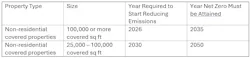
The city of Cambridge, Mass., for example, has adopted a Building Energy Use Disclosure Ordinance (BEUDO) that applies to non-residential properties with more than 25,000 covered sq ft. Buildings with more than 100,000 covered sq ft are required to begin reducing emissions in 2026, while smaller buildings have until 2030 to initiate compliance (see Table below). Emissions for each property are measured against declining emissions intensity limits (based on building type and square footage), and owners of covered properties are required to report their data annually.
In 2019, New York City adopted Local Law 97, which establishes building-specific greenhouse gas emissions intensity caps for buildings over 25,000 sq ft as part of the city’s goal to reduce building emissions 40% by 2030, and 80% by 2050.
While many BPS standards are localized, there are several state-wide policies. Colorado, for example, has approved BPS rules that apply across the entire state, encompassing commercial, multi-family, and public buildings 50,000 sq ft or larger. Affected owners must annually benchmark and report energy use, and buildings must meet energy performance targets established through state rulemaking. These standards align with Colorado’s broader statutory goal of reducing statewide greenhouse gas emissions 50% by 2030 and 90% by 2050 (from 2005 levels).
Lighting systems, advanced controls, commissioning, submetering, and long-term system flexibility often represent some of the most impactful and cost-effective compliance tools, placing electrical scope at the center of building owners’ long-term performance strategies.
For electrical contractors and facility managers, understanding local BPS will help you advise your customers about energy-efficient solutions they should invest in now, so they’re not scrambling to meet standards that will take effect over the next few years. Knowing how BPS differ from traditional energy codes is critical to managing risk, delivering sustainable systems, and adding value to your projects.
Building performance standards drive meaningful energy Impact
The number of existing buildings far surpasses new commercial construction, and as such, codes that apply solely to new builds and major renovations cannot deliver energy reductions at scale. BPS requirements aim to meet those large-scale goals. Even if your area has not adopted BPS, it’s essential to be aware of what might lie ahead.
BPS requirements typically apply to existing buildings regardless of when they were constructed, meaning buildings that were fully code-compliant at the time of construction may still be required to meet new performance targets. Investing in more flexible, energy-efficient lighting control solutions as part of a lighting retrofit means that you are much less likely to have to replace or rethink a system that’s only three to five years old as requirements change.
While BPS details vary by locality, the technical direction is consistent: Buildings must reduce energy use or meet emissions intensity thresholds over time. Penalties for non-compliance can range from flat fees to substantial fines based on building square footage or excessive carbon emissions, and, in some jurisdictions, penalties tied to excessive emissions or square footage can reach into the millions of dollars per compliance cycle. In most cases, the goal is to encourage energy-efficient upgrades rather than to raise revenue. For electrical contractors, these standards translate into opportunities to advise clients on the best lighting layouts, control zoning, commissioning scope, and documentation to help ensure that the building can achieve compliance across multiple performance periods.

Lighting and controls as core compliance infrastructure
Smart lighting and control upgrades, such as LED retrofits, networked lighting controls with occupancy sensing, daylight-responsive dimming, and scheduling, can deliver significant energy reductions while minimizing disruption to workflow and productivity. When integrated with other systems, including HVAC and plug-load controls, these solutions can further improve building performance and provide a more comfortable, human-centric space.
Advanced lighting controls also position buildings to respond to future compliance pathways, such as load flexibility, time-of-use optimization, and integration with building management or reporting platforms. Data generated by smart lighting control platforms can help facilities teams track energy use, validate savings, and identify opportunities for additional energy efficiency enhancements. Under performance-based standards, the ability to continuously adapt over time is often as important as the initial energy-reduction strategies.
Designing for flexibility and future performance
One challenge associated with BPS upgrades is keeping flexible control technologies on the bill of materials. Value-engineered designs with minimal control capability or limited system scalability may reduce initial cost but can expose owners to future compliance risk. Cost-benefit analyses often show that systems designed to meet only today’s targets can fall out of compliance well before the end of their expected service life, since many BPS programs also become more stringent with each compliance cycle.
Advanced lighting control systems are designed to support additional energy-saving strategies, and a cloud-based system can enable performance improvements through software updates, reprogramming, or recommissioning without costly changes to installed hardware. Considering the financial penalties for a system that fails to meet ongoing BPS, or the cost of replacing the system before its end-of-life, the delta between installing a code-compliant lighting system and an advanced lighting and control system can be significantly less than those incremental costs.
From a design and installation standpoint, incorporating adaptable control architectures, flexible zoning, and integration-ready infrastructure helps mitigate risk and reduce the likelihood of expensive rework.
Delivering durable systems in a performance-based environment
BPS are becoming more commonplace, especially in states and municipalities with aggressive emissions reduction goals and decarbonization mandates. For electrical contractors, understanding local BPS requirements is a differentiator that demonstrates expertise to clients and provides value long after the installation is complete, encouraging repeat customers.
Get familiar with any applicable local performance standards, design for adaptability and long-term system performance, and be better positioned to reduce risk, win more projects, and deliver higher value over time.
About the Author
 Shaun Taylor
Shaun Taylor
Shaun Taylor, Government Relations Supervisor at Lutron, has a diverse professional background, including key leadership roles in sustainability and sales. Notable positions include serving as First Vice Chair and Chair of the Market Leadership Advisory Board at the USGBC - National Capital Region Chapter from December 2014 to December 2015, and as a Sales Supervisor at Lutron Electronics from September 2008 to June 2022, managing the Commercial Experience Center in Washington DC. Previous experience includes cryptolinguist with the United States Air Force, Assistant Property Manager at Archstone, and Sales Consultant at KB Home. Shaun Taylor holds a Master of Liberal Arts in Extension Studies with a focus on Sustainability and Environmental Management from Harvard University, along with a BA in Communications from American University and a Linguistic Certification in Arabic from the Defense Language Institute.