Key Takeaways
- Proper lighting, including vertical fixtures and dimming options, enhances both functionality and ambiance in the bathroom.
- Humidity sensors and appropriately sized exhaust fans are essential for preventing mold, protecting finishes, and maintaining air quality.
- Smart controls like occupancy sensors and timers improve convenience, reduce energy waste, and ensure code compliance.
- Investing in quality controls and thoughtful design elevates the bathroom experience, making it safer, more comfortable, and more efficient.

The bathroom is one of the most frequently renovated and demanding rooms in the home. In a well-designed bathroom, lighting and ventilation control must work together to provide convenience, enhance safety, and manage humidity to deliver a comfortable and healthy environment through daily cycles of heat, moisture, and high humidity. Homeowners want options that support the way they use space, like bright light in the morning, flattering light for getting ready, and a gentle glow — not blinding brightness — for late-night trips to the bathroom. Well-designed lighting and controls can help meet and exceed these expectations.
Despite the bathroom being one of the most used rooms in the home, lighting quality and ventilation are routinely treated as afterthoughts. Lighting and exhaust fan controls are often specified only to meet minimum requirements and are often deprioritized in the overall bathroom design.
For contractors, this gap is an opportunity to recommend lighting and fan controls that noticeably improve the finished bathroom. A contractor who helps clients understand how controls enhance comfort, convenience, and performance becomes a trusted resource for future projects. Humidity sensors and quality dimmers require a relatively small up-front investment but provide value for years. They can help prevent mold and mildew, reduce callbacks, protect fixtures and finishes, and give homeowners the right light at any time.
Expertise in bathroom lighting and ventilation is an underrated way for residential contractors to differentiate their services, deliver greater value, and earn repeat business.
Start With the Best Light
Beautiful bathroom lighting, like lighting throughout the home, is not one fixed level — it changes with the time of day and the task at hand. More light is not necessarily better light. Vertical illumination from fixtures positioned to light the face in the mirror is usually more useful and flattering than a single bright overhead fixture. In a larger bathroom, a dedicated light above the shower can also improve comfort and safety.
As you choose fixtures that complement the design vision, remember that dimming is essential to creating a flexible space. Bright light is wonderful for morning routines or applying makeup, but low light levels ensure a soothing, relaxing ambiance for a bath or a soft night light in a dark room. Ideally, overhead and mirror lighting should be controlled separately for greater versatility and comfort.
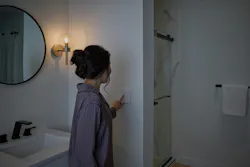
Code and comfort are equally important considerations. Occupancy sensors, vacancy sensors, dimmers, timers, and humidity controls may be required to meet applicable codes, but they also add convenience and reduce energy waste by ensuring lights and fans are not left on unnecessarily. Sensors and other smart controls remove the nagging question: “Did I turn off the light or leave the fan running?” Simple, easy-to-install controls can go a long way toward improving a customer’s peace of mind.
Excess Moisture Does More than Fog Up Mirrors
Exhaust fans are critical to managing bathroom air quality. Select fans that are properly sized for the bathroom and meet applicable airflow requirements. Excess moisture and humidity do more than make the morning routine frustrating; they can contribute to mold and mildew, damaged finishes, and peeling paint.
An automatic, humidity-sensing control takes the guesswork out of when to turn the fan on and off. Controls such as humidity sensors work behind the scenes to automatically monitor humidity and support proper ventilation, even during long, hot showers. They automatically turn the fan on when humidity rises above the set threshold and turn it off after conditions return to normal. This simple upgrade can help reduce complaints and callbacks while protecting the appearance and performance of the newly renovated space.

Use Your Expertise to Guide Customer Conversations
Code compliance is a given, but it does not have to be a design constraint. Talk with homeowners early about local code considerations for bathroom lighting, controls, ventilation, and fixture placement. Many control options can satisfy code requirements while also adding convenience, flexibility, and a more polished experience.
Emphasize the consequences of skipping the finishing touches that make a significant difference. Homeowners may be tempted to concentrate their budget on showers, sinks, tile, and fixtures, then minimize spending on lighting and controls that noticeably enhance everyday quality of life. Talk through the risks of a poorly lit bathroom, the damage that can result from unmanaged moisture, and the daily frustration of inadequate task lighting. It is easier and more cost-effective to install the right controls during the renovation than to retrofit them later.
By pairing technical expertise with thoughtful, well-researched recommendations, contractors can deliver a better bathroom today and build client relationships that extend well beyond a single project.
About the Author
Eric Mace
Lutron Electronics
Eric Mace is the Senior Product Manager for Dimmers, Switches, and In-Wall Sensors at Lutron Electronics, where he leads the strategy and development of the company’s flagship retail controls. With a 20-year background in Lutron's Engineering department, Eric brings a strong analytical problem-solving approach to launching new innovative products. He holds a Bachelor of Science degree in Mechanical Engineering from Penn State University.