6 Things You May Not Know About Lever Connectors
Key Highlights
- Lever connectors use individual ports and an internal bus bar, so wires don't need to touch each other to make a reliable connection.
- IDEAL lever connectors are the only UL-approved option with push-in capability, saving electricians time on large jobsites.
- Clear housing, audible clicks, and built-in test ports make it easy to verify every connection is secure.
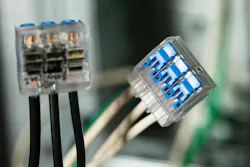
Greg Anliker, End User Experience Manager, and Kate Gredlics, Product Manager, at IDEAL Electrical
As lever connectors become more common on jobsites across North America, many electricians are taking a closer look at how they compare to traditional connection methods. Like any new technology, there are some myths and misconceptions about safety, proper installation, and how to use lever connectors to save time. Lever connectors provide secure connections, so understanding all their benefits can help give the best experience on the job.
Here are 6 facts electricians should know about lever connectors:
1. You don’t need the wires to make physical contact with each other.
Many electricians who have only used twist-on connectors may not be used to connectors with multiple ports. When using twist-on connectors, the stripped ends of the wires twist together and must make physical contact with each other in order to secure the connection. However, in a lever connector with multiple ports, each wire is inserted into its own port. Electricity still flows through an internal bus within the connector. The wires do not need to touch each other to maintain a reliable electrical connection.
2. You shouldn’t fit 2+ wires into one port.
Similarly, electricians may assume two smaller wires could easily fit into one port together, because port sizes are designed around the thickest wire gauge they’re rated for. However, this should never be done, no matter how small the wires. Even if two wires could physically fit into one port, doing this will compromise the safety and integrity of the electrical connection. Lever connectors are only rated and tested to support one wire per port, so electricians should select a model with enough ports for all their wires.
3. You don’t need to use all the ports.
When using a lever connector, electricians can leave ports empty and still keep the electrical connection secure. Ports in between wires and around wires can be left empty. For example, even in a 5-port lever connector, one wire inserted at each end with 3 empty ports in between will still provide a connection just as secure and reliable as two wires in ports right next to each other. Most lever connectors are available with 2, 3, or 5 ports.
4. You don’t always need to open the levers first.
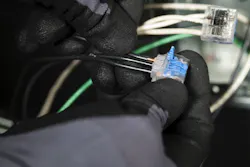
In typical lever connector applications, an electrician will open a port's lever, insert the wire, then close the lever to secure the wire in place. Most electricians are familiar with this approach, and it's important to follow for applications like stranded or delicate fixture wire.
However, when using solid wire, electricians can save time with certain types of lever connectors, especially over large professional jobsites where each second saved on individual wire splices can add up. IDEAL lever connectors are the only UL-approved lever connector with push-in capability, meaning electricians can push in solid wire without lifting the lever first. IDEAL lever connectors also have profiled sides, allowing for easier grip while holding, so pushing in wires becomes even easier.
5. You can connect different wire types and sizes together easily.
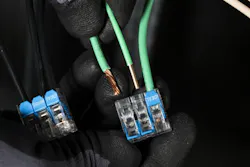
Lever connectors also make it easier to connect different types of wires. Sometimes, twisting together two wires that are completely different sizes or types can be difficult. In lever connectors, large and small wires as well as solid and stranded wire can be connected to each other easily because they get inserted into separate ports. For example, IDEAL lever connectors are designed to accommodate a wide wire range, with one model supporting 24 to 12 AWG and another supporting 22 to 10 AWG.
6. You can easily verify the connection is secure.
Lever connectors offer many ways to verify that the wires are securely connected in their ports. The levers closing into place secures the wires inside. Some lever connectors also provide the user with secondary ways to ensure their connections. For example, IDEAL 10 AWG lever connectors have an audible click when the lever closes, while the 12 AWG lever connectors include a secondary snapping function to lock the port shut.
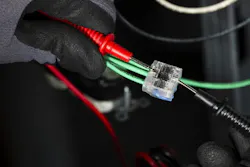
Additionally, these lever connectors feature clear housing to visually see whether the wires are fully seated in their ports. They also contain two built-in test ports to easily verify voltage, one in the front and one in the back.
Why Lever Connectors are a Versatile Solution
As more electricians become familiar with how lever connectors function, they can discover benefits that go beyond simply making electrical connections. Once electricians understand the technology behind them, they can take better advantage of a secure connector designed to simplify installation.
Sponsored by: