Working Space Requirements for Elevated and Other Nonstandard Equipment Locations
This article offers an overview of National Fire Protection Association (NFPA) Standard 70, The National Electrical Code (NEC) minimum requirements applicable to working space and accessibility requirements, considerations for elevated and other non-standard equipment locations, and a summary of exceptions and requirements related to non-standard locations. Unless otherwise noted, the NEC references in this article are from the 2026 edition of the Code.
General overview of working space and accessibility
Most engineers are familiar with NEC basic requirements related to working space as detailed in Sec. 110.26, which applies to spaces about electrical equipment of 1,000VAC or 1,500VDC or less. Fewer may be familiar with sections for equipment of higher voltages (those over 1,000VAC or 1,500VDC) — Sec. 110.32, Sec. 110.33, and Sec. 110.34 — because such equipment is less common than lower-voltage equipment. Even fewer engineers may be familiar with Sec. 240.24, Sec. 404.10, Sec. 430.102, and NEC Chapter 6, “Special Equipment,” mostly because of the relative rarity of installing electrical equipment in special situations. Unless otherwise noted, all equipment discussed in this article should be considered 1,000VAC nominal or less.
The NEC provides minimum requirements for equipment installations, not necessarily ideal or even (as many field personnel will attest) adequate spaces, concerning the ability to safely and efficiently perform work. Designers should not only consult the NEC, but also local building codes, utility requirements, and experienced personnel in their design process.
To best understand and apply the NEC sections discussed, the following NEC Art. 100 definitions are provided:
- Accessible: When applied to equipment, “Capable of being reached for operation, renewal, and inspection.”
- Readily accessible: “Capable of being reached quickly for operation, renewal, or inspection without those requiring ready access to take actions such as to use tools other than keys, to climb over or under, to remove obstacles, or to resort to portable ladders.”
In brief, Sec. 110.26 requires electrical equipment of 1,000VAC nominal or less to be installed with a minimum width [Sec. 110.26(A)(2)] of the greater of 30 in. or the width of the equipment, a minimum height [Sec. 110.26(A)(3)] of the greater of 6.5 ft or the height of the equipment, and a depth between 3 ft and 5 ft, depending on the nominal line-to-ground system voltage and the grounded/not grounded conditions and/or the exposure of live parts of the installation [Sec. 110.26(A)(1)].
Regarding working space requirements, in terms of where and how equipment may normally be located, the NEC also requires that switches and circuit breakers used as switches be located so that they can be operated from a readily accessible place. Article 404 provides requirements for installing switches, with Sec. 404.10(A) specifically addressing the accessibility and grouping requirements for switches — particularly those used for disconnecting means in electrical installations (see Fig. 1 below).
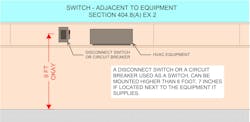
While the NEC provides a general, qualifiable definition of “readily accessible” in Art. 100, Sec. 240.24 and Sec. 404.10(A) further define and quantify this as “the center of the grip of the operating handle… when in its highest position,” of 6 ft, 7 in. or less above the floor or working platform. Exceptions to this height requirement are discussed in subsequent sections of this article.
Exceptions and modifications to working space requirements
Sec. 110.26(A)(4) relates to equipment installed above lay-in ceilings or within crawl spaces. It provides separate requirements for equipment located in spaces with limited access because of installation or functional requirements. For equipment installed above a lay-in ceiling, the area must be accessible through an opening that is not smaller than 22 in. by 22 in. For equipment installed in a crawl space, the area must be accessible through an opening that is not smaller than 22 in. by 30 in. Such installations must still have a working space with a minimum width and depth as required by Sec. 110.26(A)(1) and Sec. 110.26(A)(2). However, the height of the working space need only be that which is “necessary to install the equipment.”
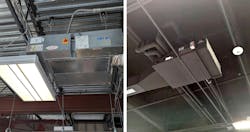
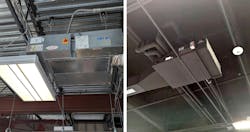
Section 240.24(A)(4) and Sec. 404.10(A), Exception No. 2 relates to equipment co-located with utilization equipment. They permit devices adjacent to the utilization equipment they supply to be mounted higher than 6 ft, 7 in. and accessed by portable means. This means if a device is near the equipment it protects, it does not necessarily have to be permanently and readily accessible; portable access, like a ladder or lift, is acceptable. This clause provides flexibility in installations where permanent accessibility might be impractical, as long as the device is still reasonably reachable when needed (Photo 1).
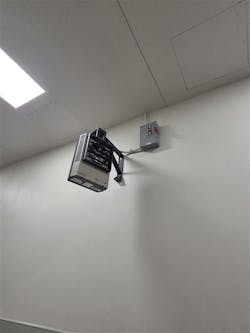
These NEC Articles provide flexibility for installations in non-standard locations, such as above accessible drop ceilings or in elevated positions. It allows switches and circuit breakers used as switches to be mounted above the standard height of
6 ft, 7 in., provided they are installed adjacent to the equipment they serve and are accessible by portable means (e.g., ladders). This exception is especially relevant in scenarios where aesthetics or space constraints necessitate overhead installations. Understanding and applying this provision ensures Code compliance while accommodating practical design and architectural considerations (Photo 2).
Sections 240.24(A)(1), 368.17(C), and 404.10(A)(1) relate to busways. Busways in industrial installations are often installed well above the working floor, with overcurrent devices for feeders and branch circuits mounted on the busway itself. Section 404.10(A)(1) permits overcurrent protective devices of busway installations to be located at the same level as the busway. Section 368.17(C) permits such an arrangement provided the disconnecting means can be operated via “suitable means such as ropes, chains, or sticks” [Sec. 368.17(C)].
Additional exceptions to Sec. 240.24, specifically Sec. 240.24(A)(2) and Sec. 240.24(A)(3), provide other overcurrent protective device exceptions in situations where the overcurrent protective device on the line side of a circuit is not readily accessible or the overcurrent protective device is not required by Code.
Section 240.10 does not require supplemental overcurrent protective devices used for luminaires, appliances, and similar equipment to be readily accessible.
Section 225.40 and 230.92 require branch-circuit overcurrent devices to be installed on the load side of a circuit in a readily accessible location, if fed from a feeder or service overcurrent protective device that is not readily accessible. When located on the load side, the overcurrent protective devices must be of a lower ampere rating than the corresponding overcurrent protective devices on the line side.
Additional requirements and exceptions
Chapter 6, “Special Equipment,” provides additional requirements for certain types and installations of electrical equipment. Examples include:
- Article 600, Electric Signs and Outline Lighting. Section 600.21(D) requires a minimum working space of 3 ft by 3 ft by 3 ft for certain types of equipment related to electric signs and outline lighting.
- Article 610, Cranes and Hoists. Sec. 610.57 requires a minimum working space dimension of 2.5 ft be maintained in the direction of access to live parts that may need examination, adjustment, servicing, or maintenance while energized.
- Article 646, Modular Data Centers. Section 646.19 permits the working space and entrance/egress requirements to be modified if specific listed exceptions are met.
While Sec. 430.102 does not provide requirements related to working space around motor protective devices, it provides other related requirements, such as that a disconnecting means be located in sight of the driven equipment unless certain exceptions are met.
Summary
In general, the NEC requires electrical equipment to be located such that it has a minimum working space of approximately 30 in. wide (or the width of the equipment), 6 ft, 6 in. high, and 3 ft to 5 ft deep, and requires that switches and overcurrent protective devices be located no higher than 6 ft, 7 in. However, exceptions abound. Where equipment is installed adjacent to the equipment it supplies (e.g., ceiling-mounted heating, ventilation, and air-conditioning equipment; equipment installed in specific locations with irregular access), the NEC permits alternative working space dimensions and installation criteria.
About the Author
 SAyed Aasif, C.Engg
SAyed Aasif, C.Engg
Sayed Aasif, C.Engg is part of the electrical and licensed Institution of Engineers’ Chartered Engineer based in India, specializing in water, commercial, industrial, and substation industry, with experience on various U.S. projects.
 William McGugan, PE
William McGugan, PE
William McGugan, PE is an electrical engineer with more than 10 years of experience in power electrical engineering, including the design, maintenance, and analysis of power systems for municipal, commercial, industrial, and federal projects.