NEC Requirements for Marinas and Boatyards
Key Takeaways
- Electrical installations at marine facilities must adhere to specific datum planes based on tidal conditions to prevent water contact with electrical equipment.
- Service equipment should be located on land, at least 5 ft from floating structures, and all signage must clearly warn of electrical shock hazards.
- Wiring methods must be suitable for wet locations, with protective conduits and sealed connectors used to ensure safety and compliance.
- Ground-fault protection devices (GFCIs) are mandatory for shore power receptacles and boat hoist outlets to prevent electric shock incidents.
- Emergency shutoff devices must be installed within sight of marina power outlets, allowing quick disconnection during emergencies or ESD events.
Article 555 covers the installation of wiring and equipment for fixed or floating piers, wharfs, docking facilities, marinas, and boatyards [Sec. 555.1]. The known hazard of electric shock drowning (ESD) require special rules to protect the users of these facilities from the hazards that arise from the use of electricity.
Electrical datum plane
The electrical datum plane (see Sidebar) is a core concept for proper application of Art. 555. Distances for this depend upon whether you are working with:
- A floating pier, in which case it’s a horizontal plane 30 in. above the water level and 12 in. above the level of the deck at the floating pier [Sec. 555.3 (A)].
- Area subject to tidal fluctuations, in which case the line is 2 ft above the highest normal tide level [Sec. 553.3(B)].
- Area not subject to tidal fluctuations, in which case the line is highest normal water level.
Service equipment
The service equipment for a floating dock or marina must be on land at least 5 ft horizontally from the floating structure and 1 ft above the datum plane [Sec. 555.4]. Transformers and enclosures must be identified for wet locations [Sec. 555.7(A) and (B)].
Signage
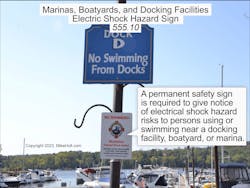
A permanent safety sign is required. It must give notice of electric shock hazard risks to persons using or swimming near a docking facility, boatyard, or marina. The safety sign must meet all the requirements of Sec. 555.10. For example, it must be clearly visible from all approaches to a marina or boatyard facility (Fig. 1).
Fuel locations
Electrical wiring and equipment serving motor fuel dispensing locations must comply with Art. 514 [Sec. 555.11]. Electrical wiring and equipment at marine craft repair facilities containing flammable or combustible liquids or gases must comply with
Art. 511 [Sec. 555.12].
Equipment and connections
Electrical equipment (excluding wiring methods) and connections (splices and terminations) not intended for operation while submerged must be located at least 12 in. above the deck of a pier or dock, but not below the electrical datum plane [Sec. 555.30(A)].
Sealed wire connector systems are limited to use with Types USE, RHW, XHHW, RW90 EP, RW90, XLPE, or TWU conductors, size 30 AWG through 2,000-kcmil copper or aluminum per the UL Guide Information Sheet for “Sealed Wire Connector Systems (ZMWQ).”
Receptacles
Mount receptacles at least 12 in. above the surface of a fixed pier but not below the electrical datum plane [Sec. 555.33]. Shore power receptacles must be:
- Part of a listed marina power outlet enclosure listed for wet locations or installed in listed weatherproof enclosures.
- Rated at least 30A.
- Of the pin and sleeve type if rated 60A or higher.
Wiring methods
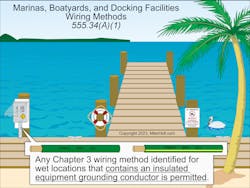
You can use any Chapter 3 wiring method identified for wet locations containing an insulated equipment grounding conductor (EGC) [Sec. 555.34(A)(1)], as shown in Fig. 2.
Sunlight-resistant, extra-hard usage cord and extra-hard usage portable power cables listed for use in the environment within which they are installed, are permitted [Sec. 555.34(A)(2)]:
(1) As permanent wiring on the underside of piers (floating or fixed).
(2) Where flexibility is necessary as on piers composed of floating sections.
Install overhead wiring such that it avoids possible contact with masts and other boat parts [Sec. 555.34(B)(1)]. Overhead branch-circuit and feeder wiring in locations of the boatyard other than those described in Sec. 555.34(B)(1) must be at least 18 ft above grade. Multiple feeders and branch circuits are permitted for marina installations per Art. 225
[Sec. 555.34(B)(2)].
Portable power cables permitted by Sec. 555.13(A)(2) must meet the five criteria of Sec. 555.34(B)(3). For example, you must run them on the underside of the pier.
Rigid metal conduit, intermediate metal conduit, reinforced thermosetting resin conduit (RTRC) listed for aboveground use, or rigid polyvinyl chloride (PVC) conduit suitable for the location must be used to protect wiring to a point at least 8 ft above the docks, decks of piers, and landing stages [Sec. 555.34(B)(4)].
Ground-fault protection (GFPE and GFCI)
Feeder conductors installed on docking facilities must be provided with GFPEs set to open at trip currents not exceeding 100mA [Sec. 555.35(A)]. Coordination with the feeder GFPE overcurrent protective device is permitted.
Exception: Transformer secondary conductors of a separately derived system that do not exceed 10 ft, and are installed in a raceway, can be installed without ground-fault protection. This exception also applies to the supply terminals of the equipment supplied by the transformer secondary conductors.
Shore power receptacles installed per Sec. 555.33(A) must have individual GFPE protection set to open at trip currents not exceeding 30mA [Sec. 555.35(B)(1)]. GFCI protection is required for docking facility outlets rated 60A and less, single-phase, and 100A and less, 3-phase for electrical systems not exceeding 150V to ground [Sec. 555.35(B)(2)].
Exception: Circuits not requiring grounding, not exceeding the low-voltage contact limit, and supplied by listed transformers or power supplies complying with Sec. 680.23(A)(2) can be installed without GFCI protection.
Boat hoist outlets on docking facilities must be GFCI protected where the circuit voltage does not exceed 240V [Sec. 555.35(C)].
Where more than three receptacles supply shore power to boats, a leakage current measurement device for marina applications must be used to determine leakage current from each boat that will utilize shore power [Sec. 555.35(D)].
Exception: Where the shore power equipment includes a leakage indicator and leakage alarm, a separate leakage test device is not required.
Disconnecting means
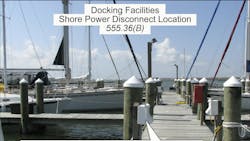
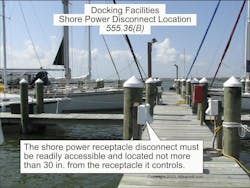
Provide a disconnecting means for each shore power receptacle. It must be a circuit breaker or switch that identifies the shore power receptacle it controls. It must be readily accessible and not more than 30 in. from the receptacle it controls [Sec. 555.36], as shown in Fig. 3.
Each marina power outlet or enclosure that provides shore power to boats must have a listed emergency shutoff device or disconnect that is marked “Emergency Shutoff” per Sec. 110.22(A) [Sec. 555.36(C)]. This disconnect provides a means to shut off power if a swimmer comes in contact with an energized metal boat, dock, or ladder and anytime it appears that ESD is occurring.
The emergency shutoff device or disconnect must be within sight of the marina power outlet, readily accessible, externally operable, and manually resettable. It must de-energize the power supply to all circuits supplied by the marina power outlet(s). You cannot use a circuit breaker handle for this purpose.
Equipment grounding conductor
Metallic items likely to become energized in a marina, boatyard, or docking facility must be connected to an EGC of the wire-type run with the circuit conductors. There’s a list in Sec. 555.37(A).
For all circuits in a marina, boatyard, or docking facility, provide an insulated equipment grounding conductor sized per Sec. 250.122 but at least 12 AWG.
A feeder to a panelboard or distribution equipment must have an insulated equipment grounding conductor [Sec. 555.37(B)] run from the service to the panelboard or distribution equipment. The required insulated equipment grounding conductor [Sec. 555.37(B)] must terminate at a grounding terminal in a panelboard, distribution equipment, or service equipment.
Luminaires
All luminaires and retrofit kits must be listed and identified for use in their intended environment. Luminaires and their supply connections must be secured to limit damage from watercraft and prevent entanglement of, and interaction with, sea life
[Sec. 555.38(A)].
Luminaires installed below the highest high tide level or electrical datum plane and likely to be periodically submersed are limited to the following
[Sec. 555.38(B)]:
(1) Identified as submersible.
(2) Operate below the low-voltage contact limit.
(3) Supplied by a swimming pool transformer per Sec. 680.23(A)(2).
Preventing mistakes
The main strategy of Art. 555 is to keep water and electricity away from each other. Knowing and respecting the datum plane is the key to a Code-compliant installation. Note that all of the requirements in Art. 555 also apply to replacements. The replacement aspect is repeated many times in Art. 555. Following this requirement is essential to performing a Code-compliant repair or upgrade.
Key Definitions
These terms are defined in Art. 100.
- Boatyard: A facility used for constructing, repairing, servicing, hauling from the water, storing (on land and in water), and launching boats.
- Docking facility: A covered or open, fixed, or floating structure that provides access to the water and to which boats are secured.
- Electrical datum plane: A specified vertical distance above the normal high-water level at which electrical equipment can be installed and electrical connections made.
- Marina: A facility, generally on the waterfront, which stores and services boats in berths, on moorings, and in dry storage or dry stack storage.
- Pier: A structure extending over the water on a fixed or floating structure that provides access to the water.
- Power outlet, marina: An enclosed assembly that can include equipment such as receptacles, circuit breakers, watt-hour meters, and panelboards.
- Shore power: The electrical equipment required to power a floating vessel, including, but not limited to, the receptacle and cords.
About the Author
 Mike Holt
Mike Holt
Mike Holt is the owner of Mike Holt Enterprises (www.MikeHolt.com), one of the largest electrical publishers in the United States. He earned a master's degree in the Business Administration Program (MBA) from the University of Miami. He earned his reputation as a National Electrical Code (NEC) expert by working his way up through the electrical trade. Formally a construction editor for two different trade publications, Mike started his career as an apprentice electrician and eventually became a master electrician, an electrical inspector, a contractor, and an educator. Mike has taught more than 1,000 classes on 30 different electrical-related subjects — ranging from alarm installations to exam preparation and voltage drop calculations. He continues to produce seminars, videos, books, and online training for the trade as well as contribute monthly Code content to EC&M magazine.