NEC Requirements for Overcurrent Protection
Article 240 provides the general requirements for overcurrent protection and overcurrent protective devices (OCPDs). The job of an OCPD is to open the circuit if the current reaches a value that may damage conductors, conductor insulation, or equipment. Table 240.3 provides a list of other Articles that may apply to overcurrent protection for your specific installation. For example, Art. 695 applies to fire pumps.
Overcurrent protection of conductors
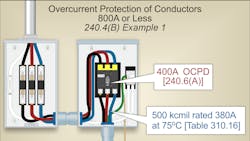
Conductors must have overcurrent protection per their ampacities as specified in Sec. 310.14. If the conductor ampacity doesn’t correspond to a standard OCPD, you can use the next higher standard OCPD rating for OCPDs rated 800A or less. That is permitted only if the three conditions of Sec. 240.4(B) are met. For example, the next higher OCPD can’t exceed 800A (Fig. 1).
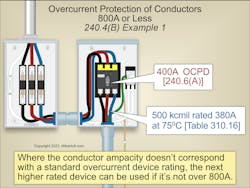
If the circuit OCPD exceeds 800A, the conductor ampacity must be equal to or greater than the standard ampere rating or setting of the OCPD, as shown in Table 240.6(A) [Sec. 240.4(C)].
Overcurrent protection for conductors cannot exceed the values listed in Sec. 240.4(D)(1) through (8). For example, 15A for 14AWG copper. There are two exceptions in Sec. 240.4(E) and (G). Flexible cord must be protected by an OCPD per its ampacity as specified in Table 400.5(A)(1) and Table 400.5(A)(2) [Sec. 240.5].
Standard ampere ratings
The standard ampere ratings for fuses and inverse time circuit breakers are in Table 240.6(A). It covers 38 ratings — from 10A to 6,000A.
The ampere rating of “adjustable trip circuit breakers” with restricted access to the adjusting means is equal to the long-time pickup current settings. Restricted access is achieved by one of the methods listed in Sec. 240.6(C)(1) through (4). For example, locating them behind bolted equipment enclosure doors.
A circuit breaker that can be adjusted remotely to modify the adjusting means can have an ampere rating equal to the adjusted current setting (long-time pickup setting) [Sec. 204.6(D)]. Remote access must be achieved by connecting through either a networked interface that complies with Sec. 204.6(D)(2)(a) and (b), or through a local non-networked interface.
All phases
Circuit breakers must automatically open all phase conductors of the circuit during an overcurrent condition [Sec. 240.15(B)]. Four exceptions exist in Sec. 240.15(B)(1) through (4). For example, individual single-pole circuit breakers rated 120/240V with handle ties identified for the purpose are permitted for each phase conductor of a 3-phase circuit supplying line-to-line loads.
OCPD location
The location of an OCPD must be:
- Readily accessible [Sec. 240.24(A)].
- Not in bathrooms, over steps, near easily ignitable materials, or where exposed to physical damage [Sec. 240.24(E), (F), (D), and (C), respectively].
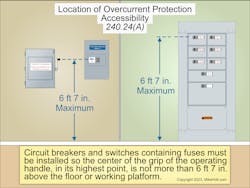
- Not too high. The center grip of the handle of the circuit breaker or switch containing fuses cannot (in its highest position) be more than 6 ft - 7 in. above the floor or working platform unless one of the four exceptions to Sec. 240.24(A) applies (Fig. 2).
Overcurrent protection is required at the point where conductors receive their supply, except as permitted by Sec. 240.21(A) through (H). The bulk of (A) through (H) is in Sec. 240.21(B)(1) through (4), which cover feeder taps. A few highlights:
- The feeder tap is permitted at any point on the load side of the feeder OCPD, including the load terminals of the feeder OCPD.
- You can’t use the next size up rule [Sec. 240.4(B)] for tap conductors.
- Tap conductors up to 10 ft long are permitted when they comply with the four requirements listed in Sec. 240.21(B)(1)(1) through (4). For example, they can’t extend beyond the equipment they supply.
- Tap conductors up to 25 ft long are permitted when they comply with the three requirements listed in Sec. 240.21(B)(2)(1) through (3). For example, the tap conductors are enclosed in a raceway or other means approved by the authority having jurisdiction.
For transformer secondary conductors, check out some key points from Sec. 240.21(C):
- The secondary terminals of a transformer can supply multiple sets of secondary conductors [Sec. 240.21(C)]. But you can’t apply the next size up rule of Sec. 240.4(B).
- Outside secondary conductors can be of unlimited length if they comply with Secs. 240.21(C)(4)(1) through (4). For example, they terminate in a circuit breaker or set of fuses and have an ampacity of at least the rating of the OCPD.
- Secondary conductors up to 25 ft long are permitted when they comply with Secs. 240.21(C)(6)(1) through (3). For example, they’re enclosed in raceway or a similar approved means.
Enclosures containing OCPDs
Enclosures containing fuses must be mounted in a vertical position [Sec. 240.33]. Enclosures containing circuit breakers must be mounted vertically if the circuit breaker handle is operated vertically in accordance with Sec. 240.81.
When the handle of a circuit breaker is operated vertically, the “up” position of the handle must be the “ON” position [Sec. 240.81]. So, in effect, an enclosure that contains one row of circuit breakers can be mounted horizontally, but an enclosure that contains a panelboard with multiple circuit breakers on opposite sides of each other must be mounted vertically.
Markings
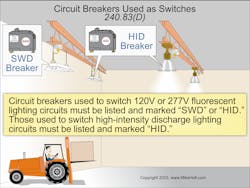
Circuit breakers used to switch 120V or 277V fluorescent lighting circuits must be listed and marked “SWD” or “HID.” Circuit breakers used to switch high-intensity discharge lighting circuits must be listed and marked “HID” [Sec. 240.83(D)] (Fig. 3).
A circuit breaker with a straight voltage marking (e.g., 240V or 480V) is permitted on a circuit if the nominal system voltage between any two conductors (line-to-neutral or line-to-line) does not exceed the circuit breaker’s marked voltage rating [Sec. 240.85].
A circuit breaker with a slash rating (such as 120/240V or 277/480V) marking is permitted if the nominal system voltage of any one conductor to ground does not exceed the lower voltage marking, and the nominal system voltage between any two conductors does not exceed the higher voltage marking.
Where a circuit breaker is used on a circuit having an available fault current higher than the marked interrupting rating by being connected on the load side of an approved OCPD having a higher rating, the circuit breaker must meet the requirements of Sec. 240.86(A), (B), or (C). For example, the combination of the line-side OCPD and the load-side circuit breakers is tested and marked on the end-use equipment, such as switchboards and panelboards.
Adjusting to 1,200A
Where the highest continuous current trip setting of an adjustable trip circuit breaker can be adjusted to 1,200A or higher, Sec. 240.87(A) through Sec. 240.87(C) apply:
(A) Documentation. It is required to:
- Provide the location of the arc-energy reduction circuit breaker(s).
- Be available to those authorized to design, install, operate, or inspect the installation.
- Demonstrate that the method chosen to reduce clearing time is set to operate at a value below the available arcing current.
(B) Method to reduce clearing time. One of the seven methods listed in Sec. 240.87(B) is required. For example, differential relaying. The method must be set to operate at less than the available arcing current.
(C) Performance testing. This must be done with primary current injection testing or another approved method when first installed on-site. It must be performed by qualified persons per the manufacturer’s instructions.
Where to start?
Article 240 requirements are intended to protect conductors and equipment from overcurrent. But Art. 430, Parts III, IV, and V amend those requirements because motors have inrush current. And Art. 695 amends them because a fire pump must run no matter what — even if that means severely damaging the pump or its supply conductors.
Those exceptions aside, start the overcurrent protection aspect of your projects by asking what is needed to protect your circuit conductors and connected equipment from overcurrent.
Definitions
The following definitions from Art. 100 provide context for understanding
overcurrent protection requirements in Art. 240:
Identified. Recognized as suitable for a specific purpose, function, or environment by listing, labeling, or other means approved by the authority having jurisdiction.
Ground fault. Unintentional electrical connection between a phase conductor and equipment grounding conductors, metal parts of enclosures, metal raceways, or metal equipment.
Overcurrent. Current that is more than the conductor’s ampacity (caused by an overload, short circuit, or ground fault).
OCPD. Device capable of protecting a circuit from an overload, short circuit, or ground fault.
Overload. Condition that occurs when equipment operates above its current rating or at more current than the ampacity of its supply conductors. A short circuit or ground fault is not an overload.
Short circuit. Abnormal connection of relatively low impedance, whether made accidentally or intentionally, between points of different potential.
Tap conductor. A conductor, other than a service conductor, with overcurrent protection rated more than the ampacity of the conductor.
About the Author
 Mike Holt
Mike Holt
Mike Holt is the owner of Mike Holt Enterprises (www.MikeHolt.com), one of the largest electrical publishers in the United States. He earned a master's degree in the Business Administration Program (MBA) from the University of Miami. He earned his reputation as a National Electrical Code (NEC) expert by working his way up through the electrical trade. Formally a construction editor for two different trade publications, Mike started his career as an apprentice electrician and eventually became a master electrician, an electrical inspector, a contractor, and an educator. Mike has taught more than 1,000 classes on 30 different electrical-related subjects — ranging from alarm installations to exam preparation and voltage drop calculations. He continues to produce seminars, videos, books, and online training for the trade as well as contribute monthly Code content to EC&M magazine.