NEC Requirements for Overvoltage Protection
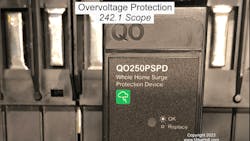
Barring something like an incorrect transformer tap connection, an overvoltage is a momentary event in which voltage “surges” beyond nominal. We often call that a transient. A breaker or fuse is designed to protect against overcurrent, not overvoltage.
To protect against transient overvoltage, you need a surge protection device (SPD). An SPD limits transient overvoltages by diverting or limiting surge current and preventing its continued flow while remaining capable of repeating these functions [Art. 100]. Article 242 provides the general, installation, and connection requirements for overvoltage protection and SPDs (Fig. 1).
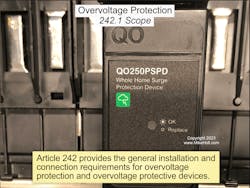
SPDs are:
- Designed to shunt transient overvoltages away from the load to protect equipment.
- Arranged so the voltage to the load does not exceed the equipment’s maximum voltage rating as designed by the manufacturer.
- Installed to reduce transient overvoltages for the purpose of protecting electronic safety equipment such as smoke detectors, AFCIs, GFCIs, CO detectors, emergency systems, fire pump equipment, elevators, and electronic breakers.
- Connected in parallel with the load.
- Not a magic fix-all for bonding deficiencies or other installation errors.
Also, they:
- Typically use metal-oxide varistors (MOVs) to divert transient current and limit the overvoltage from a surge to the connected load.
- Change the impedance from open to closed to clamp transient overvoltage and current pulses. For example, it’s typical for an SPD to start clamping at over 150V for a 120V circuit.
Key factors in a successful SPD installation are:
- Having the correct short-circuit current rating for the application.
- Selecting the correct SPD type.
- Installing the SPD in the correction location (both in the circuit and physically).
- Determining the best practical conductor routing and sizing.
- Workmanship that results in smooth bends.
SPDs (1,000V or Less)
An SPD must be listed [Sec. 242.6]. The SPD must be marked with its short-circuit current rating and cannot be installed where the available fault current exceeds that rating [Sec. 242.8].
SPDs are susceptible to failure at high fault currents. A hazardous condition is present if the short-circuit current rating of an SPD is less than the available fault current. To understand more about this, we turn to Sec. 110.10. This has a long first sentence, the crux of which is the protective devices must be selected and coordinated so they can clear a fault without extensive damage to the equipment.
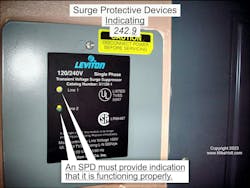
An SPD must indicate that it is functioning properly [Sec. 242.9], as shown in Fig. 2. When you install an SPD, ensure this indication is readily visible without needing to move aside conductors or to stand on one’s head to see it.
Type 1 and 2 SPDs
A Type 1 SPD is listed for installation at or ahead of the service disconnect [Art. 100]. It can be connected in one of the two locations specified in Sec. 242.13(A):
(1) On the supply side of the service disconnect as permitted by Sec. 230.82(4).
(2) On the load side of the service disconnect per Sec. 242.14.
Where installed at services, Type 1 SPDs must be connected to one of the points listed in Sec. 242.13(B)(1) through (4):
(1) Service neutral conductor.
(2) Grounding electrode conductor.
(3) Grounding electrode for the service.
(4) Equipment grounding terminal in the service equipment.
A Type 2 SPD is listed for the installation on the load side of the service disconnect, e.g., a feeder [Art. 100] and cannot be installed on the line side of the service, unless installed in accordance with Sec. 230.82(8) [Sec. 242.14(A)].
Notice that you can use a Type 1 SPD on the service side or the load side, but you can typically use a Type 2 SPD only on the load side. So should you simply specify Type 1 SPDs, since they appear to be better? It’s not that one is better than the other, it’s that you need to select an SPD that is appropriate for the conditions at its point of connection in your distribution system. You have several specifications to consider, such as the clamping voltage.
Connecting
Only one conductor can be connected to a terminal unless the terminal is identified for multiple conductors [Sec. 110.14(A)]. Ignoring this rule is a fairly common Code violation for SPD installations.
If two conductors can fit into the terminal and you can tighten the lug with no problem, then it’s good. Right? Let’s make a brief stop in the world of mechanical physics. The fastener is designed to exert X amount of clamping force onto a conductor of Y size by stretching a certain tiny distance. If you effectively double the size of that conductor, the amount of clamping force is severely reduced. That X value is chosen to keep the wire effectively clamped despite vibration, thermal expansion and contraction, and the force of gravity.
Some people who violate Sec. 110.14(A) believe that if they turn the screw tighter, that makes up for the extra conductor. But going back to mechanical physics, the excess torque does not increase the elastic limit of the fastener and thus produce more clamping force. Instead, it may reduce clamping force by exceeding the fastener’s elastic limit and make the problem even worse. While these poor connections show up on an infrared scan after vibration, thermal expansion and contraction, and gravity take their toll, a conscientious electrician doesn’t make them in the first place.
If you install a surge-protective device (a unit containing multiple SPDs), you must connect it to each phase conductor of the circuit [Sec. 242.20].
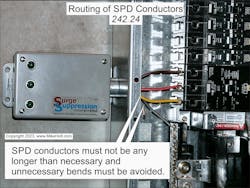
Don’t make SPD conductors any longer than necessary. Avoid unnecessary bends [Sec. 242.24], as shown in Fig. 3. Don’t make sharp bends, either. Shorter conductors and minimal bends (both in quantity and angle) will improve the performance of the surge protection by helping to reduce conductor impedance during high-frequency transient events.
Overvoltage protection strategy
For industrial and commercial applications, you can’t just install an SPD at a panel and consider everything protected. Any given SPD will clamp between X voltage and Y voltage. Because of that, a successful SPD implementation uses a tiered approach.
Typically, for an SPD system, you start at the service and install SPDs that will trap, divert, or block high-voltage transients (nearly always induced by lightning) coming in from the outside. There’s an upper limit to that voltage, and lightning is well above it. So a lightning protection system is your first line of defense. Assuming that’s in place, you want your service level SPDs to knock the transient voltage down to something your service equipment can handle.
Then the next level of SPDs might be at each feeder distribution panel. Again, you knock the transient voltage down. At the branch panels, you knock it down again. Utilization equipment may have its own SPDs. For example, you commonly find MOVs connected across the hot and neutral of the power supply of plug-in devices.
How granular you get and how much you spend on an SPD implementation depends on how much risk you can assume in terms of equipment loss and operations interruption.
For residential applications, an SPD at the main panel is usually considered sufficient even though the typical home doesn’t have a lightning protection system. It does have several utility connections (water, phone, gas, cable, electric) and each is grounded. If you connect these various grounds (as required by Sec. 250.64(D)(2)), you create the equivalent of a long ground rod in the form of bare copper wire run horizontally. This is called a “counterpoise.”
The residential SPD system is designed to stop induced transients. It won’t stop lightning, which can jump across the SPD terminals. Lightning travels miles across the open sky, a few more inches is no challenge. To fully protect connected equipment inside a home, you must unplug it.
The spark gap arrestor is a type of SPD that takes advantage of lightning’s tendency to jump. A very high transient voltage will jump from the line across a gap to ground, leaving a reduced (but still high) voltage in the line. These are typically used in commercial and industrial applications such as roof-mounted chillers (HVAC) and telecommunications equipment.
The NEC doesn’t go into details about developing a strategy for a given application, because that is outside the scope of the NEC [Sec. 90.2]. But the reality is the same people following the NEC to make an installation is essentially free from hazard also make decisions about how to optimize the installation to meet the various goals of the owner and/or tenant. A two-tiered SPD system might be fine for one factory but inadequate for another.
Yet, an SPD implementation is only part of an overvoltage protection strategy. A good strategy also includes having zero defects in your equipment grounding (bonding) conductor, bonding of metallic objects, anti-induction routing of conductors, using soft starters on big motors where practical, judicious use of distribution transformers to isolate loads from transient sources, and zero neutral-ground bonds on the load side of the service or separately derived system.
About the Author
 Mike Holt
Mike Holt
Mike Holt is the owner of Mike Holt Enterprises (www.MikeHolt.com), one of the largest electrical publishers in the United States. He earned a master's degree in the Business Administration Program (MBA) from the University of Miami. He earned his reputation as a National Electrical Code (NEC) expert by working his way up through the electrical trade. Formally a construction editor for two different trade publications, Mike started his career as an apprentice electrician and eventually became a master electrician, an electrical inspector, a contractor, and an educator. Mike has taught more than 1,000 classes on 30 different electrical-related subjects — ranging from alarm installations to exam preparation and voltage drop calculations. He continues to produce seminars, videos, books, and online training for the trade as well as contribute monthly Code content to EC&M magazine.