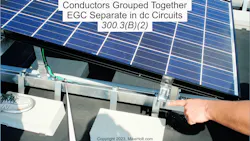
Single conductors specified in Table 310.4(1) must be installed in a Chapter 3 wiring method [Sec. 300.3(A)]. All conductors of a circuit, including the neutral and equipment grounding conductors (EGCs), must be installed in the same raceway, cable, trench, or cable tray except as permitted by Sec. 300.3(B)(1) through (4). For example, you can run grounding and bonding conductors outside a raceway or cable assembly (Fig. 1).
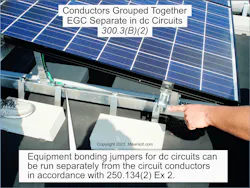
Where subject to physical damage, conductors, raceways, and cables must be protected per the requirements contained in Sec. 300.4(A) through (H). For example, where a raceway crosses a structural expansion joint, you must use a listed expansion/deflection fitting or other approved means.
Underground Installations
When raceways or cables are installed underground, they must have a minimum burial cover per Table 300.5(A) [Sec. 300.5(A)]. Note 1 to Table 300.5(A): “Cover” is measured as the shortest distance from the top of the cable or raceway to the finished grade.
Cables and conductors (other than MC cable) installed under a building must be contained in a raceway [Sec. 300.5(C)]. Single conductors and multiconductor cables installed underground must be protected from damage per Sec. 300.5(D)(1) through (4). For example, underground service conductors must have their location identified by a warning ribbon placed in the trench at least 12 in. above the underground conductors.
Direct-buried UF or USE conductors or cables can be spliced underground without a splice box [Sec. 300.15(G)], if the splice is made per Sec. 110.14(B) [Sec. 300.5(E)].
Also:
- Backfill material for underground wiring must not damage raceways, cables, or conductors [Sec. 300.5(F)].
- Raceways through which moisture might contact live parts must be sealed at either or both ends. Sealants must be identified for use with the cable insulation, conductor insulation, bare conductor, shield, or other components [Sec. 300.5(G)].
- Raceways that terminate underground must have a bushing or fitting at the end of the raceway to protect direct buried conductors or cables [Sec. 300.5(H)].
- Raceways that are subject to movement by settlement or frost must be arranged to prevent damage to conductors or equipment connected to the wiring [Sec. 300.5(J)].
Underground conductors must be installed inside the same raceway or multiconductor cable. Or they must be near each other in the same trench [Sec. 300.5(I)].
Exception No. 2: Underground parallel conductors can have the conductors of each phase, neutral or equipment grounding conductor installed in separate nonmetallic raceways where inductive heating at raceway terminations is reduced by using aluminum locknuts and cutting a slot between the individual holes through which the conductors pass as required by Sec. 300.20(B).
Corrosion
Raceways, cable trays, cable armor, cable sheathing, boxes, cabinets, enclosures, elbows, couplings, fittings, supports, and support hardware must be suitable for the environment. Steel raceways, cables, cable trays, cabinets, enclosures, fittings, and support hardware must be protected against corrosion by a coating of approved corrosion-resistant material [Sec. 300.6(A)].
Where rigid metal conduit (RMC) or intermediate metal conduit (IMC) is threaded in the field and corrosion protection is required, coat the threads with an approved electrically conductive, corrosion-resistant compound.
Different temperatures
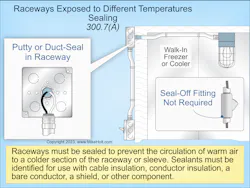
Raceways subjected to different temperatures, where condensation is known to be a problem, must be filled with a sealant identified for the conductor or cable insulation to prevent the circulation of warm air to a colder section of the raceway [Sec. 300.7(A)] (Fig. 2).
Raceways must be provided with expansion, expansion-deflection, or deflection fittings where necessary to compensate for thermal expansion, deflection, and contraction [Sec. 300.7(B)].
Electrical continuity
Metal raceways, cable armor, and metal enclosures must be metallically joined together and connected to all boxes, fittings, and cabinets to provide electrical continuity [Sec. 300.10]. Raceways and cable assemblies must be mechanically secured to boxes, fittings, cabinets, and other enclosures.
This establishes the effective ground-fault current path necessary to open the circuit overcurrent protective device in the event of a ground fault [Sec. 250.4(A)(5)]. So the rule doesn’t apply to short lengths used to support or protect cables.
Securing and supporting
Raceways, cables, and boxes must be securely fastened in place [Sec. 300.11(A)]. You can’t use ceiling grid support wires for this purpose [Sec. 300.11(B)]. You can’t use raceways to support raceways or cables, except Class 2 power-limited cables can be supported to the raceway that supplies power to the equipment controlled by the Class 2 power-limited cable.
You can use raceways to support boxes per Sec. 314.23.
Mechanical continuity
Raceways and cable sheaths must be mechanically continuous between boxes, cabinets, conduit bodies, fittings, or other enclosures [Sec. 300.12].
Conductor splices must be made inside enclosures per Sec. 300.15. Conductor splices are not permitted inside a raceway, except for wireways per Sec. 376.56.
Continuity of the neutral conductor of a multiwire branch circuit must not be interrupted by removal of a wiring device. For multiwire branch circuit applications, the neutral conductors must be spliced together, and a pigtail is required for wiring the device (the exception is when wiring a GFCI device).
Boxes
At least 6 in. of spliced or unspliced conductor, measured from the point in the box where the conductors enter the enclosure, must be left at each outlet point [Sec. 300.14] (Fig. 3).
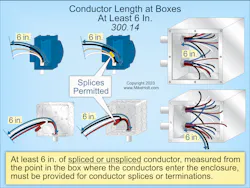
Boxes with openings less than 8 in. at any dimension must have at least 6 in. of conductor, measured from the point where the conductors enter the box, and at least 3 in. of conductor outside the box.
A box must be installed at each conductor splice point or conductor termination point, except as permitted by Sec. 300.15(A) through (H). For example, there’s already a box or wiring compartment integral to the equipment.
Number and size of conductors in a raceway
Raceways must be sized to permit the installation and removal of conductors without damaging their insulation [Sec. 300.17].
- When all conductors within a raceway are the same size, same insulation type, number of conductors permitted, or raceway size, use Annex C [Note (1) of Chapter 9].
- When different size conductors are installed in a raceway, conductor fill is limited to the percentages in Table 1 and Note (6) of Chapter 9.
Follow these steps to size raceways:
Step 1: Determine the total area needed for the conductors (Chapter 9, Table 5 for insulated conductors and Chapter 9, Table 8 for bare conductors).
Step 2: Select the raceway from Chapter 9, Table 4 per the percent fill listed in Chapter 9, Table 1.
Ducts and plenums
Wiring methods are not permitted in ducts that transport dust or flammable vapors [Sec. 300.22(A)].
You can use equipment and wiring methods in a duct fabricated to transport environmental air, but only if the equipment and wiring method is necessary for the direct action upon (or sensing of) the contained air [Sec. 300.22(B)].
MC cable without an overall nonmetallic covering and metal raceways can be installed in ducts fabricated to transport environmental air. Flexible metal conduit in lengths not exceeding 4 ft can be used to connect adjustable equipment and devices within the fabricated duct [Sec. 300.22(B)].
Exception: Plenum rated Class 2 and Fire Alarm power-limited cables can be installed in ducts specifically fabricated for environmental air-handling purposes under both of the following conditions:
(1) The wiring methods or cabling systems are necessary to connect to equipment or devices associated with the direct action upon, or sensing of, the contained air.
(2) The total length of such wiring methods or cabling systems does not exceed 4 ft.
Wiring methods, cable tray systems, and equipment installed in spaces not specifically fabricated for environmental air-handling purposes but used for air-handling purposes as a plenum must comply with Sec. 300.22(C)(1) through (3). For example, you can use metal raceways, AC cable, MC cable without a nonmetallic cover, electrical metallic tubing, rigid metal conduit, intermediate metal conduit, flexible metal conduit, surface metal raceways, or metal wireways.
Cables, raceways, and equipment installed behind suspended-ceiling panels must be located so the suspended-ceiling panels can be removed for access to electrical equipment [Sec. 300.23].
Stressed
One reason there’s not a clear and concise definition of “good workmanship” is much of Art. 300 fits inside that definition. For example, Art. 300 stresses mechanical continuity and mechanical integrity. These play a big role in how well a raceway will perform its job of protecting conductors. And if the raceway is metallic, these also determine whether the raceway can serve as an effective, reliable ground fault current path.
About the Author
 Mike Holt
Mike Holt
Mike Holt is the owner of Mike Holt Enterprises (www.MikeHolt.com), one of the largest electrical publishers in the United States. He earned a master's degree in the Business Administration Program (MBA) from the University of Miami. He earned his reputation as a National Electrical Code (NEC) expert by working his way up through the electrical trade. Formally a construction editor for two different trade publications, Mike started his career as an apprentice electrician and eventually became a master electrician, an electrical inspector, a contractor, and an educator. Mike has taught more than 1,000 classes on 30 different electrical-related subjects — ranging from alarm installations to exam preparation and voltage drop calculations. He continues to produce seminars, videos, books, and online training for the trade as well as contribute monthly Code content to EC&M magazine.