Key Takeaways
- Metal raceways include conduit and tubing, both hollow with circular cross sections, with specific types suited for different applications and environments.
- -MC and RMC are versatile, suitable for all conditions including wet and corrosive environments, and can be threaded or threadless, while FMC and EMT are primarily used with compression fittings and are less durable.
- Proper installation involves secure fastening, support at specified intervals, correct bending techniques, and tight fittings to maintain electrical integrity and safety.
- The choice of raceway depends on factors like environmental conditions, physical damage risk, and whether it can serve as an Equipment Grounding Conductor (EGC), with metal raceways generally offering better EGC performance than wire conductors.
- Flexible raceways are ideal for equipment requiring movement or vibration minimization, but they require specific installation practices, including short EGC runs and proper bending techniques.
Metal raceways are either conduit or tubing. Both are hollow and have a circular cross-section. Tubing is thinner than conduit and designed for use with compression fittings. The thicker wall of conduit means you can thread the non-flexible types and assemble with threaded connectors.
Where electrically and mechanically continuous, all types of metal raceway can be used as an equipment grounding conductor (EGC) [Sec. 250.118]. They make better EGCs than wire conductors because their much larger surface area will carry high-frequency current via the skin effect (Fig. 1).
Nonmetallic raceways do have some advantages over metal raceways, primarily in the area of corrosion resistance. There are also disadvantages (e.g., you can’t use them as EGCs).
Six types
The six types of metal raceway are:
- Intermediate metal conduit (IMC) [Art. 342]. IMC is a circular metal raceway that can be threaded. It has the same outside diameter as rigid metal conduit (RMC) but is made of a stronger metal, which allows a thinner wall, making it lighter and providing a larger interior cross-sectional area for holding conductors. It’s typically threaded, but threadless connectors can also be used (same for RMC).
- Rigid metal conduit (RMC) [Art. 344]. RMC is also a circular metal raceway that can be threaded. It costs less per foot than IMC but is heavier and isn’t as strong.
- Flexible metal conduit (FMC) [Art. 348]. FMC is a circular raceway made of a helically wound, formed, interlocked metal strip.
- Liquidtight flexible metal conduit (LFMC) [Art. 350]. LFMC is essentially FMC with an outer liquidtight, nonmetallic, sunlight-resistant jacket.
- Electrical metallic tubing (EMT) [Art. 358]. EMT is a thin-wall alternative to conduit. Like conduit, it is of circular cross-section. It is used with light compression fittings that cost less than their counterparts for IMC and RMC. EMT isn’t threaded.
- Flexible metallic tubing (FMT) [Art. 360]. FMT is a thin-walled version of FMC. Like EMT, it is used with compression fittings and is not threaded.
Common requirements
All metal raceways have these requirements:
- Each type of metal raceway and its associated fittings must be listed. None of them is interchangeable among types [e.g., Sec. 342.6].
- When the raceway is cut in the field, reaming (nonflexible) or trimming (flexible) is required to remove the rough edges [e.g., Sec. 342.28].
- Raceway must be securely fastened and supported. The exact dimensions vary by raceway type. For example, IMC is required to be secured/fastened within 3 ft of each box, but FMC is only required within 12 in. of each. But IMC every 3 ft of run and FMC every 4.5 ft of run. If you look at the relative wall strength and material weight, you can see why this is the case.
- The number of conductors cannot exceed the percentage fill specified in Chapter 9, Table 1.
- Avoid using with dissimilar metals.
- Make bends in a manner that does not damage the raceway or significantly change the internal diameter. For the non-flexible raceways, this means using the correct shoe type in your bender (it will be marked for EMT or whatever) and using the shoe or shoe groove that matches the raceway size. For the flexible raceways, it means bending to the desired angle rather than bending past it and coming back. All bends must follow a smooth radius.
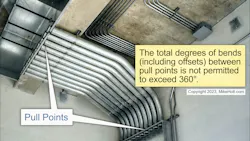
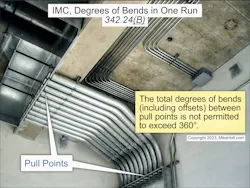
- The total of bends (including offsets) between pull points cannot exceed 360° (Fig. 2).
- All fittings must be made up tight [e.g., Sec. 344.42]. But this does not mean crank down as hard as you can. For example, you tighten the coupling for EMT only enough to make a slight dimple in the tubing. EMT fittings have small screws for that reason. Going beyond this could distort the tubing wall, adding excess friction for a conductor pull.
Differences
We already noted that the support distances vary by raceway type. What are some other differences? We can start with “Uses Permitted”, which is Section xxx.10 of each Article. This is a major factor in deciding which raceway to use.
IMC and RMC can be used in all atmospheric conditions and occupancies [Sec. 342.10(A), Sec. 344.10(A)]. They can also be used where subjected to physical damage, while no other metal raceway can be used under this condition. FMC, LFMC, EMT, and FMT have this condition under “Uses not permitted” in Section xxx.12 of each Article.
IMC and RMC can be used in concrete or direct burial (or in areas subject to severe corrosive influences), where provided with corrosion protection approved for the condition. They can be used in wet locations if you follow the requirements of Sec. 342.10(D) or Sec. 344.10(D). No other metal raceway can be used in wet conditions.
Consider the “Uses Not Permitted” for FMC. It cannot be installed:
(1) In wet locations.
(2) In hoistways, other than as permitted in Sec. 620.21(A)(1).
(3) In storage battery rooms.
(4) In any hazardous location, except as permitted by Sec. 501.10(B).
(5) Exposed to material having a deteriorating effect on the installed conductors.
(6) Underground or embedded in poured concrete.
(7) Where subject to physical damage.
Compare this to IMC and RMC, which do not even have a “Uses Not Permitted” section.
For EMT, the “Uses Not Permitted” are:
- Where subject to physical damage.
- For the support of luminaires or other equipment except as conduit bodies no larger than the largest trade size of the tubing [Sec. 358.12].
IMC, RMC, and LFMC can be used in hazardous locations. FMC, EMT, and FMT cannot be used in hazardous locations.
IMC and RMC can be threaded, or they can use threadless connectors. If threaded, a bushing must be used to protect the conductors where they exit. No bushing is required with the other metal raceways, but those others are not allowed to be threaded.
If the end of a metal raceway is threaded, you must cut off the threaded part if you wish to use a threadless connector, or the contact area will be greatly reduced. Not only will the connector have less grip, but this mix will reduce the efficacy of the raceway as an EGC.
Threadless connectors for IMC and RMC have some limitations. For example, if buried in concrete, these connectors must be of the concrete-tight type.
Size limits vary. FMC and LFMC cannot be smaller than ½ in. or larger than 4 in. [Sec. 348.20]. IMC, RMC, and EMT cannot be smaller than ½ in. or larger than 6 in. And FMT is available only in 3/8 in., ½ in., and ¾ in.
Flexible versus non-flexible
If flexibility is necessary to minimize the transmission of vibration from equipment or to provide flexibility for equipment that requires movement after installation, choose a flexible raceway for the last few feet. Running a non-flexible raceway to a big pump, for example, guarantees something will break. Maybe a raceway connector will loosen (and start a corrosion process if threaded), or maybe the equipment will be damaged.
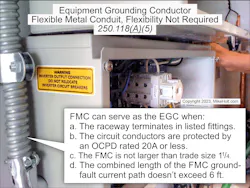
When using a flexible raceway, an EGC of the wire-type must be installed with the circuit conductors [Sec. 348.60 and Sec. 350.60] or the length must not exceed 6 ft [Sec. 250.118.5.d, 6.d, 7.b] (Fig. 3).
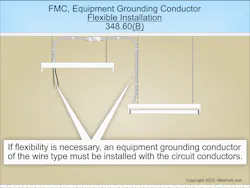
If an EGC is installed outside the flexible metal raceway, it can be no longer than 6 ft and must be routed with the flexible metal raceway per Sec. 250.102(E)(2). So to go beyond 6 ft, install the wire-type EGC inside the metal raceway.
Raceway choices
Each type of raceway has its pros and cons. The correct choice of raceway depends upon the conditions of the application. If the raceway will be exposed to damage, it seems you should choose RMC or IMC. But what if you choose rigid polyvinyl conduit (PVC) [Art. 352] and run the raceway underground? Or what if you set bollards in front of the raceway because you identified there’s a danger of trucks backing into it? Perhaps you could run the raceway along the top of the wall, out of the way of trucks? Maybe you can’t do any of these protective measures, so you opt for IMC. You still want to mitigate the danger of damage as much as you can. While IMC is tough, it isn’t invincible.
The primary advantage of a metal raceway over nonmetallic is that you can use it as an EGC. Before choosing the type of metal raceway, consider its “Uses Permitted” [e.g., Sec. 348.10] and “Uses Not Permitted” [e.g., Sec. 348.12]. Conforming to the installation requirements for that particular raceway is a matter of observing the EGC rules and providing support at the required distances.
About the Author
 Mike Holt
Mike Holt
Mike Holt is the owner of Mike Holt Enterprises (www.MikeHolt.com), one of the largest electrical publishers in the United States. He earned a master's degree in the Business Administration Program (MBA) from the University of Miami. He earned his reputation as a National Electrical Code (NEC) expert by working his way up through the electrical trade. Formally a construction editor for two different trade publications, Mike started his career as an apprentice electrician and eventually became a master electrician, an electrical inspector, a contractor, and an educator. Mike has taught more than 1,000 classes on 30 different electrical-related subjects — ranging from alarm installations to exam preparation and voltage drop calculations. He continues to produce seminars, videos, books, and online training for the trade as well as contribute monthly Code content to EC&M magazine.