A “receptacle” is a contact device installed at an outlet for the connection of an attachment plug [Art. 100]. Article 406 contains the requirements for the rating, type, and installation of receptacles, cord connectors, attachment plugs, and flanged inlets (Fig. 1).
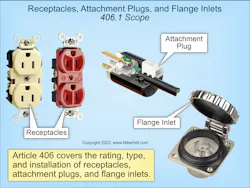
Receptacles:
- Must be listed and marked with the manufacturer’s name or identification, voltage rating, and ampere rating [Sec. 406.3(A)].
- Rated 20A or less and connected to aluminum conductors must be marked CO/ALR [Sec. 406.3(C)].
- Rated 15A and 20A with terminals not marked CO/ALR can be used with copper and copper-clad aluminum conductors
[Sec. 406.3(D)]. - With terminals marked CO/ALR can be used with aluminum, copper, and copper-clad aluminum conductors.
- Of the isolated ground type must be identified by an orange triangle on the face of the receptacle [Sec. 406.3(E)]. Their grounding terminals must connect to an insulated equipment grounding conductor per Sec. 250.146(D).
- Rated 15A and 20A, 125V and nonlocking-type that are automatically controlled to remove power for energy management or building automation must be permanently marked with the word “controlled” [Sec. 406.3(F)].
Exception: The controlled receptacle marking is not required for wall switch-controlled receptacles used for lighting in a dwelling as permitted by Sec. 210.70(A)(1) Exception No. 2.
General installation requirements
Receptacles installed on 15A and 20A branch circuits must be of the grounding type, except as permitted for 2-wire receptacle replacements in Sec. 406.4(D)(2). The receptacle grounding terminal must be connected to the circuit equipment grounding conductor per Sec. 250.146 [406.4(C)]. The cord connectors grounding terminal must be connected to the circuit equipment grounding conductor.
Note 1: For acceptable types of equipment grounding conductors, see Sec. 250.118(A).
Note 2: See Sec. 250.130 for extensions of existing branch circuits.
The grounding terminal of receptacles must be connected to an equipment grounding conductor per Sec. 250.146 [Sec. 406.11].
Receptacles that are replaced must comply with the eight requirements of Sec. 406.4(D)(1) through (8). For example, if an EGC exists in an outlet box, replacement receptacles must be of the grounding type and the receptacle grounding terminal must connect to the circuit equipment grounding conductor per Sec. 406.11.
If there’s no equipment grounding conductor in the outlet box, replacement receptacles can be any of the three types listed in Sec. 406.4(D)(2)(a) through (c). You can use a non-grounding receptacle, GFCI, or grounding type receptacle protected by a GFCI. An equipment grounding conductor is not required from the GFCI-protected grounding-type receptacle to any receptacle
outlets downstream.
You can provide protection by a GFCI circuit breaker, GFCI receptacle, or downstream from a feed-through type GFCI receptacle.
When you replace existing receptacles in locations where:
- GFCI protection is required, the replacements must be GFCI protected [Sec. 406.4(D)(3)]. Exception: Where the outlet box size will not permit installing a GFCI receptacle, a GFCI-protected grounding-type receptacle marked “GFCI Protected” and “No Equipment Ground” per Sec. 406.4(D) is permitted [Sec. 406(D)(3)].
- AFCI protection is required, the replacement receptacle(s) must be one of those listed in Sec. 406.4(D)(4). For example, a listed AFCI receptacle [Sec. 406(D)(4]. Tamper resistance is required, the replacement receptacle(s) must be listed tamper resistant, except if a non-grounding receptacle is replaced with another non-grounding receptacle or a receptacle connected to aluminum conductors is replaced with a CO/ALR receptacle [Sec. 406(D)(5)].
- Weather resistance is required, replacement receptacles must be weather resistant per Sec. 406.9(A) and (B) [Sec. 406(D)(6)].
Automatically controlled receptacles must be replaced with an equivalently controlled receptacle. If automatic control of the receptacle is no longer required, the replacement receptacle must not be marked per Sec. 406.3(F) [Sec. 406(D)(7)].
Receptacles must be provided with GFPE where replacements are made at receptacle outlets that are required to be GFPE protected (e.g., Sec. 555.35(B)(1)) [Sec. 406(E)(8)].
Physical protection of floor receptacles must allow floor-cleaning equipment to be operated without damaging the receptacles [Sec. 406(G)(1)]. All 125V, single-phase, 15A and 20A floor receptacles in food courts and passenger transportation facilities waiting spaces must be GFCI protected [Sec. 406(G)(2)].
Receptacle mounting
Outlet boxes for receptacles must be securely fastened per Sec. 314.23
[Sec. 406.5]. Receptacles mounted in boxes that are:
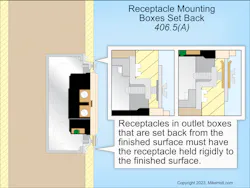
- Set back from the finished surface must be installed so the receptacle yoke is held rigidly to the surface [Sec. 406.5(A)] (Fig. 2).
- Flush with the finished surface must have the receptacle yoke held rigidly to the outlet box [Sec. 406.5(B)].
Receptacles must be flush with (or project from) the faceplates [Sec. 406.5(D)]. Don’t install receptacles in a face-up position in:
- Or on countertop surfaces or work surfaces unless listed for countertop surface or work surface applications [Sec. 406.5(G)(1)].
- The area below a sink [Sec. 406.5(G)(2)].
Don’t install them in enclosures with other switches or receptacles if the voltage between the devices exceeds 300V, unless the devices are separated by barriers identified for the purpose
[Sec. 406.5(J)].
Damp or wet Locations
Receptacles in a damp location must be installed in an enclosure that is “weatherproof” when an attachment plug is not inserted (damp location rated) or the attachment plug is inserted when the cover is closed (wet location rated) [Sec. 406.9(A)].
15A and 20A receptacles installed in a wet location must be within an enclosure that is weatherproof when an attachment plug is inserted using an outlet box hood identified as “extra duty” [Sec. 406.9(B)].
Hinged covers of outlet box hoods must be able to open at least 90° (or fully open if the cover is not designed to open 90° from the closed to open position) after installation.
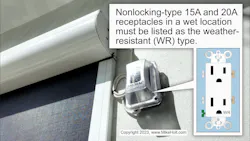
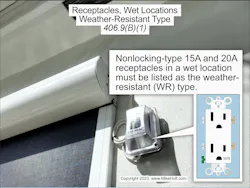
Nonlocking-type 15A and 20A receptacles in a wet location must be listed as weather-resistant (WR) type (Fig. 3).
Receptacles rated 30A or more installed in a wet location must be listed as the weather-resistant (WR) type and comply with Sec. 406.9(B)(2)(a) or (b).
(a) Unattended while in use. It must be in an enclosure that is weatherproof when an attachment plug is inserted.
(b) Attended while in use. It can use an enclosure that is weatherproof when the cover is closed.
Receptacles are not permitted inside a bathtub or shower or within 3 ft horizontally from any outside edge of a bathtub or shower stall. This includes the space measured vertically from the floor to 8 ft vertically above the top of the bathtub rim or shower stall threshold [Sec. 406.9(C)].
Exception No. 1: Receptacles for hydromassage bathtubs installed per Sec. 680.73 can be installed in the prohibited receptacle zone.
Exception No. 2: In dwelling unit bathrooms with less than the required zone, the bathroom sink receptacle, required by Sec. 210.52(D), can be located on the farthest wall opposite the bathtub rim or shower stall threshold.
Exception No. 4: In dwelling unit bathrooms, a single receptacle for an electronic toilet or electronic bidet seat is permitted in the prohibited receptacle zone if the receptacle is not in the space between the toilet and the bathtub
or shower.
Tamper-resistant receptacles
Nonlocking-type 15A and 20A, 125V and 250V receptacles must be tamper resistant, if installed in any of the areas listed in Sec. 406.12(1) through (10):
(1) Dwelling units, boathouses, mobile homes, and manufactured homes, including their attached or detached garages and accessory buildings, and common areas of multifamily dwellings.
(2) Hotel and motel guest rooms and guest suites, and their common areas.
(3) Childcare facilities.
(4) Preschools and education facilities.
(5) Clinics, medical and dental offices, outpatient facilities, and spaces of nursing homes and limited care facilities used exclusively as patient sleeping rooms. Also within the associated business offices accessible to the general public, lobbies and waiting spaces.
(6) Places of awaiting transportation, gymnasiums, skating rinks, fitness centers, and auditoriums.
(7) Dormitory units.
(8) Residential care/assisted living facilities, social and substance abuse rehabilitation facilities, and group homes.
(9) Foster care facilities, nursing homes, and psychiatric hospitals.
(10) Areas and common areas of agricultural buildings accessible to the public.
Exception to (1) through (10): Receptacles in the following locations do not have to be tamper resistant:
(1) Receptacles more than 51/2 ft above the floor.
(2) Receptacles that are part of a luminaire or appliance.
(3) A receptacle within dedicated space for an appliance that in normal use is not easily moved.
(4) Nongrounding receptacles installed as permitted in Sec. 406.4(D)(2)(a).
Avoiding violations
Receptacles exist so that people can plug power cords into them. This fact is the basis for nearly every requirement in Art. 406. If, for example, the box is not firmly attached, the person pushing the plug into the receptacle is going to move the receptacle. If a non-weatherproof receptacle is used in a wet location, the simple act of approaching it to plug something in could result in lethal shock. If you think of the user, the requirements in Art. 406 will be fairly easy to recall and correctly apply.
About the Author
 Mike Holt
Mike Holt
Mike Holt is the owner of Mike Holt Enterprises (www.MikeHolt.com), one of the largest electrical publishers in the United States. He earned a master's degree in the Business Administration Program (MBA) from the University of Miami. He earned his reputation as a National Electrical Code (NEC) expert by working his way up through the electrical trade. Formally a construction editor for two different trade publications, Mike started his career as an apprentice electrician and eventually became a master electrician, an electrical inspector, a contractor, and an educator. Mike has taught more than 1,000 classes on 30 different electrical-related subjects — ranging from alarm installations to exam preparation and voltage drop calculations. He continues to produce seminars, videos, books, and online training for the trade as well as contribute monthly Code content to EC&M magazine.