Key Revisions to Chapter 1 of the 2026 NEC
Key Takeaways
- The definition of Energy Management System now requires both monitoring and controlling loads, clarifying its scope and application.
- A new section introduces Power Control Systems (PCS), including multisource and single-source types, to better manage increasing electrical loads and prevent overloads.
- Cybersecurity is now explicitly addressed with added informational notes, emphasizing the importance of protecting network-connected electrical equipment.
- Arc-flash hazard warning labels must now include the date of the incident energy or PPE category calculations, aligning with NFPA 70E for enhanced safety.
- Space clearance requirements for electrical equipment are clarified, with specific measurement guidelines for equipment doors opened at 90° versus 180°, improving safety and accessibility.
The 2026 edition of the National Electrical Code (NEC) is the result of more than 4,000 public inputs (formerly called “proposals”) and just fewer than 2,000 public comments. Hundreds of changes were made, and over the next several issues, we plan to cover some of the most important ones. In this edition, we focus on a few of the key changes made to Chapter One.
Article 100: Energy management system
The definition of energy management system (EMS) was revised for accuracy.
The previous definition of an EMS contained a very problematic error. It indicated that an EMS monitors, powers, or both. But a system that only monitors power consumption is not managing anything. It could be argued that an electric utility meter was an EMS, although clearly that was not the intent. Likewise, a system that only controls power isn’t an EMS. A photocell does not monitor, but it does control, so does that mean it is an EMS? Again, that was clearly not the intention.
New to the 2026 NEC, an EMS must do both. It must monitor loads and control loads. However, it does not necessarily have to monitor and control the same loads. For example, it could monitor lighting loads in a building and control the electric vehicle supply equipment (EVSE).
Article 100: Power control system (PCS)
A new definition of power control system (PCS) was added, with two different varieties.
With the somewhat recent push for further electrification across the United States, PCSs will be increasingly common. Adding a couple hundred amperes of available power for vehicle charging, for example, is often unrealistic and can only be achieved with clever management of the existing electrical system. Fortunately, we have the technology to address these concerns — and that technology is the PCS.
Just like an EMS, the PCS monitors and controls power. But unlike an EMS, the PCS can also prevent overloads. The PCS is further broken down into two types: multisource and single source. As both the name and the definitions indicate, a multisource PCS controls multiple power sources, such as those found in a microgrid. A single-source PCS would be more appropriate if only one power supply exists, such as an electric utility service.
Section 110.3: Examination, identification, installation, use, and listing (product certification) of equipment
An Informational Note regarding cybersecurity was added, and the issue of NEC requirements versus product instructions is now addressed.
Cybersecurity has been a hotly debated topic over the last few years in the NEC revision process. Everyone seems to agree that cybersecurity is critically important for electrical equipment that is connected to a network, but what role the NEC should play is not universally agreed upon.
There are standards from UL, IEC, and NEMA that are all included in this Section in the form of Informational Notes, and NFPA has even created a Cybersecurity Advisory Committee, which, according to NFPA, is for “reviewing and standardizing cybersecurity best practices across the landscape of NFPA standards; … advising on current cybersecurity threats, technologies, and emerging technology in NFPA standards; and reviewing and recommending, as appropriate, proposed NFPA standards addressing cybersecurity requirements.”
The issue of cybersecurity is unlikely to go away anytime soon, and it will be interesting to see if the NEC eventually incorporates specific requirements in this area or if a new NFPA standard is created to offer more guidance or specific requirements.
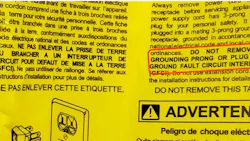
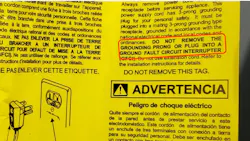
For as long as the NEC has required instructions to be followed, there has been discussion of which takes precedence: the product instructions or the NEC itself. The answer to that has always been neither. Both the NEC and the instructions must be followed, and that has always been the case. Now it is quite clear in Sec. 110.3(B) that both must be followed (Photo 1).
Section 110.16: Arc-flash hazard warning
The arc flash marking requirements were revised to correlate with NFPA 70E, Standard for Electrical Safety in the Workplace.
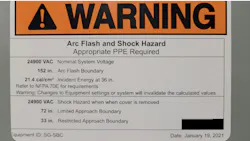
Since its inception in the 2002 NEC, Sec. 110.16 has been revised every three years like clockwork. Without a doubt, the most significant of those changes is this one. Without saying it directly, it is clear that the NEC requires the installer to apply the label based on NFPA 70E requirements. As in NFPA 70E, the label must include the voltage, the arc flash boundary, and guidance on the required personal protective equipment (PPE) based on the estimated incident energy level or the PPE Category.
Unlike NFPA 70E, the date that the values on the label were determined must also be included. These values will help qualified persons understand the required ratings or levels of their PPE if energized work is performed, such as troubleshooting or measuring voltage (Photo 2). These values are typically derived using specialized software. Those without access to that software will likely need to hire an engineering firm or similar provider, or become familiar with the “table method” in NFPA 70E.
Section 110.26: Spaces about electrical equipment
The access/egress obstruction requirements were clarified, exposed versus enclosed live parts are better addressed, and DC voltages were added.
Since its addition to the 2020 NEC, the language regarding access and egress obstruction has been controversial. Changes in the 2023 Code clarified that obstruction is a reduction of width and height to less than 24 in. wide and 6 ft 6 in. high, which was a welcome clarification. But is this to be measured with equipment doors opened to 90° or opened to greater than 90°?
If two pieces of equipment facing each other have doors that can open 180°, it would be hard to imagine an obstruction of access and egress. But the clarification in the opening text of Sec. 110.26 indicates that you must measure for this obstruction for equipment that can be opened 90°, which seems to require you to measure with the doors at 90° — even if they can open to 180°.
This means the required width is not reduced for equipment with doors that can open 180°. According to proponents of this clarification, this was put in place to address the worst-case scenario of a worker propping the doors open 90°, even if the doors could possibly open 180°. A good example of that scenario is an electrician working on switchgear with door-mounted equipment.
The language regarding low voltages that was formerly found in Sec. 110.26(A)(1)(b) was relocated to a more appropriate location, namely Sec. 110.26(A). This allows the AHJ to use special permission to allow smaller working spaces. Where this text was formerly located was problematic because it insinuated that special permission could only be used to reduce the required depth, but not the width, height, or anything else in Sec. 110.26. The truth is, the AHJ can use special permission whenever they feel that equivalent safety has been provided (see Sec. 90.4), so the relocation of the text makes good sense.
Section 110.26(A)(1) was revised to more clearly address the requirements for enclosed live parts. Although the text in Sec. 110.26(A)(1) told the reader that measurements are taken to the enclosure when live parts are exposed, the conditions beneath the table only referred to exposed live parts. Adding language about enclosed live parts is a welcome addition.
Lastly, DC voltages were added in multiple locations throughout Sec. 110.26. These changes should be viewed as editorial, as the text ultimately required this before.
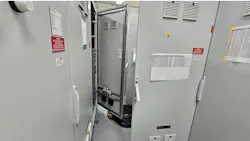
Similar changes were also made in Part III of Art. 110 for higher voltages (Photo 3).
Section 120.7: Power control systems
Using a PCS for load calculations is now a general provision (Part I), and the allowances were clarified.
Section 220.70 was added to the 2023 NEC to recognize EMSs. However, that Section provided very little in the way of technical requirements. For the 2026 edition, the Section was moved to Part I, which is where it likely should have been placed all along.
The term EMS is no longer used in the Section because it was replaced by PCS. An EMS simply monitors and controls loads, which could be as simple as turning them on and off. A PCS, however, monitors and controls loads to prevent overloading of conductors and equipment. If a simple EMS is used to turn things on and off and prevent simultaneous operation of loads, Sec. 120.6 applies. If a PCS is used, which controls loads to prevent overloading, this section applies.
Section 120.41: Dwelling units
The lighting and general-purpose load calculations for dwelling units were reduced by 33%.
This Section provides the load calculations for general-purpose receptacles and lighting in dwellings. When was the last time you bought a 60W incandescent lamp? When was the last time you even saw one? Recent data has proven what everyone already knew — the load calculations for dwellings needed updating.
Although the NEC needed updating, it cannot be changed until data has been collected to support the change. Now that it has been, the Code has changed. This is exactly how the process is supposed to work, and this change should be welcomed by all. A similar change was made to the optional calculation method in Sec. 120.82.
About the Author
 Ryan Jackson
Ryan Jackson
Ryan Jackson is a National Electrical Code instructor and textbook author in the Salt Lake City, Utah area. He is also a technical consultant for the Steel Tube Institute. He is a member of Code-Making Panels 3 and 17 for the National Electrical Code and serves on several technical committees for UL Standards and Engagement. He is certified as an inspector in electrical, building, mechanical, and plumbing codes, and has taught the NEC and NFPA 70E at the national level over the last three decades.