Courtesy of www.MikeHolt.com.
All questions and answers are based on the 2023 NEC.
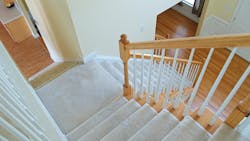
Q1: Where lighting outlets are installed for an interior stairway with _____ risers between floor levels, there shall be a listed wall-mounted control device at each floor level and at each landing level that includes a stairway entry to control the lighting outlets.
a) three or more
b) four or more
c) six or more
d) any number of
Q2: The installation and use of all boxes and conduit bodies used as outlet, device, junction, or pull boxes, depending on their use, and handhole enclosures, are covered within _____.
a) Art. 110
b) Art. 200
c) Art. 300
d) Art. 314
Q3: Motor branch-circuit short-circuit and ground-fault protection and motor overload protection _____ be combined in a single protective device where the rating of the device provides the required overload protection.
a) shall be permitted to
b) shall not be permitted to
c) shall
d) shall not
Q4: Ground-fault protection of equipment shall be provided for solidly grounded wye electrical services of more than 150V to ground but not exceeding 1,000V phase-to-phase for each service disconnecting means rated _____ or more.
a) 1,000A
b) 1,500A
c) 2,000A
d) 2,500A
Q5: PV system DC circuit conductors that rely on other than color coding for polarity identification shall be identified by an approved permanent marking means such as _____.
a) labeling
b) sleeving
c) shrink-tubing
d) any of these
Q6: PV system DC circuit conductor marking means for nonsolidly grounded positive conductors shall include imprinted plus signs (+) or the word POSITIVE or POS durably marked on insulation of a color other than _____.
a) green
b) white
c) gray
d) all of these
Answers:
Q1: c) six or more
Section 210.70(A)(2)(3) requires, "Where lighting outlets are installed for an interior stairway with six or more risers between floor levels, there shall be a wall switch or listed wall-mounted control device at each floor level and at each landing level that includes a stairway entry to control the lighting outlets."
Q2: d) Article 314
Per Sec. 314.1: "This article covers the installation and use of all boxes and conduit bodies used as outlet, device, junction, or pull boxes, depending on their use, and handhole enclosures."
Q3: a) shall be permitted to
As stated in Sec. 430.55, "Motor branch-circuit short-circuit and ground-fault protection and motor overload protection shall be permitted to be combined in a single protective device where the rating of the device provides the overload protection specified in Sec. 430.32."
Q4: a) 1,000A
Per Sec. 230.95(A): "GFPE shall be provided for solidly grounded wye electrical services of more than 150V to ground but not exceeding 1,000V phase-to-phase for each service disconnect rated 1,000A or more."
Q5: d) any of these
Section 690.31(B)(2)(a) states, "Conductors that rely on other than color coding for polarity identification shall be identified by an approved permanent marking means such as labeling, sleeving, or shrink-tubing that is suitable for the conductor size."
Q6: d) all of these
According to Sec. 690.31(B)(2)(b), "The permanent marking means for nonsolidly grounded positive conductors shall include imprinted plus signs (+) or the word POSITIVE or POS durably marked on insulation of a color other than green, white, or gray."
These materials are provided by Mike Holt Enterprises in Leesburg, Fla. To view Code training materials offered by this company, visit www.mikeholt.com/code.
About the Author
 Mike Holt
Mike Holt
Mike Holt is the owner of Mike Holt Enterprises (www.MikeHolt.com), one of the largest electrical publishers in the United States. He earned a master's degree in the Business Administration Program (MBA) from the University of Miami. He earned his reputation as a National Electrical Code (NEC) expert by working his way up through the electrical trade. Formally a construction editor for two different trade publications, Mike started his career as an apprentice electrician and eventually became a master electrician, an electrical inspector, a contractor, and an educator. Mike has taught more than 1,000 classes on 30 different electrical-related subjects — ranging from alarm installations to exam preparation and voltage drop calculations. He continues to produce seminars, videos, books, and online training for the trade as well as contribute monthly Code content to EC&M magazine.