Courtesy of www.MikeHolt.com.
All questions and answers are based on the 2023 NEC.
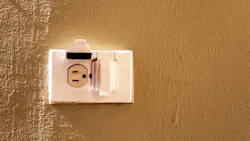
Q1: Receptacles of _____, 125V and 250V installed in a wet location shall have an enclosure that is weatherproof whether or not the attachment plug cap is inserted.
a) 15A and 20A
b) 30A and less
c) up to 50A
d) up to 100A
Q2: Where raceways contain 4 AWG or larger insulated circuit conductors and these conductors enter a cabinet, a box, an enclosure, or a raceway the conductors shall be protected from abrasion during and after installation by an identified fitting providing a smoothly rounded _____ surface.
a) fiberglass
b) plastic
c) insulating
d) gray
Q3: Rigid metal conduit (RMC) and fittings are permitted to be installed in concrete, in direct contact with the earth, in direct burial applications, or in areas subject to severe corrosive influences when protected by _____ approved for the condition.
a) ceramic
b) corrosion protection
c) backfill
d) a natural barrier
Q4: Where two or more explosionproof enclosures that require conduit seals are connected by nipples or runs of conduit not more than _____ long, a single conduit seal in each such nipple connection or run of conduit shall be considered sufficient if the seal is located not more than 18 in. from either enclosure.
a) 12 in.
b) 18 in.
c) 24 in.
d) 36 in.
Q5: Where non-metallic (NM) sheathed cables pass through cut or drilled slots or holes in metal members, the cable shall be protected by _____ which are installed in the opening before the installation of the cable and which securely cover all metal edges.
a) anti-short devices
b) sleeves
c) plates
d) listed bushings or grommets
Q6: For large equipment that contains overcurrent devices, switching devices, or control devices, there shall be one entrance to and egress from the required working space not less than 24 in. wide and _____ high at each end of the working space.
a) 5½ ft
b) 6 ft
c) 6½ ft
d) 7 ft
Answers:
Q1: a) 15A and 20A
Section 406.9(B)(1) confirms, "Receptacles of 15A and 20A, 125V and 250V installed in a wet location shall have an enclosure that is weatherproof whether or not the attachment plug cap is inserted."
Q2: c) insulating
Section 300.4(G)(1) requires, "An identified fitting providing a smoothly rounded insulating surface."
Q3: b) corrosion protection
Per Sec. 344.10(B)(1): RMC and fittings are "permitted to be installed in concrete, in direct contact with the earth, in direct burial applications, or in areas subject to severe corrosive influences where protected by corrosion protection approved for the condition."
Q4: d) 36 in.
Section 501.15(A)(3) states, "Where two or more explosionproof enclosures that require conduit seals are connected by nipples or runs of conduit not more than 36 in. long, a single conduit seal in each such nipple connection or run of conduit shall be considered sufficient if the seal is located not more than 18 in. from either enclosure."
Q5: d) listed bushings or grommets
Per Sec. 300.4(B)(1): Where NM cables pass through cut or drilled slots or holes in metal members, "the cable shall be protected by listed bushings or listed grommets covering all metal edges that are securely fastened in the opening prior to installation of the cable."
Q6: c) 6½ ft
According to Sec. 110.26(C)(2), "For large equipment that contains overcurrent devices, switching devices, or control devices, there shall be one entrance to and egress from the required working space not less than 24 in. wide and 6½ ft high at each end of the working space."
These materials are provided by Mike Holt Enterprises in Leesburg, Fla. To view Code training materials offered by this company, visit www.mikeholt.com/code.
About the Author
 Mike Holt
Mike Holt
Mike Holt is the owner of Mike Holt Enterprises (www.MikeHolt.com), one of the largest electrical publishers in the United States. He earned a master's degree in the Business Administration Program (MBA) from the University of Miami. He earned his reputation as a National Electrical Code (NEC) expert by working his way up through the electrical trade. Formally a construction editor for two different trade publications, Mike started his career as an apprentice electrician and eventually became a master electrician, an electrical inspector, a contractor, and an educator. Mike has taught more than 1,000 classes on 30 different electrical-related subjects — ranging from alarm installations to exam preparation and voltage drop calculations. He continues to produce seminars, videos, books, and online training for the trade as well as contribute monthly Code content to EC&M magazine.