Illustrated Catastrophes: Which Way is Up?
Which Way is Up?
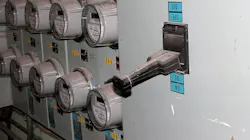
At first glance, I thought this circuit breaker was turned off. Upon closer examination, I realized it was in the ON position, despite the handle pointing in the down position. There are even two sets of ON/OFF labels facing in opposite ways that add to the confusion.
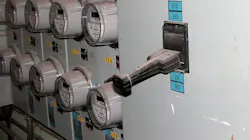
For circuit breaker handles that operate in the vertical position instead of operating rotationally or horizontally, Sec. 240.81 requires the “up” position of the handle to be the ON position. This breaker is off when the handle is up and on when the handle is down.
It appears this circuit breaker enclosure may have been designed to be installed upside down as well as right-side up. Installing a circuit breaker in this position may have been permitted at one point, but it has not been allowed for a very long time. It can lead to a terrible mistake if the user is not paying very close attention to the ON/OFF markings on the enclosure. Can you imagine what could happen in an emergency if this switch was accidentally thrown into the ON position when the operator thought he was shutting it off?
How Low Can You Go?
I’m not 100% sure where the service point is for the service conductors installed overhead from the pole on the right-hand side of this building. It could be at the pole, line terminals of the meter, or at the splices on the wires entering the weatherhead. For this discussion, I’m going to say the service point is at the pole. That being the case, the lowest point of the drip loop is way too low and is not NEC compliant.

Section 230.24(B)(1) requires a minimum clearance of 10 ft from the lowest point of the drip loop to this sidewalk, which is accessible to pedestrians. These drip loop conductors are only 7½ to 8 ft above the sidewalk. I’m average height and can almost touch them while standing underneath and reaching up. A person just a little taller than I am could easily reach them.
Regarding another concern, there also appears to be some communications cables “hitching a ride” along the service raceway. This is a violation of Sec. 300.11(C) and Sec. 805.133(B). To be Code compliant, these cables must be independently secured and supported.
About the Author
 Russ LeBlanc
Russ LeBlanc
Owner
Russ started in the electrical trade as an apprentice in 1985. He worked his way up to become a Journeyman Electrician and then eventually became a Master Electrician and Licensed Construction Supervisor. In 1999 Russ become an Electrical Instructor for The Peterson School of Engineering in Massachusetts where he developed his passion for teaching, and quickly became Department Head of Electrical Instruction. Russ has taught thousands of apprentices, electricians, engineers, inspectors, and other electrical professionals during his career as an instructor. He continues to provide electrical professionals with Electrical Code seminars, Arc-Flash Awareness training seminars and educational material through his LeBlanc Consulting Services in North Reading, MA whose specialty is educating electricians. He has been an active member of the NFPA Electrical Section and has authored hundreds of National Electrical Code proposals and comments which have become Code rules to improve the safety for the electrical industry. Russ is also an IAEI certified Electrical Inspector.
Please visit www.russleblanc.net for more information.