Illustrated Catastrophes: Papa Smurf Would Not Be Happy
Papa Smurf Would Not Be Happy
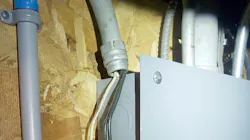
Thanks to Tim Rechek for sharing this photo. “I came across this panel at a house in North Fond du Lac, Wis.,” he says.“I was here to wire a new air conditioner. From the looks of what I saw, the panel was upgraded and rather than piping back into the panel, they just left the wires in free air — not to mention the PVC coupled with Smurf couplings. Clearly, this was a homeowner special. It amazes me what you come across on some service calls.”
Using ENT couplings (aka “Smurf” couplings because of their bright blue coloring) with PVC conduit is not permitted. While Sec. 352.48 requires joints between lengths of PVC conduit and between PVC conduit and couplings, fittings, and boxes be made by an “approved” method, Sec. 300.15 requires fittings and connectors to be used “only with the specific wiring methods for which they are designed and listed.” ENT couplings are not designed and listed for use with PVC conduit.
Another big problem is the conductors in “free air.” Section 310.10 requires individual conductors to be installed in a Chapter 3 wiring method. Section 300.10 requires the EMT raceway to be connected to the cabinet to provide effective electrical continuity. I could cite more violations, but I am limited for space on this page.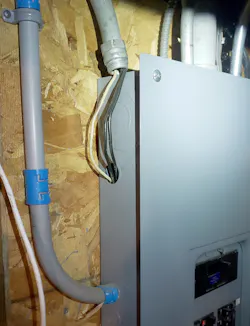
Airing Your Dirty Laundry
“This was taken from the second floor back deck of an apartment,” says Stephen M. Daniels, president of Stephen M. Daniels Electrical Contractors in Lancaster, Pa. “The clothesline was tied to the triplex feeding the main electrical service.”
Stephen, thanks for sharing this photo. Although we cannot be 100% sure if these wires are covered by the scope the Code, it certainly makes for a great conversation if they are. Section 230.9(A) requires service conductors installed as open conductors or multiconductor cable without an overall outer jacket to maintain a clearance of at least 3 ft from windows that are designed to be opened, doors, porches, balconies, ladders, stairs, fire escapes, or similar locations.
Section 230.24(A) requires overhead service conductors to have a vertical clearance of not less than 8 ft above the surface of roofs. This vertical clearance above the roof is required to be maintained for no less than 3 ft in all directions from the edge of the roof. Lastly, Sec. 300.11(D) prohibits cable wiring methods from being used as a means of support for other cables, raceways, or nonelectrical equipment.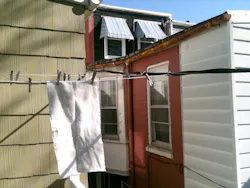
About the Author
 Russ LeBlanc
Russ LeBlanc
Owner
Russ started in the electrical trade as an apprentice in 1985. He worked his way up to become a Journeyman Electrician and then eventually became a Master Electrician and Licensed Construction Supervisor. In 1999 Russ become an Electrical Instructor for The Peterson School of Engineering in Massachusetts where he developed his passion for teaching, and quickly became Department Head of Electrical Instruction. Russ has taught thousands of apprentices, electricians, engineers, inspectors, and other electrical professionals during his career as an instructor. He continues to provide electrical professionals with Electrical Code seminars, Arc-Flash Awareness training seminars and educational material through his LeBlanc Consulting Services in North Reading, MA whose specialty is educating electricians. He has been an active member of the NFPA Electrical Section and has authored hundreds of National Electrical Code proposals and comments which have become Code rules to improve the safety for the electrical industry. Russ is also an IAEI certified Electrical Inspector.
Please visit www.russleblanc.net for more information.