Illustrated Catastrophes: Sketchy Chandelier Wiring
All references are based on the 2023 edition of the NEC.
Sketchy Chandelier Wiring
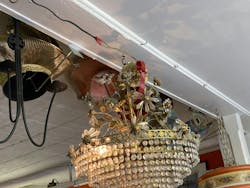
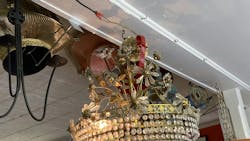
I discovered this fancy chandelier for sale in a local shop. I also noticed some questionable wiring for this luminaire. The lamp cord feeding it has been spliced with two red crimp connectors and extended over to a receptacle where it is plugged in. Splicing and extending the lamp cord is a violation of Sec. 400.13. Are the metal parts of this luminaire connected to an equipment grounding conductor (EGC) in accordance with Part V of Art. 410? I don’t think so. The lamp cord only has two conductors. There is no EGC to trip the circuit breaker in the event of a ground fault in the luminaire wiring.
Perhaps the shop owner did this handy work or hired an unqualified person to power up this luminaire for display purposes. I’m not sure of that, but I am sure that this luminaire is presently not grounded and bonded. I am also wondering if this chandelier is listed as required by Sec. 410.6 (Sec. 410.2 in the 2026 edition). Over the years, I have had several customers purchase unlisted or custom-made luminaires at flea markets, yard sales, and garage sales, only to have me inform them that I would not install them because they were not listed.
A Terrible Use of Tubing
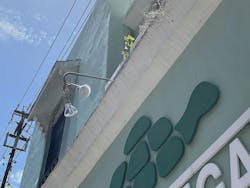
Like the Sword of Damocles, these floodlights dangled precariously above my head as I entered this store. The only thing keeping that box from falling on my head was a single electrical metallic tubing (EMT) set-screw connector. I hope the installer tightened that screw really tightly!
Quite simply, EMT cannot be used in this manner. Section 300.11(C) (Sec. 300.13(C) in the 2026 edition) places restrictions on using raceways as a means of support. None of the language there allows EMT to support a box. More specifically, Sec. 358.12(2) prohibits using EMT for the support of luminaires or other equipment other than conduit bodies no larger than the trade size of the EMT. Sections 314.23(A) through 314.23(H) provide many Code-compliant methods of supporting boxes, but none of them include using tubing to support boxes. A few methods allow conduit to support boxes, but EMT is not a conduit. Lastly, using set-screw EMT connectors in this outdoor wet location is a violation of Secs. 358.42 and 314.15, which require fittings installed in wet locations to be listed for use in wet locations. These set-screw connectors and couplings are not listed for wet locations.
About the Author
 Russ LeBlanc
Russ LeBlanc
Owner
Russ started in the electrical trade as an apprentice in 1985. He worked his way up to become a Journeyman Electrician and then eventually became a Master Electrician and Licensed Construction Supervisor. In 1999 Russ become an Electrical Instructor for The Peterson School of Engineering in Massachusetts where he developed his passion for teaching, and quickly became Department Head of Electrical Instruction. Russ has taught thousands of apprentices, electricians, engineers, inspectors, and other electrical professionals during his career as an instructor. He continues to provide electrical professionals with Electrical Code seminars, Arc-Flash Awareness training seminars and educational material through his LeBlanc Consulting Services in North Reading, MA whose specialty is educating electricians. He has been an active member of the NFPA Electrical Section and has authored hundreds of National Electrical Code proposals and comments which have become Code rules to improve the safety for the electrical industry. Russ is also an IAEI certified Electrical Inspector.
Please visit www.russleblanc.net for more information.