Illustrated Catastrophes: Sharp Turn Ahead!

All references are based on the 2026 edition of the NEC.
Sharp Turn Ahead!
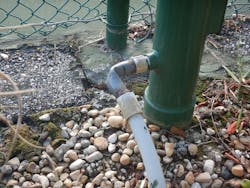
I’m guessing this installer did not have an LB, a box, a 90-degree rigid PVC conduit fitting, or a rigid PVC conduit bender. So, instead of using the correct fittings or bending methods to make this turn, he simply glued a piece of liquidtight flexible nonmetallic conduit (LFNC) into the rigid PVC conduit coupling and connector.
The second paragraph of Sec. 300.17 (Sec. 300.15 in 2023 edition) requires fittings and connectors to be “used only with wiring methods for which they are designed and listed.” Similarly, Sec. 356.42 requires only fittings listed for use with LFNC to be used with LFNC. Rigid PVC conduit connectors and couplings are not listed for use with LFNC. Using fittings with wiring methods for which they are not listed is also a violation of Sec. 110.3(B). The ultra-sharp bend in the LFNC certainly does not comply with the bending requirements in Sec. 356.24. A sharp bend like that will make it virtually impossible to pull conductors through that raceway! Lastly, I would say that this insulation was not done in a professional and skillful manner and does not comply with Sec. 110.12.
A Forgotten or Overlooked Rule
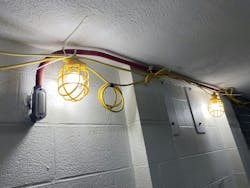
While this string of temporary lights may be installed for temporary lighting purposes — and the installers may be following some of the requirements in Art. 590 for temporary wiring — they may have forgotten or overlooked one of the most important rules in Art. 590. Section 590.4(A) [Sec. 590.2(A) in 2023 edition] requires all of the applicable requirements for permanent wiring to apply to temporary wiring installations unless modified by Art. 590. Section 590.6(I) [Sec. 590.4(J) in 2023 edition)]contains requirements for supporting cable assemblies and flexible cords and flexible cables differently than might otherwise be required in Chapters 3 and 4 for the respective wiring methods or equipment, but I don’t find any language in Art. 590 that modifies the requirements in Sec. 358.12(2), which prohibits EMT from being used to support luminaires or other equipment. Nor do I find any language in Art. 590 that modifies the requirements in Sec. 300.13(C) [Sec. 300.11(C) in 2023 edition] restricting the use of raceways for supporting cables or other equipment. None of the language in Sec. 300.13(C) or Sec. 358.12(2) allows this lighting string to be supported by EMT.
About the Author
 Russ LeBlanc
Russ LeBlanc
Owner
Russ started in the electrical trade as an apprentice in 1985. He worked his way up to become a Journeyman Electrician and then eventually became a Master Electrician and Licensed Construction Supervisor. In 1999 Russ become an Electrical Instructor for The Peterson School of Engineering in Massachusetts where he developed his passion for teaching, and quickly became Department Head of Electrical Instruction. Russ has taught thousands of apprentices, electricians, engineers, inspectors, and other electrical professionals during his career as an instructor. He continues to provide electrical professionals with Electrical Code seminars, Arc-Flash Awareness training seminars and educational material through his LeBlanc Consulting Services in North Reading, MA whose specialty is educating electricians. He has been an active member of the NFPA Electrical Section and has authored hundreds of National Electrical Code proposals and comments which have become Code rules to improve the safety for the electrical industry. Russ is also an IAEI certified Electrical Inspector.
Please visit www.russleblanc.net for more information.