Illustrated Catastrophes: Deep Knee Bends?
All references are based on the 2026 edition of the NEC.
Deep Knee Bends?
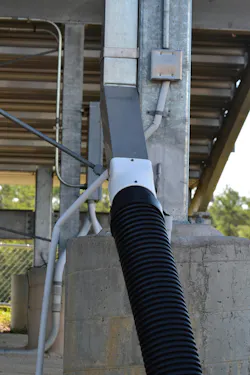
Apparently, the person who installed the rigid PVC conduit into the bottom of the weatherproof box didn’t have access to bending equipment or any factory-made bends. Instead, it looks as though he or she bent the conduit over their knee. The result was a conduit that is kinked in a few spots.
Making bends as horrible as what’s shown here is a violation of Sec. 352.24(A). Bends are supposed to be made so that the conduit is not damaged and so there will effectively be no reduction of the internal diameter of the conduit. Bends made in the field must be made with bending equipment identified for the purpose.
After a closer look, you may also spot another problem. The rigid PVC conduit is not connected to the box. There is no connector on the conduit. It is just shoved up tight against the threaded opening in the box. I would consider this a violation of Sec. 300.14 [Sec. 300.12 in 2023] because the raceway is not continuous or mechanically secured to the box. One last problem to point out is the lack of an expansion fitting on the PVC conduit emerging from grade. I would consider this a violation of Sec. 300.7(J) [Sec. 300.5(J) in 2023].
Lousy Landscape Wiring
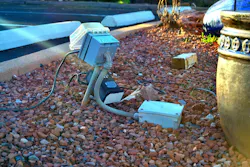
I spotted this mess in the landscaped area at the edge of a parking lot. The transformer for the landscape lighting is broken and lying on the ground, and I’m guessing it was originally secured to the 4 in. × 4 in. wooden post, which was also broken and lying on the ground. Did a vehicle bump into this equipment, causing the damage? If so, Sec. 110.27(B) requires enclosures or guards to be installed to prevent this type of damage to the electrical equipment.
Another problem here is that the box with the extra-duty receptacle cover is not properly supported. Using only one rigid metal conduit (RMC) to support this box does not comply with Sec. 314.23(F). Two conduits threaded into the box must be used for supporting boxes in installations such as this. Liquidtight flexible nonmetallic conduit (LFNC) should never be used to support boxes. While Sec. 356.12 may not specifically state that using LFNC to support boxes is prohibited, Sec. 314.23 requires boxes like the one installed for the receptacles here to be supported in accordance with the provisions specified in Sec. 314.23(A) through (H), and none of those provisions include using LFNC to support boxes.
About the Author
 Russ LeBlanc
Russ LeBlanc
Owner
Russ started in the electrical trade as an apprentice in 1985. He worked his way up to become a Journeyman Electrician and then eventually became a Master Electrician and Licensed Construction Supervisor. In 1999 Russ become an Electrical Instructor for The Peterson School of Engineering in Massachusetts where he developed his passion for teaching, and quickly became Department Head of Electrical Instruction. Russ has taught thousands of apprentices, electricians, engineers, inspectors, and other electrical professionals during his career as an instructor. He continues to provide electrical professionals with Electrical Code seminars, Arc-Flash Awareness training seminars and educational material through his LeBlanc Consulting Services in North Reading, MA whose specialty is educating electricians. He has been an active member of the NFPA Electrical Section and has authored hundreds of National Electrical Code proposals and comments which have become Code rules to improve the safety for the electrical industry. Russ is also an IAEI certified Electrical Inspector.
Please visit www.russleblanc.net for more information.