Illustrated Catastrophes: A Cluster of Catastrophes
All references are based on the 2026 edition of the NEC.
A Cluster of Catastrophes
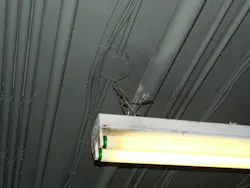
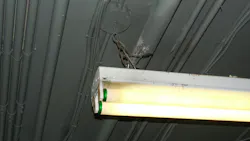
There are several violations in this photo. I want to focus on the luminaire wiring first. Upon closer examination, I discovered there is no equipment grounding conductor (EGC) connected to the luminaire. There is only a black wire and a white wire running from the 4-in. octagonal box through the supporting chain to the luminaire — but no EGC. This lack of an EGC violates the requirements of Sec. 410.42 and Sec. 410.44. The black wire is spliced in the air, and the wire connector is floating in the breeze. The choice of wiring methods from the box to the luminaire is questionable, too, since it consists of two exposed, insulated wires that are not part of a flexible cord or cable.
Another problem in this photo is the two EMT raceways being used to support cables. One EMT is connected to the 4-in. octagonal box and has a bundle of cables secured to it. The other EMT (the right side of the photo) has two MC cables secured to it. Using EMT raceways to support random cables does not comply with the provisions spelled out in Sec. 300.13(C), which allows raceways to support cables in certain situations. This is not one of those situations.
A Sorry Sign Situation

The liquidtight flexible metal conduit (LFMC) connected to the box on the sign is not properly supported. Section 350.30(A) requires LFMC to be securely fastened within 12 in. of each box, conduit body, or other conduit termination. Installing a clip or two to support the LFMC would help solve that problem. Another problem is the location of the disconnect for the sign. Where is it?
Section 600.6(A)(1) requires a disconnecting means to be located at the point where the branch circuit or feeder supplying the sign enters the sign enclosure.
To satisfy the requirements in Sec. 600.6(A)(1), a switch could be installed in the box attached to the side of the sign where the LFMC is connected. If the disconnecting means is installed remotely from the sign location, then a label must be installed at the sign location indicating where the disconnecting means for the sign is located. Installers, service technicians, and first responders may have a difficult time locating the disconnect for this sign. That is certainly an inconvenience for service personnel, but any delay in shutting off the power to this sign could prove costly or even deadly — especially during emergencies such as a fire.
About the Author
 Russ LeBlanc
Russ LeBlanc
Owner
Russ started in the electrical trade as an apprentice in 1985. He worked his way up to become a Journeyman Electrician and then eventually became a Master Electrician and Licensed Construction Supervisor. In 1999 Russ become an Electrical Instructor for The Peterson School of Engineering in Massachusetts where he developed his passion for teaching, and quickly became Department Head of Electrical Instruction. Russ has taught thousands of apprentices, electricians, engineers, inspectors, and other electrical professionals during his career as an instructor. He continues to provide electrical professionals with Electrical Code seminars, Arc-Flash Awareness training seminars and educational material through his LeBlanc Consulting Services in North Reading, MA whose specialty is educating electricians. He has been an active member of the NFPA Electrical Section and has authored hundreds of National Electrical Code proposals and comments which have become Code rules to improve the safety for the electrical industry. Russ is also an IAEI certified Electrical Inspector.
Please visit www.russleblanc.net for more information.