Illustrated Catastrophes: A Double Whammy
All references are based on the 2026 edition of the NEC.
A Double Whammy
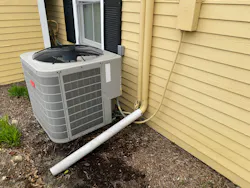
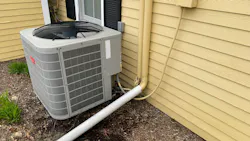
There are a couple of problems in this photo that I want to point out. In the foreground, you can see some liquidtight flexible metal conduit (LFMC) connecting the wall-mounted disconnect and the air conditioning unit. There are exactly zero supporting clips on this LFMC. This is a violation of Sec. 350.30(A), which requires LFMC to be securely fastened in place within 12 in. of each conduit termination. For sizes ½-in. through 1¼-in., Exception No. 2 allows lengths of up to 3 ft from connector to connector, with the connectors being the means of securement and support. But the length of LFMC in the photo exceeds 3 ft and is closer to 5 ft long.
In the background of the photo, in between the two buildings, there is an extension ring installed over a recessed box. This is not a weatherproof type of extension ring and is not listed for use in wet locations as required by Sec. 314.15(B). There is also no cover on this extension ring/box assembly as required by Sec. 314.25. In fact, the circuit wires are exposed and hanging outside of this box.
A Saggy Seaside Installation
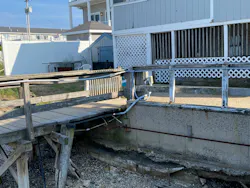
I spotted this wiring at a marina dock in New England. There are several runs of rigid PVC conduit here, none of which has expansion fittings as required by Sec. 352.44. There are also far too few supporting clips. For rigid PVC conduit in sizes ½ in. through 1 in., Sec. 352.30(B) requires the conduit to be supported at intervals no greater than 3 ft. The combination of missing clips and missing expansion fittings has caused the conduit installed just below the railing on the left side to sag quite a bit. The conduit on the right-side railing has completely separated from the conduit body “T” fitting installed in the corner where the two railings meet.
In New England, outdoor PVC conduit installations can regularly experience temperatures of at least 100°F, causing the conduit runs to experience significant length changes due to thermal expansion and contraction. According to Table 352.44, a 100-ft run of PVC conduit will experience a length change of approximately 4 in. when exposed to a 100°F temperature change. Expansion fittings must be used where the conduit will experience a length change of ¼ in. or greater.
About the Author
 Russ LeBlanc
Russ LeBlanc
Owner
Russ started in the electrical trade as an apprentice in 1985. He worked his way up to become a Journeyman Electrician and then eventually became a Master Electrician and Licensed Construction Supervisor. In 1999 Russ become an Electrical Instructor for The Peterson School of Engineering in Massachusetts where he developed his passion for teaching, and quickly became Department Head of Electrical Instruction. Russ has taught thousands of apprentices, electricians, engineers, inspectors, and other electrical professionals during his career as an instructor. He continues to provide electrical professionals with Electrical Code seminars, Arc-Flash Awareness training seminars and educational material through his LeBlanc Consulting Services in North Reading, MA whose specialty is educating electricians. He has been an active member of the NFPA Electrical Section and has authored hundreds of National Electrical Code proposals and comments which have become Code rules to improve the safety for the electrical industry. Russ is also an IAEI certified Electrical Inspector.
Please visit www.russleblanc.net for more information.