Illustrated Catastrophes: Space Wars Episode 22
All references are based on the 2026 edition of the NEC.
Space Wars Episode 22
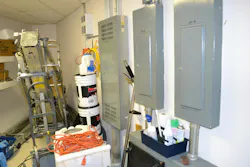
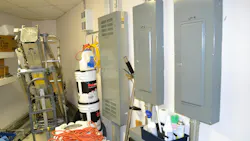
In the ongoing saga of the space battle, this photo shows us what not to do near electrical panels. Do not store things in front of the panels. Section 110.26(A) establishes that working space dimensions be kept clear for equipment that is likely to be examined, adjusted, serviced, or maintained when the equipment is energized. Section 110.26(A(1) requires a minimum working space depth of 3 ft in front of these panelboard enclosures. Section 110.26(A)(2) requires a minimum width of 30 in. or the width of the equipment, whichever is greater. Section 110.26(A)(3) requires a minimum height of 6.5 ft of clear working space in front of the panelboard enclosures. This clear working space is needed to make it safer for electricians to work on the energized electrical equipment. Section 110.26(B) clearly states that the working space shall not be used for storage, yet this is one of the most common violations that I encounter. Lastly, Section 240.24(A) requires circuit breakers and fused switches to be readily accessible, but moving these stored items out of the way to access the circuit breakers in these panels means the circuit breakers are not readily accessible as required by that Section.
A Not-So-Liquidtight Installation
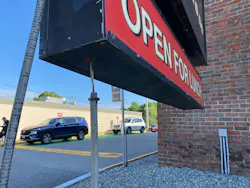
I am going to assume that the liquidtight flexible nonmetallic conduit (LFNC) dangling beneath the sign enclosure was originally installed with the LFNC connector securely fastened to the sign enclosure as required by Sec. 300.14. But you might know what happens when you assume. I am not sure how or why the locknut is no longer holding the LFNC connector securely in place, but I do know that the result is a violation of Code rules.
In addition to not complying with Sec. 300.14, this installation presently does not comply with Sec. 300.13(A), which requires raceways to be securely fastened in place. This raceway is dangling by the circuit wires. The sharp metal edges where the conductors enter the sign enclosure expose the conductors to physical damage, increasing the possibility of a short circuit or ground fault. Where subject to physical damage, Sec. 300.6 requires conductors, raceways, and cables to be protected. One last problem is the gaping, unclosed hole where the conductors enter the sign, through which bees, wasps, mice, chipmunks, and other critters could easily make a comfortable home and wreak havoc with the wiring and equipment inside.
About the Author
 Russ LeBlanc
Owner
Russ started in the electrical trade as an apprentice in 1985. He worked his way up to become a Journeyman Electrician and then eventually became a Master Electrician and Licensed Construction Supervisor. In 1999 Russ become an Electrical Instructor for The Peterson School of Engineering in Massachusetts where he developed his passion for teaching, and quickly became Department Head of Electrical Instruction. Russ has taught thousands of apprentices, electricians, engineers, inspectors, and other electrical professionals during his career as an instructor. He continues to provide electrical professionals with Electrical Code seminars, Arc-Flash Awareness training seminars and educational material through his LeBlanc Consulting Services in North Reading, MA whose specialty is educating electricians. He has been an active member of the NFPA Electrical Section and has authored hundreds of National Electrical Code proposals and comments which have become Code rules to improve the safety for the electrical industry. Russ is also an IAEI certified Electrical Inspector.
Please visit www.russleblanc.net for more information.