How to Stay Compliant With PLAs and Prevailing-Wage Requirements

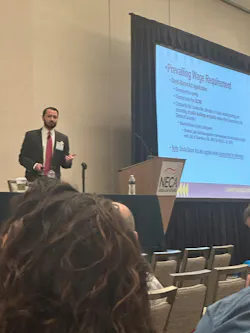
For electrical contractors pursuing federally funded construction work, navigating the labor requirements attached to a project can be almost as important as understanding the electrical scope of work. That was one of the key takeaways that came out of an early-morning educational session on Day 2 of the NECA 2026 show titled “Project Labor Agreements and Prevailing Wages: Legal Update and Compliance Basics.” Based on the attendance at this 8 a.m. presentation, this certainly seemed to be a hot topic among conference goers.
According to the U.S. General Services Administration, a project labor agreement (PLA) is defined by the U.S. Federal Acquisition Regulation (FAR 52.222-34) as a pre-hire collective bargaining agreement with one or more labor organizations. It establishes the terms and conditions of employment for a specific construction project and is an agreement described in 29 U.S.C. 158(f).
Speaker John M. Harras, counsel in the New York office of Venable LLP, focuses his legal practice on labor and employee benefits matters. In this session, he specifically provided attendees with guidance on labor and employee benefits compliance for employers working on construction projects subject to prevailing wage laws, such as Article 8 of the New York Labor Law and the Davis-Bacon Act.
Drawing on his experience as collections counsel for the Joint Industry Board of the Electrical Industry in New York, Harras has personally seen contractors in real-world settings struggling with compliance. “We often saw that people who were signing onto project labor agreements were consistently getting it wrong,” he said. “They were not remitting the contributions correctly.”
Why do project labor agreements (PLAs) continue to cause confusion in the electrical contracting community? One reason may be the rate at which things seem to change makes it difficult to keep up. The popularity of several recent articles EC&M posted on its website reiterates just how much this topic resonates with our audience.
Written by Freelance Writer Tom Zind, the piece on “Federal Project Labor Agreement Mandate at Risk” took a look at a recent court ruling that ended a short-lived requirement that parties to contracts for federal projects of $35 million or more must enter into project labor agreements (PLAs) at the outset.
By June of 2025, Zind reported in “Trump Administration Affirms Federal Project Labor Agreement Rule” that the administration had confirmed the requirement would remain in effect, subject to exceptions. Harras’s NECA presentation addressed how contractors can navigate this uncertainty while meeting project-specific obligations.
Considering all of the change that’s taken place in a relatively short amount of time, it’s no surprise it’s been difficult for contractors to keep up with PLA requirements. For starters, Harras explained that media headlines can often seem contradictory or even misleading. He also pointed out that prevailing-wage requirements can apply to federally financed work even when the federal PLA mandate does not, which may seem contradictory. Finally, especially without specific advice from legal counsel on a particular project, it’s challenging for electrical contractors to be in compliance with all requirements pertaining to the PLA, their existing union agreement, prevailing wages, benefit contributions, and paid sick leave.
Harras traced the PLA mandate’s changing administrative and legal history throughout his presentation. Despite the fact that this issue has been in a state of flux in recent years, he offered several best practices for electrical contractors wanting to stay in compliance, including:
- Follow the PLA mandate. This means negotiating the best terms possible in a letter of assent.
- Annualize the fringe benefit credit. Take advantage of the credit toward “traditional” fringe benefit payment.
- Manage overtime costs with a bona fide benefit program. Exclude fringe benefits from regular rate for overtime calculation.
- Beware of ERISA withdrawal liability risk from PLAs. Overly broad and vague jurisdiction provisions of PLAs can create unexpected pension liability when a PLA requires contributions to Taft-Hartley multiemployer plans.
Despite ongoing litigation attempts, Harras advised contractors against assuming that the requirement had disappeared. “I do think that ultimately the PLA mandate will survive court scrutiny,” he said.
About the Author
 Ellen Parson
Ellen Parson
Editor-in-Chief - EC&M
Ellen Parson is the Editor-in-Chief for EC&M. She has a journalism degree from the University of Missouri-Columbia. She's been a business-to-business writer and editor for more than 25 years, most of which have been covering the construction and electrical industries. Contact her at [email protected].