The Power Revolution: Understanding the New Sources of Generation
Although data centers now receive most of the attention in discussion about the hottest segments in the electrical construction market, there’s actually another opportunity that over the next decade could be even bigger: the expansion and revitalization of the U.S. electrical grid.
The enormous appetite for additional power that new data centers, mega-projects such as semiconductor plants, industrial plants, hospitals, airports and school and universities will have is creating extraordinary demand for new power plants and new sources alternative power generation, as well as energy-efficiency measures to curb power usage.
In the 2026 NECA Show seminar entitled, “Solving the Doubling of Electricity Demand Between Now and 2050,” Brian Nelson, ABB U.S. Renewable Segment Leader, offered a solid overview of the new power sources that will come online, including natural gas, renewables and the renewed interest in DC power as a solution for many electrical loads. On top of the business created by the installation of these new sources of generation is the need to update much of the existing electrical equipment in facilities. Nelson said transformers, circuit breakers and utility poles have a lifespan of between 30 and 40 years and will often need to be updated with more modern equipment.
He said that because so many of the new loads coming online require digital power, electrical contractors, design engineers and other electrical professionals will need to have a thorough understanding of DC power systems and battery power, which he said, “will be used everywhere.” These loads include EV chargers, industrial drives, lighting, heat pumps, batteries, solar arrays, robots and data centers. “So many things are now powered by DC,” he said. “We live in a DC world but we are plugged into AC.”
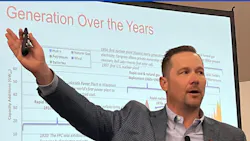
Nelson said renewables will continue to be deployed because they are the fastest and cheapest way to generate electricity, and that new natural gas systems will start having a major impact on the U.S. electrical grid by the 2030s and will continue to be a major source of new power generation through the late 2030s. He said during the 2030s, new nuclear power generation will also be a factor.
Three key takeaways from Nelson’s presentation are the importance of:
- Identifying new installation and services opportunities from next-generation renewables and storage;
- Understanding digital and grid-enhancing technologies and how they create new work for contractors;
- And Learning how microgrids and VPP-enabled sites expand the role of electrical professionals in resiliency and distributed energy.
About the Author
 Jim Lucy
Jim Lucy
Editor-in-Chief, Electrical Wholesaling & Electrical Marketing
Over the past 40-plus years, hundreds of Jim’s articles have been published in Electrical Wholesaling, Electrical Marketing newsletter and Electrical Construction & Maintenance magazine on topics such as electric vehicles, solar and wind development, energy-efficient lighting and local market economics. In addition to his published work, Jim regularly gives presentations on these topics to C-suite executives, industry groups and investment analysts.
He launched a new subscription-based data product for Electrical Marketing that offers electrical sales potential estimates and related market data for more than 300 metropolitan areas. In 1999, he published his first book, “The Electrical Marketer’s Survival Guide” for electrical industry executives looking for an overview of key market trends.
While managing Electrical Wholesaling’s editorial operations, Jim and the publication’s staff won several Jesse H. Neal awards for editorial excellence, the highest honor in the business press, and numerous national and regional awards from the American Society of Business Press Editors. He has a master’s degree in communications and a bachelor’s degree in journalism from Glassboro State College, Glassboro, N.J. (now Rowan University) and studied electrical design at New York University and graphic design at the School for Visual Arts.