Why Use a Power Quality Monitor?
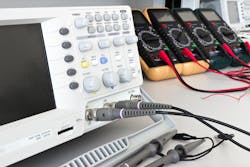
When I worked in a manufacturing facility as an electrical engineer, I can’t recall a day where I did not use an oscilloscope or a multimeter to design or troubleshoot an electrical problem. Using these two tools was second nature to me. I was rarely without my multimeter, ready to solve an electrical problem at a moment's notice. When I moved into the power quality field, I encountered a few limitations when using these two tools to investigate a power quality issue.
The multimeter captures voltage and current magnitudes, which supports detecting steady-state undervoltage or overvoltage conditions, but it does not provide information on transients or harmonics. Transient and harmonic distortion events typically cause electronic devices to misoperate when these events reach a particular level. Oscilloscopes are great at capturing periodic waveforms at a high sample rate, but imagine capturing waveforms for a week at a busy facility. The captured data can be overwhelming and analyzing it can take time, as it provides too much or too little information.
A power quality monitor can record data and capture waveforms for an extended period of time. I had one temporarily installed at a facility, which continuously captured data for more than a month. The only time I downloaded the information was when we removed it from the site. The captured data included continuous voltage magnitudes, current magnitudes, imbalances, and harmonic distortion percentages for the entire recording period. The captured waveforms only triggered on the pre-determined thresholds, which were customizable.
A power quality monitor performs a cycle to cycle comparison by capturing a waveform and then comparing it to the previous cycle’s waveform. This is a typical algorithm for power quality monitors. If the captured waveform deviates from the previous waveform by the triggered value, set by the user, it then stores the waveforms (pre-event waveform, triggered event waveform, and post-event waveform) in memory as an event. If the waveform does not meet the triggered threshold, then the algorithm scraps the waveform from its storage. This prevents the memory from filling up and also filters out waveforms that are not needed for analysis. An added and useful feature that some power quality monitor manufacturers offer is the software identifies and labels the power quality event per IEEE Std 1159 – Recommended Practice for Monitoring Electric Power Quality.
The next time you’re dealing with a power quality issue, use a power quality meter with supporting software to help expedite the troubleshooting process.