Restoring Lighting Reliability in a High-Bay Museum After a Power Event
Key Takeaways
- The outage affected over 70% of the museum's high-bay LED lighting, creating safety and visibility concerns in a difficult-to-access environment.
- Traditional surge protection was insufficient; the team implemented circuit-level surge suppression, transient voltage protection, and noise filtering to prevent future failures.
- Installation of protection devices was straightforward, requiring minimal labor and no major modifications to the existing electrical system.
- Lighting controls were upgraded from manual toggles to automated scene control and scheduling, improving operational efficiency and security.
- Focusing on circuit protection addressed the immediate risk without the need for comprehensive electrical system overhaul, reducing costs and downtime.
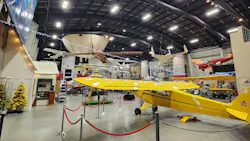
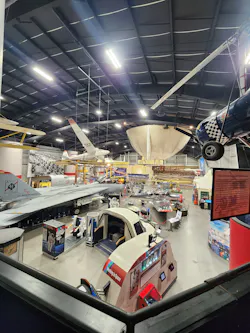
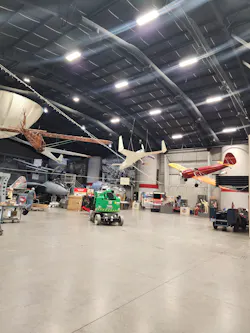
In large exhibit spaces, lighting systems are expected to operate in the background, supporting visibility without drawing attention. That changes quickly when a system fails. In the Tulsa Air & Space Museum’s 18,000-sq-ft, hangar-style building, an unexpected power disturbance knocked out multiple systems, including over 70% of the high-bay LED lighting. The outage created an immediate problem. Fixtures are mounted roughly 50 ft above the floor, making access difficult and time-consuming.
In a space designed to showcase aircraft and exhibits, consistent lighting is essential for safety, visibility, and overall visitor experience. Restoring it required specialized equipment and disrupted normal activity. The outage affected more than just the lighting, reinforcing concerns that the problem might extend beyond individual fixture failure.
Tyson Tausig, a Tulsa-based lighting distributor with Broken Arrow Electric Supply, helped the museum investigate the problem and determine next steps. The lights were a combination of different LED fixtures, having been slowly replaced over the years. They were mounted high in the hangar and maintained using a narrow jib, 40-ft electric articulating manlift. Due to the number of systems affected, the problem was initially attributed to a likely power event. Concerns remained when a clear cause could not be identified. Replacing the fixtures was expensive, time-consuming, and disruptive.
Traditional surge protection did not address the type of failure the museum experienced. To reduce the risk of repeat failures, the team looked at protecting the lighting at the circuit level. Rather than attempting to isolate a single cause or redesign the broader electrical system, they focused on protecting the circuits most directly tied to the lighting load.
Treating the issue as a power quality problem
The team was responsible for coordinating replacement fixtures and evaluating the problem. “We knew that if something like this happened again, we were going to be right back up in the air replacing fixtures,” said Tausig. “That wasn’t a situation anyone wanted.”
Based on the extent of the loss and the range of affected equipment, the condition was treated as a power quality problem rather than a single isolated failure.
Power disturbances can originate from the utility or from within a facility, and they often occur without warning. Surges, sags, swells, transients, overvoltage, undervoltage, and electrical noise are all common contributors to poor power quality. LED lighting systems and their associated controls rely on electronic components that can be affected by these types of disturbances.
For the museum, the goal shifted from naming a single cause to reducing exposure to future events. While the local power authority later determined that interference from wildlife had caused the outage, the original failure could not be diagnosed at the time. This led the team to focus on reducing exposure without identifying a single root cause.
Selecting a circuit-level protection strategy
A circuit-level solution was applied directly to lighting circuits without requiring changes to the facility’s entire electrical system. By combining surge suppression, transient voltage protection, electrical noise filtering, and automatic shutdown in a single device, the units provided circuit-level protection for the lighting. The goal was to reduce exposure to future disturbances and limit the likelihood of repeated callbacks.
Installation on existing lighting circuits
Protection for the LEDs at the museum was added to four existing circuits using four 208V units, each tied into an existing 20A breaker. The electrical panel is located within a storage build-out inside the facility, so installation did not require special access equipment. The installation was completed by Strike, a local electrical contractor. "There were no issues. The install was straightforward,” said Casey Smith, the electrician who performed the work. “All four breakers passed through the units.”
From an installation standpoint, the additional labor was limited. Each unit could be installed and placed into service in roughly an hour. Each device draws approximately 3W of power and includes onboard indicators that show power status and fault conditions. Rated for use on circuits up to 30A and compatible with common commercial lighting voltages, including 277V, they can be integrated into existing lighting panels.
Lighting controls and system updates
In addition to addressing the failure, the project also included updates to how the lighting system was controlled and used on a daily basis. Previously, lighting in the hangar was run manually using toggle switches at the panel. Museum staff turned the lights on at the beginning of the day and off at closing. The updated system introduced scene control and automatic time schedules, allowing lighting to better align with operating hours and usage patterns. The system also supports lighting conditions for security camera visibility and special events outside normal operating hours. The controls upgrade and the power protection work were completed independently and did not affect the overall project schedule.
Preventing repeat failures
At the time of installation, the museum was not actively monitoring power quality conditions. The decision to implement circuit-level protection was based on the scale of the previous failure and the difficulty of accessing the fixtures.
By focusing on the circuits serving the high-bay lighting, the project team addressed the most immediate risk without overhauling the facility’s electrical system. In a space where access is difficult and lighting supports daily operation, the approach combines targeted protection with updated controls to reduce the likelihood of repeat failures and improve how the system is used over time.
About the Author
 Andrew Manning
Andrew Manning
Andrew Manning is a Partner at Mechanical Ingenuity Corp., manufacturers of the Wavecrest, which is a power quality protection device that automatically protects sensitive electronics from dirty power, including transients, sags, EMI noise, over/under voltage, surge, and more. He may be reached at [email protected].