What Is Harmonic Pollution?
Key Takeaways
- Harmonic pollution is caused by non-linear devices that draw uneven, pulsed currents, distorting the fundamental sine wave of power systems.
- These distortions generate harmonic voltages that can lead to overheating, equipment failure, and false readings in monitoring devices.
- Harmonic currents and voltages increase with system impedance, amplifying their disruptive effects even at low current levels.
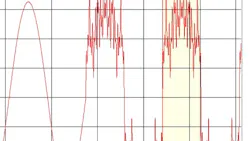
Harmonic pollution refers to the distortion of normal electrical voltage and current sine waves caused by unwanted high-frequency currents.
In an ideal power distribution system, voltage flows as a clean, continuous sine wave operating at a fundamental frequency (typically 50 Hz or 60 Hz). However, modern non-linear devices — such as variable-speed drives, computers, LED drivers, and electronic ballasts — don’t draw power smoothly. Instead, they absorb current in abrupt, uneven pulses. These high-frequency current pulses distort the fundamental waveform, injecting electrical "noise" or pollution into the power network. In other words, properly operating power generators create clean sine waves. It’s the things that we plug into the system that create harmonic distortion.
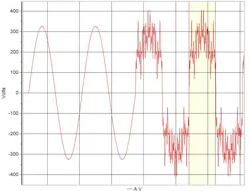
While non-linear loads primarily create harmonic currents, this current distortion transforms into voltage distortion across the impedance of the system, which affects the entire electrical ecosystem. Just as Ohm’s Law (V = I x Z) applies at fundamental frequencies, it also governs harmonic frequencies. When harmonic currents flow through the natural impedance of conductors, transformers, and power distribution equipment, they generate corresponding harmonic voltages. Because electrical impedance typically increases alongside higher harmonic frequencies, even relatively small harmonic currents can produce disproportionately large, disruptive harmonic voltage drops across a facility depending on the impedance.
This widespread voltage and current pollution creates operational challenges for industrial and commercial facilities. Harmonic pollution causes equipment to overheat, leads to premature failures, trips circuit breakers without an obvious overload, and causes false readings in monitoring devices. Ultimately, unmanaged harmonic pollution wastes energy, degrades power quality, and risks sudden uptime interruptions by exposing sensitive connected equipment to polluted power.
About the Author
 Ross Ignall
Ross Ignall
Ross Ignall is the Director of Business Development and Marketing at Dranetz Technologies, a GMC Instruments company, where he has more than two decades of experience in power monitoring and analysis. With a background in engineering and product management and a career focused on instrumentation, power quality and energy solutions, Ross has been instrumental in building the GMC Instruments brand Dranetz. He works closely with engineers, utilities, and facility teams to align technology with real-world needs. A published author, IEEE and IEC committee member, and speaker in the fields of instrumentation, power quality, and demand/energy, he is a trusted resource in helping organizations take a smarter, data-driven approach to power system reliability. Ross can be reached at [email protected].