Harmonics: What Electrical Contractors Need to Know — Part 1
Key Highlights
- Harmonics are distortions in electrical waveforms caused by nonlinear loads like VFDs, LED lighting, and UPS systems, which pollute the power supply and can lead to equipment issues.
- Triplen harmonics (multiples of three) can cause neutral conductor overheating and pose risks of insulation failure and equipment damage due to their in-phase behavior in three-phase systems.
- Unexplained overheating, nuisance tripping, and equipment malfunctions in plants often stem from harmonic distortion, making harmonic analysis essential for maintenance and reliability.
- Effective harmonic mitigation involves measurement, analysis, and implementing solutions like filters and proper system design to prevent costly downtime and extend equipment life.

Unplanned downtime is a significant expense. In fact, the average large industrial plant loses about 27 hours of production monthly to unscheduled outages. According to a report from Siemens, “The True Cost of Downtime 2024,” for the world’s 500 largest companies, these disruptions result in more than $1.4 trillion in losses each year.
With maintenance teams under pressure to reduce downtime, understanding how harmonics can impact plant operations will help keep costs under control. If you have dealt with unexplained overheating, reduced motor life, tripped breakers, or equipment malfunctions, you may not have realized that harmonics was the culprit. In this first article in the series, we will introduce harmonics and review why they’re a concern in electrical systems. Then we’ll dive into some specific examples from plant operations.
What are harmonics?
In an AC power system, the ideal voltage and current waveforms are pure 60 Hz or 50 Hz sine waves. This is the fundamental frequency: 60Hz is used mostly in the Americas, while 50 Hz is used in Europe and other parts of the world. Harmonics are “pollution” in an electrical system, distorting the normal sine wave by adding higher-frequency components on top of the fundamental waveform (see graphic below). For a 60 Hz system:
- Fundamental frequency (f₁): 60 Hz
- 2nd Harmonic (f₂): 120 Hz
- 3rd Harmonic (f₃): 180 Hz
- … and so on.
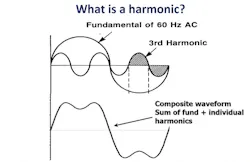
Utilities and alternative energy power sources produce mostly pure sine waves at the fundamental frequency.
So where do harmonics come from? They are caused by the things that we plug into the power system. Harmonic distortion is usually produced by loads that draw current in non-linear ways, such as pulses (think computer switching power supplies) rather than smoothly.
Common harmonic-producing loads include:
- Variable-frequency drives (VFDs)
- LED lighting
- Computers and office electronics
- UPS systems
- Battery chargers
- Welders and arc furnaces
- Inverters and converters
Why are harmonics a concern?
While some harmonic content is expected in systems with modern electronic loads, harmonics can create a variety of negative consequences. A few of these are defined below.
Transformers and motors can experience excessive heating and reduced life, particularly from 3rd, 5th, and 7th harmonics. Neutral conductors can overheat due to triplen harmonics (3rd, 9th, etc.) that add arithmetically in 3-phase systems. In addition, harmonics increase eddy currents and core losses, reducing equipment life.
Protective device misoperation
Circuit breakers, relays, and fuses may trip due to distorted current waveforms. Harmonics can also affect the timing and sensitivity of protection schemes.
Harmonic current does not perform useful work, but still increases the RMS current. This can reduce the power factor and may affect utility charges or require costly correction.
Drives and inverters may trip or fault due to distorted waveforms. Control systems may experience communication interference if harmonic noise enters signal lines.
In certain conditions, harmonics can resonate with capacitive or inductive elements in the system. This can significantly amplify voltage distortion or current spikes, sometimes leading to insulation failure, damaged capacitor banks, and other failures.
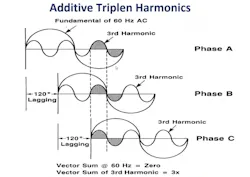
In a balanced 3-phase system, the phase voltage and currents are 120 degrees apart and tend to cancel in the neutral. Triplen harmonic currents behave differently. They are in phase with each other and can add in the neutral. That means a neutral conductor may carry more current than expected, even when the phase currents look reasonable.
Watch for triplen harmonics in systems with:
- Shared neutrals
- Heavy single-phase nonlinear loading
- Office areas with many electronic loads
- LED lighting conversions
- Data-heavy facilities
- UPS-fed panels
Harmonics examples from plant operations
A commercial panel serves office electronics, LED lighting, and other single-phase nonlinear loads. Phase current does not appear excessive, but the neutral is running hot. A likely next step is to measure neutral current and look for triplen harmonics.
A facility adds or changes large loads. Soon after, fuses open or capacitors fail. One possible cause is harmonic resonance between the capacitor bank and the system impedance. PQ and harmonic measurements should be taken before selecting a correction method.
A drive trips without an obvious voltage problem
A variable frequency drive trips during normal production. Standard RMS voltage readings look acceptable. Harmonic distortion, voltage notching, or higher-frequency noise may be involved. A power quality recording can help separate supply issues from equipment or process issues.
EV chargers go offline randomly.
EV chargers or banks of chargers randomly go offline for unexplained reasons. The AC power supplying the EV charger(s) could have high harmonic content, which can result in random shutdowns.
Key takeaways
To help electrical professionals better understand why harmonics matter, here are several key critical considerations to remember.
- Harmonics are like "power pollution." Unlike a clean 60 Hz sine wave, harmonics are higher-frequency distortions caused by nonlinear loads (like VFDs, LEDs, and UPS systems) that pull current in pulses rather than a smooth flow.
- With the average large plant losing 27 hours of production monthly to unscheduled outages, identifying harmonics is as much a financial necessity as a technical one. They often hide behind symptoms like unexplained overheating or nuisance trips.
- Triplen harmonics (multiples of three, such as the 3rd or 9th harmonic) add up in the neutral conductor rather than canceling out. This can lead to dangerously hot neutrals even when phase currents appear balanced.
- Harmonics do more than distort waves; they increase eddy currents in transformers, reduce equipment lifespan through heat, cause resonance that can destroy capacitor banks, and trigger power factor penalties.
In the next article, we’ll cover harmonics standards and measurement as well as ways to mitigate their impact on electrical systems.
About the Author

Ross Ignall
Ross Ignall is the Director of Business Development and Marketing at Dranetz Technologies, a GMC Instruments company, where he has more than two decades of experience in power monitoring and analysis. With a background in engineering and product management and a career focused on instrumentation, power quality and energy solutions, Ross has been instrumental in building the GMC Instruments brand Dranetz. He works closely with engineers, utilities, and facility teams to align technology with real-world needs. A published author, IEEE and IEC committee member, and speaker in the fields of instrumentation, power quality, and demand/energy, he is a trusted resource in helping organizations take a smarter, data-driven approach to power system reliability. Ross can be reached at [email protected].