Meeting Rising Electrical Demand with Renewable Generation and Energy Storage
Key Takeaways
- Increasing electrification in buildings drives higher power densities, requiring careful infrastructure sizing and upgrades.
- Renewable generation, such as solar PV, can reduce reliance on utility power and support sustainability goals when properly integrated.
- Energy storage systems like BESS and thermal energy storage enhance flexibility, support demand management, and improve resilience.
- Proper planning for system integration, including code compliance and future expansion, is essential for cost-effective and reliable operations.
- Early stakeholder coordination enables facilities to optimize energy use, defer infrastructure upgrades, and adapt to evolving utility rates and grid conditions.
Electrical consumption is increasing on campuses and in commercial buildings as they transition to all-electric systems and integrate advanced technologies that drive higher power densities. The result is escalating operating costs, power quality challenges, increased strain on local power grids, and potentially costly infrastructure upgrades to handle higher peak loads.
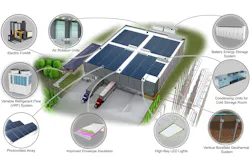
Renewable generation, such as solar photovoltaics, along with thermal and battery energy storage systems, can play an integral role in managing a facility’s overall energy profile and electrical demand. When strategically integrated into a building’s electrical infrastructure, these systems can help optimize energy use, manage demand, and support more reliable, resilient, and cost-effective operations (Fig. 1).
Drivers of increasing electrical demand
Organizations are increasingly choosing electricity over other energy sources for building heating, ventilation, air conditioning, and domestic hot water systems. As a result, electrical loads and system capacities are increasing to accommodate this shift. For new buildings, this means integrating geothermal or dry-type HVAC systems, using either packaged DX refrigerant systems or water systems with dry coolers.
These systems typically increase electrical load compared with older water chiller system designs that use evaporative cooling towers. Moreover, adding heat exchangers to hot- or cold-water systems creates a pressure drop, requiring larger pump sizes to maintain the necessary flow. Operating these systems year-round for both heating and cooling also drives the need for redundant equipment and separate electrical services to maintain operations in facilities that cannot shut down for standard equipment maintenance.
Electric water heating is also increasingly being considered as an alternative to natural gas boilers. Electric boilers can add significant electrical load while still requiring many of the same pumps and safety equipment as the natural gas boilers they replace.
This increase in demand has important implications for electrical infrastructure, beginning with properly sizing equipment to accommodate the new load. Boiler horsepower (BHP) does not translate one-to-one to electrical power; instead, the ratio is closer to 10kW of electrical power per BHP. Incorrect conversions can result in severe under-sizing or over-sizing of equipment.
Voltage is another important consideration. Medium-voltage electrode boilers typically operate in the 12kV range. If available electric utility power differs from the voltage required by the boiler, supplemental transformers will be needed, increasing both up-front electrical construction costs and long-term operational losses.
Organizations seeking to reduce carbon emissions from existing buildings, especially central utility plants, are incorporating heat recovery systems such as heat recovery chillers. Although these systems offset fossil fuel use, they typically require higher electricity consumption as a result of shifting energy sources from natural gas (for the boilers) to electricity (for the heat recovery chiller). For example, a recent project added a 555kW heat recovery chiller to a chiller plant with three existing 500kW traditional chillers and three natural gas boilers rated at a total of 210 BHP. In addition to the electrically driven equipment increasing the plant’s electrical load, the recovered heat that would otherwise have been rejected through the cooling towers is reused to reduce the reliance on fossil-fueled boilers (Fig. 2).
Planning for solar PV systems
Renewable generation provides campuses and commercial buildings with opportunities to produce energy on site, reducing reliance on electric utility-supplied electricity while supporting energy, cost, and carbon-reduction goals. Successful integration requires considering how and when energy is produced relative to building demand, as well as utility rate structures, available space, existing electrical infrastructure, and project goals.
When considering a solar photovoltaic (PV) system as part of a building design, clearly defining the project goals is an important first step. Across the United States, the lifetime cost of solar electrical generation is competitive with the cost of electricity at the commercial-building level. However, electricity rates and electric utility fee schedules vary widely — with some electric utilities charging a departing load fee to customers who reduce their electricity use because another source begins serving that load. Understanding whether the intention is to supplement utility-supplied electricity or to pursue a more ambitious goal of net-zero emissions will help determine the appropriate system size, configuration, and approach to integration.
For PV systems that maximize rooftop use to offset a building’s energy use and reduce emissions, there’s only a moderate cost to add the necessary connections and controls for the PV system to meet electric utility and electrical code requirements. The PV system capacity is typically small relative to the building’s normal demand load and does not significantly affect main service switchboard sizing. For projects with the more ambitious goal of net-zero emissions, the PV system capacity must exceed the building’s normal demand load. Producing electricity during the peak of the day to offset more constant energy usage can drive an increase in the main service switchboard size and possibly a larger electric utility transformer than would otherwise be needed if there isn’t a method for storing the surplus energy.
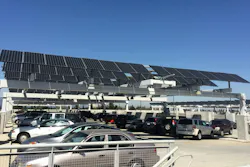
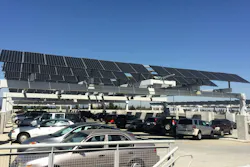
Available space is another important consideration. PV systems that do not fit well on the roof of a lab or hospital building may be better suited to ground-mounted installations or structures such as parking garages (see the Photo). Placing the arrays in these locations could also provide additional benefits. For example, elevated solar panels mounted on parking structures can create shade for the top level of parking.
Regardless of system size or location, PV and electrical system designs must meet applicable codes and electric utility requirements, including provisions for fire department response and electric utility safety. Integration also requires consideration of access, fall protection, maintenance, and equipment clearances. Items such as the external disconnects required by NEC Sec. 690.13 require advance planning, especially for electrical systems where PV panels are planned for future installation and will not appear on the documents reviewed by the AHJ. As electricity rates continue to rise, the cost of PV continues to decrease, making it increasingly appealing to add PV where it is practical or to plan for future PV installations to take advantage of market conditions.
Integrating energy storage
Energy storage can provide building owners with greater flexibility in how and when energy is used, extending its value beyond the integration of renewable generation. Depending on facility needs and operating priorities, different storage technologies can support load management, cost reduction, reliability, sustainability, and infrastructure optimization.
Battery energy storage systems (BESS) are increasingly being deployed at utility, campus, and building scales. At the electric utility level, BESS is a widely accepted solution for time-shifting and load management. At the building or campus level, it can support a broader strategy when integrating other energy systems, such as fuel cells or parking-area solar, particularly in markets where electric utility reliability is not a given.
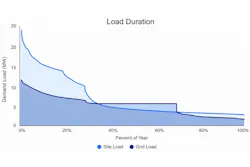
How BESS are sized, interconnected, and controlled depends on the building's dispatch strategy. To minimize infrastructure capacity requirements and mitigate electric utility demand charges, BESS can be dispatched for peak shaving. Interconnection can occur anywhere in the electrical distribution system where peak shaving is beneficial, but most typically at the building's main service switchboard. BESS installations would ideally be sized to reduce peak loads to average loads and programmed to dispatch when facility load exceeds a certain threshold.
To minimize energy costs, BESS can be dispatched for load shifting, with capacity sized to meet energy usage during the highest time-of-use electric utility rate periods (e.g., 4 p.m. to 9 p.m.). To minimize marginal emissions, BESS can be dispatched for carbon-aware load shifting, reducing facility load during periods of highest carbon intensity, typically when renewables such as solar PV are unavailable. For reliability, BESS would be sized based on the demand and duration of critical loads. Often, BESS sizing is simply based on available space and funding.
BESS can also mitigate solar intermittency with grid-firming and grid-forming capabilities. In a net-zero application, BESS would be charged when solar PV generates excess energy and discharged when solar PV generation is unavailable. Its grid-forming capabilities would allow the building to operate in island mode when electric utility power is offline or operate entirely off-grid.
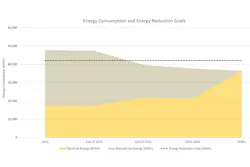
In conjunction with thermal plant optimization, dispatching BESS for peak shaving can significantly reduce peak demand loads, associated electric utility demand charges, and infrastructure costs (Fig. 3). This is especially valuable in geographic markets with high utility rates or constrained electrical infrastructure.
Older BESS units were limited to either electric utility support or island-mode backup power. Modern BESS units are capable of making the transition from electric utility grid-interactive operation to island-mode operation without a building outage, essentially functioning as outdoor UPS systems. This capability broadens applications to buildings where sensitive loads must not experience any power interruption.
One challenge for BESS siting is fire code compliance. Fire Code (IFC) 1207.6 lumps different battery chemistries into simplified categories, with broad requirements for each chemistry. IFC 1207.8.1 requires a 100-foot separation from any building, while IFC 1207.9.3 requires 10 feet of separation from any vehicle parking (not just EV charging spots). BESS equipment also has its own requirements, such as side clearances for service, vertical clearances for cooling or equipment removal, or underground duct bank routing to and from site power equipment.
Battery systems are not the only option for shifting energy use. For larger campus-type central energy systems, thermal energy storage (TES) may be incorporated into the central plant during building design to time-shift energy usage by producing and storing heated or chilled water depending on the climate zone and electricity costs. This is also an effective way to plan for the availability of energy sources such as solar overproduction.
Head-to-head, thermal energy storage has typically been found to have a lower first cost and therefore a better return on investment than BESS when time-of-use and electricity rates are the only energy storage use cases. Building-scale BESS costs are currently on the order of $250 per kilowatt-hour, while TES costs are approximately $50 per kilowatt-hour. However, as BESS costs fall and chiller efficiency improves, BESS becomes more competitive.
Connecting today’s energy decisions to future demand
As campuses and commercial buildings continue to electrify, renewable generation and energy storage should not be treated as isolated additions to the electrical system. Their value depends on aligning each technology with the facility’s load profile, electric utility rate structure, carbon-reduction goals, resilience requirements, available space, and existing infrastructure. Early coordination among the owner, design team, electric utility, and permitting authorities allows solar PV, BESS, thermal energy storage, and heat recovery systems to complement one another, reducing peak demand, improving reliability, and potentially deferring costly electrical infrastructure upgrades.
As energy storage costs decline and control systems become more sophisticated, buildings will have greater flexibility to respond to changing electric utility rates, grid conditions, and carbon intensity. Designing today’s systems with adaptable controls and capacity for future expansion will position campuses and commercial buildings to meet growing electrical demand while maintaining reliable, resilient, and cost-effective operations.
About the Author
 Richard Austin, PE
Richard Austin, PE, LEED AP, is a senior project engineer at Affiliated Engineers, Inc., specializing in electrical systems design for corporate research, healthcare, mission-critical, and higher education facilities. His expertise includes renewable generation and energy storage, with experience in microgrids, battery energy storage systems (BESS), EV charging infrastructure, solar photovoltaic systems, uninterruptible power supplies (UPS), and generators.
 Jeff Mark, PE
Jeff Mark, PE, LEED AP BD+C, is a project manager at Affiliated Engineers, Inc., specializing in electrical systems design for higher education, R&D, corporate, commercial, mission-critical, and government facilities. His expertise includes renewable generation and energy storage, with experience in microgrids, battery energy storage systems (BESS), solar photovoltaic systems, and EV charging infrastructure.