Advancing a Safer Workplace Amidst a Pandemic
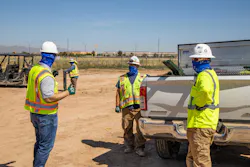
A year after the United States recorded its first confirmed case of COVID-19 and shelter-in-place orders were issued across much of the nation, an untold number of businesses were forced to shutter their doors temporarily or for good, including many throughout the electrical industry. Other companies, however, quickly pooled their resources to come up with Plan B.
One such company includes San Jose, Calif.-headquartered Rosendin, an electrical contractor (EC) with more than 6,000 employees nationwide. Like many last March, the company found itself confronted by unprecedented restrictions on travel and group gatherings, and the necessity to follow strict health guidelines. The company swiftly implemented all Centers for Disease Control (CDC) guidelines and health department recommendations but felt that wasn’t enough. To keep the business moving forward, the engineering, estimating, training, safety, IT, operations, and human resources departments collaborated to set forth a new company standard.
A pioneering safety plan
As shelter-in-place orders were issued in rapid succession, Rosendin shifted gears at a pace the company had never before seen. Teams worked together to develop a safety plan focused on keeping its workforce healthy and productive. Designed in collaboration with numerous partners, including PAR Electrical Contractors and Hoffman Construction Co., the early creation and adoption of this plan allowed the EC to refine the program with the intention of making it more effective.
The company designed its COVID-19 safety measures to protect workers in offices, prefabrication warehouses, and on construction job sites. Protocols include social distancing, handwashing/sanitizing stations, and the use of personal protective equipment (PPE), such as face masks (Photo 1).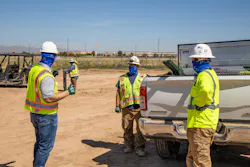
Additional policies include dedicated safety personnel on each job site, pre-shift health checks, staggered shifts and breaks, full-time cleaning crews, single-directional walkways, and an 800-number and email to answer employee questions.
With that said, it’s safe to consider that future proposals will contain and/or will ask companies about their experience with COVID-19 CDC procedures and what they will continue to implement for future projects. Currently, it's crucial to document and log all processes related to mitigating the spread, especially procedures that were innovative or exceeded the CDC guidelines.
For example, Rosendin's Hillsboro, Ore., and Prineville, Ore., offices purchased several evaporative coolers to help disinfect against COVID-19. Although these industrial-grade evaporative cooler units are effective at evaporating water into the air, they were not originally designed to act as a chemical sprayer or applicator. The company repurposed the units to deliver a thin, wet film of disinfectant over a large area (Photo 2).
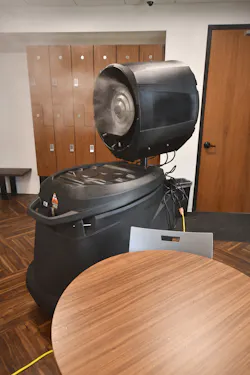
The modified units also have been used with success on two large data center projects. The unit disinfects tools, laydown areas, and all touch surfaces in prefabrication shops. Offices that do not have these modified units use sprayers or backpack foggers to clean these areas.
The essential protocol, however, is the company’s stop-work policy that predates the pandemic, which encourages employees to call out unsafe practices — regardless of who is acting in an unsafe manner. To protect our workers, customers, and communities, the company implemented a 4-level investigation should anyone show COVID-related symptoms on a job site.
Seamless transition to remote workforce
Another hurdle faced by Rosendin was the sudden need to transition to a remote workforce. When the CDC, state, and local jurisdictions recommended reduced group sizes, the company quickly shifted to a 50% (or more) remote workforce by leveraging its existing cloud infrastructure. The IT department ensured everyone was connected to their data and had access to collaborative tools for communicating and managing their work. In addition, training around the software was increased to maximize its benefit.
Addressing mental health
Beyond the practical work issues, the executive team felt it was equally, if not more, important to address the employees’ mental and emotional health. To achieve this, the company turned to two of its core values: "We Care" and "We Listen." Frequent and transparent communication became essential in addressing employee concerns regarding their health, safety, job security, and mental well-being. A dedicated email address was established for employee concerns and questions, as well as an 800-number. The executive team, led by CEO Mike Greenawalt, began sending emails and videos to employees. These communications served to outline the steps taken to ensure the health and safety of craft workers and office employees alike. Rosendin also worked closely with construction organizations and building trades, such as the National Electrical Contractors Association (NECA), Associate General Contractors (AGC), and the IBEW local unions, to establish guidelines and set the industry standard.
Complete collaboration
Undoubtedly, a great deal of uncertainty still exists with the current global crisis. Construction companies in particular are struggling with the unknown end-date and cost of technology to deal with this pandemic. Prior to the pandemic, COVID-related costs were not factored into the estimates when teams bid on jobs. As the situation became increasingly severe, the company’s executive team took early steps to address safety and project concerns and understand how supply chain vendors were going to react.
The EC worked with its network of suppliers and vendors at the outset to help understand equipment availability and cost. As a result, teams across the nation have been able to make critical purchasing decisions, including bulk buys, to avoid shortages and logistic hang-ups, and current projects have experienced few cost or schedule setbacks.
Perhaps the most sophisticated effort the company must accomplish through all of this is orchestrating the delivery, staging, inspection, installation, and startup of a project. Coordinating the safe interaction of craft workers, multiple subcontractors, consultants, and project stakeholders is a challenge. To achieve this, Rosendin is enforcing social distancing, requiring face masks as part of required PPE, sanitizing equipment throughout the day, and implementing staggered break schedules. The innovation, insight, and ingenuity of company foremen and superintendents have led to the development of tools, jigs, and techniques to keep craftspeople healthy while maintaining installation efficiency and project delivery.
Working toward a safer future
It is essential for ECs to finish projects cost-effectively and execute contractual obligations. To do so, employee must not only feel safe, but extensive safety measures must also be implement to help mitigate the spread of COVID-19. Everyone is eager for the day when COVID-19 is no longer a threat. Until that time comes, however, construction teams must work together to keep workers safe and job sites open.
Shayne Stevens, CSP, CHST, CMSP, is the senior corporate safety director at Rosendin.
About the Author
Shayne Stevens
Shayne Stevens, CSP, CHST, CMSP, is the senior corporate safety director at Rosendin
Related
 Getty Images 1208953647
 Ecm Covid 0520 Pr