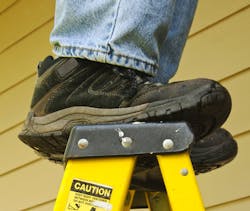
A canon of ladder safety is to avoid using ladders on unstable surfaces. But when you have to do so, make that surface as stable as you can.
A commonly cited example is using a ladder in an outdoor transformer pen, which is usually surfaced with gravel. Problem solved: dig two holes in the gravel and jam the feet into them.
If you work indoors, is this even an issue of concern for you? Consider these examples:
- You’ve been tasked to work on the low-voltage lighting, security, and communications system that is above the ceiling tiles in the factory’s administration building. The building has tile floors and the custodians do a fantastic job of waxing them.
- You’re working in an area of the shop where the floor has imperfections such as large holes, various small ridges, and bumps that make it impossible to position your ladder so it is level.
- The floor feels slippery. Maybe there was a spill of oil or something, but that floor does not provide enough friction for you to consider it a stable surface for your ladder.
Let’s look at some solutions:
- To prevent the ladder feet from sliding on this too-smooth surface, a good solution is to place a ladder mat on the floor before setting the ladder there.
- Place a sheet of plywood over that area; it should provide a flat and stable surface, as it covers the rough floor below it. If sliding is still a concern, look for a way to block the plywood in the direction of a slide. For example, you could park a lift truck sideways against that edge and it would stop the plywood from moving.
- You can solve this problem by using granular oil absorbent; spread a thin layer across the surface. Walk on it a bit so it absorbs and sticks. Don’t have any of this around? Sawdust also works. If you are really in a pinch but a grocery store is nearby, grab a bag of kitty litter. Just be sure you clean up the “grit” as part of your job cleanup.
About the Author
 Mark Lamendola
Mark Lamendola
Mark is an expert in maintenance management, having racked up an impressive track record during his time working in the field. He also has extensive knowledge of, and practical expertise with, the National Electrical Code (NEC). Through his consulting business, he provides articles and training materials on electrical topics, specializing in making difficult subjects easy to understand and focusing on the practical aspects of electrical work.
Prior to starting his own business, Mark served as the Technical Editor on EC&M for six years, worked three years in nuclear maintenance, six years as a contract project engineer/project manager, three years as a systems engineer, and three years in plant maintenance management.
Mark earned an AAS degree from Rock Valley College, a BSEET from Columbia Pacific University, and an MBA from Lake Erie College. He’s also completed several related certifications over the years and even was formerly licensed as a Master Electrician. He is a Senior Member of the IEEE and past Chairman of the Kansas City Chapters of both the IEEE and the IEEE Computer Society. Mark also served as the program director for, a board member of, and webmaster of, the Midwest Chapter of the 7x24 Exchange. He has also held memberships with the following organizations: NETA, NFPA, International Association of Webmasters, and Institute of Certified Professional Managers.