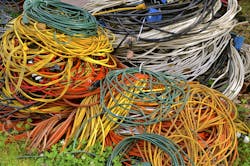
Less attention is paid to portable cord safety today, under the theory that battery-powered tools solve all issues that could arise with portable cords. One flaw in this theory becomes evident when it’s necessary to run a portable cord or two to supply power to the battery chargers.
Also, we use batteries mostly for handheld power tools. Many stationary tools (e.g., conduit benders or table saws) don’t lend themselves well to batteries. And since the tools aren’t carried around (they seldom move during the work day), the main advantage of a battery is not applicable. And a battery-powered arc welder is probably not going to be under your Christmas tree this year.
To ensure the safe use of portable cords, start by selecting the correct one for the application. A good practice for a maintenance department, construction company, or electrical services firm is to buy only extra-hard-duty portable cords. Generally, Type SOOW will give you the most versatility because it is oil-, sunlight-, water-, and weather-resistant. It’s also suitable for outdoor use. It would be best to standardize on one type for all work, if possible.
It also might work well if you can standardize on the conductor size, though this may not be practical. For example, you determine that 8 AWG will cover nearly all your needs. However, perhaps it is gross overkill for most of your needs and only occasionally would you need that thick (and heavy) of a cord.
Where you don’t want to standardize is length. You would get the most versatility if all your cords were 25-ft cords, but that means you might often be plugging one cord into another to get enough length for most of your jobs. It’s not unsafe to do this, it’s impractical. And a safety issue can arise from this practice when people start tying two cords in a knot (thus damaging the conductor insulation and the cord jacket), taping them together, or cable-tying them together. It is best to use a single 100-ft cord if you need to get power 90 ft out from the receptacle.
A portable cord is basically an extension of a branch circuit (thus, extension cord), only it’s not run inside the wall. It’s run in the occupied space or in the open if outdoors. Such a cord is perfectly safe if routed with a little thought and care. Follow these best practices:
- If a cord is damaged, remove it from service. Don’t attempt to repair it.
- If a cord has been repaired, remove it from service. Cut it into pieces and discard it so it does not get repaired again. The typical repair does not even come close to restoring the integrity of a damaged cord.
- Running a cord across a stair step creates a tripping hazard; instead, run the cord lengthwise on a stairway and tape it to one side (duct tape works well for this).
- Run it in a cord guard if it crosses a pedestrian pathway and is running along the ground.
- Use an overhead cord tree system or similar, where practical, if the cord is running in an area with heavy foot traffic.
- Always use an overhead system when running a cord across an area with vehicular traffic. Inside factories or warehouses, that would include lift truck aisles. Outdoors, you may need to account for vertical clearances. Or you may need to find a different power source or move your tools/equipment to eliminate routing across that driveway in the first place.
- Even if a cord is rated for oil or water, avoid running it into oil or water. While there is almost no chance that doing so will result in an electric shock, the operative word here is “almost.” And almost is not good enough. You don’t know the history of that cord and what it’s been through. It may have insulation damage that you cannot see. Always give the cord the best chance of protecting you instead of making “optimum condition” your only line of defense.
About the Author

Mark Lamendola
Mark is an expert in maintenance management, having racked up an impressive track record during his time working in the field. He also has extensive knowledge of, and practical expertise with, the National Electrical Code (NEC). Through his consulting business, he provides articles and training materials on electrical topics, specializing in making difficult subjects easy to understand and focusing on the practical aspects of electrical work.
Prior to starting his own business, Mark served as the Technical Editor on EC&M for six years, worked three years in nuclear maintenance, six years as a contract project engineer/project manager, three years as a systems engineer, and three years in plant maintenance management.
Mark earned an AAS degree from Rock Valley College, a BSEET from Columbia Pacific University, and an MBA from Lake Erie College. He’s also completed several related certifications over the years and even was formerly licensed as a Master Electrician. He is a Senior Member of the IEEE and past Chairman of the Kansas City Chapters of both the IEEE and the IEEE Computer Society. Mark also served as the program director for, a board member of, and webmaster of, the Midwest Chapter of the 7x24 Exchange. He has also held memberships with the following organizations: NETA, NFPA, International Association of Webmasters, and Institute of Certified Professional Managers.