Safety Best Practices When Using Electrical Testing Equipment
Key Takeaways
- Always use test equipment appropriate for the specific measurement task and environment to ensure safety and accuracy.
- Regularly inspect test leads, equipment, and connections for damage before use to prevent accidents.
- Qualified personnel should receive proper training and demonstrate competence before operating test equipment, especially in high-voltage environments.
- Use PPE such as insulated gloves, arc flash suits, and rubber blankets, especially when working near energized systems or performing arc flash prevention measures.
- Maintain a routine calibration schedule for test equipment to minimize measurement errors and ensure safety standards are met.
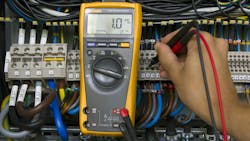
Because electricity is inherently dangerous, there is no way to make test equipment inherently safe. But using test equipment that’s appropriate for the test and the environment while following established test equipment safety practices will close the gap almost completely.
Consider a modern CAT IV digital multimeter (DMM). It has a long list of safety features to protect the user. This example from a generating station in Ohio illustrates how, even though you can’t fix stupid, you can sometimes protect people from it.
What not to do
An “electrical tech” contractor turned out to be a non-qualified person (NQP). He brought the charred remains of his “defective” DMM to the metrology lab. The metrology tech was immediately suspicious. He asked many questions and demanded to see the work order for which the DMM was being used.
The work order called for some voltage measurements. This was part of the system engineer’s effort to compare actual voltage drop to calculated voltage drop on some of the longer feeders.
This NQP decided to measure the current flowing through a 400A bus. Going through the normal jack provides a high impedance, as there is negligible current flow through the meter. The current jack, however, allows current to flow through the meter, and it has a 2A fuse. The NQP’s method was to connect via the current jack and measure between one phase and ground, which of course does not tell you the current flow. It turned the meter into a clump of melted metal and plastic. The lucky NQP survived to find a job elsewhere.
Digital multimeter best practices
Here are some tips for using a DMM correctly:
- Know what measurements you need to take, what measurement points are best, and how to set the meter for those measurements.
- Set the meter for the intended measurement before connecting it.
- Don’t take measurements you don’t need to take.
- Never use a DMM to directly take current measurements in a power distribution system. Use a current clamp with a DMM or use a meter designed for that purpose.
- Know the expected voltage range rather than let Autorange find it for you. While
- Autorange is perfectly safe in itself, there is an operational and safety need for you to know what voltage to expect before you connect the DMM.
- Don’t use cheap imports. The name brands are built to rigorous safety standards, while cheap knockoffs are built to no safety standards
Using a current clamp
Unlike a probe, the clamp does not come into contact with energized terminals. But that doesn’t mean the clamp makes measurement inherently safe. You’re still going to be standing in front of an open enclosure and may be putting your hand close to an energized surface.
You will almost certainly need to lift and (slightly) twist cables to get the clamp around the conductor under test. You have to measure the field around one conductor at a time (the three conductors are out of phase, thus the fields will tend to cancel each other). And you need to get the center of each cable as close to the alignment marks as possible. Typically, these alignment marks delineate the center space of the jaw.
Take the same arc blast and shock prevention cautions that you would take if using probes. That includes using and/or wearing personal protective equipment (PPE), such as rubber blankets, insulated gloves, or even an arc flash suit.
General safety practices
The tips for safely using a DMM also apply generally to most test equipment. Arguably the most important safety tip is ensure you are a “qualified person” [NFPA 70E Sec. 110.6(A)]. To be a qualified person, you must have demonstrated the skills and knowledge to use the test equipment with the particular equipment under test and you must have received the safety training to identify the hazards and reduce the associated risk. That’s a paraphrasing of the NFPA 70E Art. 100 definition.
But what if your company just bought a new piece of test equipment of a type that nobody on site has used before? Do you have to take a class on how to use it? Often, it will suffice for an employee seeking to become qualified to study the manual, make up a mock test, and demonstrate the correct use to a supervisor or other designated person who has also read the manual. This would also assume the employee is a “qualified person” on somewhat similar equipment used in the same environment. That can be a big assumption.
One solution is your electrical distributor may have someone who can perform the training, or they can get someone. The manufacturer may have training videos, conduct training webinars, or provide other means of remote training.
For work quality, the safety training is all well and good but often insufficient; there is just way too much to learn about how to use the test equipment and correctly interpret the test results. This problem is why we have courses and certifications for thermographers. “Do the job right the first time” is also a major safety principle.
Some safety practices that apply to test equipment in general:
- Use the correct test equipment for the measuring job and environment [NFPA 70E Sec. 110.6(C)]. This sometimes has more effect on the work than the safety of the worker, but it is always a safety issue even if the major effect is on the work. For example, you might attempt to measure resistance across a 480V bolted connection using your 9V DMM instead of using a conductance tester for that same job. A supervisor reviewing that work would have to write another work order to do the job all over again, meaning double the exposure to nearby energized circuits.
- Use test equipment that is rated for the environment of use [NFPA 70E Sec. 110.6(B)].
- Test equipment designed for laboratory use is typically not also designed with safety features that make it suitable for use with the 480V distribution system in the typical manufacturing plant.
- Physically inspect the test equipment [NFPA 70E Sec. 110.6(D)] before taking it to the field and again before using it. While major brands ruggedize much of their equipment, sometimes things just happen. An electrical test tech came back from lunch to continue cable testing only to notice a crack in his Hi-Pot tester. It wasn’t there when he left. Though he suspected a lift truck hit it, nobody saw anything. His routine practice of inspection before each use may have saved his life.
- Physically inspect test leads from one end to the other. If there is obvious damage, replace them. If you can’t be sure if those are okay, replace them so you are sure about the test leads you actually use.
- Decide on a connection hand. Seasoned pros often put one hand behind their back when connecting probes or clamps, to avoid creating a possible current path across their heart. This practice also prevents creating an ionization trail between two test probes; that trail creates a significant risk of an arc flash.
- Be careful using “ground” as a voltage level reference. That point might not be connected to the equipment grounding conductor (EGC). If it’s on the load side and connected to a load side ground rod, it might be 90V or more higher than the EGC.
- If testing to verify circuit de-energization, also measure phase-to-phase and phase-to-neutral.
- Avoid setting battery-powered test equipment near heat sources.
- Don’t use the cords of cord-connected test equipment to raise or lower the equipment [NFPA 70E Sec. 110.7 (A)].
- Don’t wrap the cords of cord-connected equipment around the equipment (unless the equipment is provisioned for that with looms or similar devices), don’t step on those cords, don’t kink them, and don’t attempt to repair them if the insulation is damaged. Replaced any damaged cord. The same thing applies to test leads.
Moving toward total safety
You will never be totally safe in the presence of electricity. What separates you from injury or death is how you handle the dangers that still confront you despite all other efforts. This is where your assessment of the measurement environment, selection of the correct measuring equipment, careful set-up and use of that equipment, and attention to detail contribute to your doing a good job that day and going home that night.
A final factor is what some call user calibration. That metrology lab tech mentioned earlier was in charge of, among other things, ensuring all test equipment was correctly calibrated. They sent each item out for calibration on a schedule or in response to a potential decalibration event (such as sharp physical shock). Calibration drifts over time as small errors creep in. This error creep also happens to the qualified person using the equipment. If your company doesn’t have a schedule for requalification, then at least take the time to read through the manual annually just so you get recalibrated on the safe and proper use.
About the Author
 Mark Lamendola
Mark Lamendola
Mark is an expert in maintenance management, having racked up an impressive track record during his time working in the field. He also has extensive knowledge of, and practical expertise with, the National Electrical Code (NEC). Through his consulting business, he provides articles and training materials on electrical topics, specializing in making difficult subjects easy to understand and focusing on the practical aspects of electrical work.
Prior to starting his own business, Mark served as the Technical Editor on EC&M for six years, worked three years in nuclear maintenance, six years as a contract project engineer/project manager, three years as a systems engineer, and three years in plant maintenance management.
Mark earned an AAS degree from Rock Valley College, a BSEET from Columbia Pacific University, and an MBA from Lake Erie College. He’s also completed several related certifications over the years and even was formerly licensed as a Master Electrician. He is a Senior Member of the IEEE and past Chairman of the Kansas City Chapters of both the IEEE and the IEEE Computer Society. Mark also served as the program director for, a board member of, and webmaster of, the Midwest Chapter of the 7x24 Exchange. He has also held memberships with the following organizations: NETA, NFPA, International Association of Webmasters, and Institute of Certified Professional Managers.