Winter Weather Hazards: Staying Safe on Electrical Job Sites
Key Takeaways
- Wear slip-resistant footwear with ASTM-certified tread to prevent slips on icy surfaces.
- Use ice scrapers and de-icer sprays to clear vehicle windows safely before driving.
- Maintain a safe following distance and avoid aggressive driving behaviors on icy roads.
- Carry kitty litter in your vehicle to improve traction on icy sidewalks and entryways without the hazards of heavy sand.
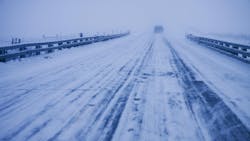
One obvious winter weather hazard is ice, which slippery to walk on. Follow these tips to reduce those hazards on electrical job sites.
- Wear shoes or boots that have a soft sole and tread. Look for “SR” (slip resistance) on ASTM-certified work boots.
- If traversing an icy patch, lower your center of gravity by crouching slightly.
- Take shorter steps, so that you have more control over your feet.
- Look where you are going — this is not the time to be checking out the scenery or looking at text messages.
- Avoid carrying anything at a level that is more than waist-high. A rollaway tool pouch system will help you do this.
Winter safety for service vehicles
As you get into your service truck, you’re already behind due to the inclement weather. Should you just take off down the road and let the defrosters remove the ice? No. Do this instead: Scrape the ice from front, side, and rear windows.
If it will not scrape off, use an automotive deicer spray if you have one. Don’t pour boiling water on windshield ice, spray WD-40 on window (it will damage the car paint and the wiper blades), and try to smash the ice (you may damage window seals, if not the glass itself). If you don’t have a deicer, then use the truck’s heater system and rear window defogger to melt the ice (or make it readily removable by hand) before heading down the road.
Heading done the road while the ice melts means your vision is compromised during the melting period, and you’ll likely eject ice sheets onto other cars. Because the road is icy and thus dangerous, the last thing you want to do is drive on it while you can barely see. So to recap:
- Start with an ice scraper.
- If that doesn’t work, use an automotive de-icer.
- If can’t do these, warm the vehicle up and melt the ice off.
Safe driving tips in inclement weather
Our road safety is now routinely threatened by aggressive drivers. When you leave a space bubble in front of your car, they move into it. As you slow to regain your front safety bubble, another driver is so close to your rear bumper you cannot see their rear bumper. These same people are typically oblivious to the hazard presented by icy roadways. A bridge may ice over, even if the ambient temperature is above freezing. And that infamous black ice that creates invisible patches that can easily send your car into a spin. Follow these tips:
- Stay out of the passing lane, unless you need to use it to exit or enter the roadway.
- Don’t make eye contact with the crazies, and definitely do not flip them off. Doing either one could trigger a greater degree of aggression.
- Don’t try to “play nice” by shrinking your safety bubble. Due to conditions, you need to increase it.
- Avoid antagonizing people through “under aggressive” driving. If the roads are reasonably clear and visibility is good, you should drive close to normal speeds. That goes double for merge ramps; you are supposed to be at the same speed as the traffic you are merging into as you approach the end of the merge ramp. It is your job to be at their speed, not their job to slow to let you on.
- Be courteous at all times. Signal your intention, don’t make fast moves, let someone over if they need over, and so on.
On the job site
So you arrive at the job site. Let’s say it’s a commercial building. The parking lot has been plowed, but the sidewalks and entry do not yet have any snow-melt on them. What should you do? Many people carry sand in their service truck for just such a situation. But a bag of sand is heavy, and carrying it increases your risk of falling. Instead, equip your vehicle with a standard paint bucket or similar container that is filled with plain kitty litter. Include in that container a bowl or cup for scooping out the litter, so that you don’t have to lift the bucket.
Kitty litter is great because it is clay. It won’t harm pets or plants. Get the cheapest unscented one available. Kitty litter won’t melt the ice, but it will bite into the ice and give people some traction as they walk on it. Its strength is also a weakness, as people will track in clay and leave mud on the floor inside, so use just enough to provide some grit.
About the Author
 Mark Lamendola
Mark Lamendola
Mark is an expert in maintenance management, having racked up an impressive track record during his time working in the field. He also has extensive knowledge of, and practical expertise with, the National Electrical Code (NEC). Through his consulting business, he provides articles and training materials on electrical topics, specializing in making difficult subjects easy to understand and focusing on the practical aspects of electrical work.
Prior to starting his own business, Mark served as the Technical Editor on EC&M for six years, worked three years in nuclear maintenance, six years as a contract project engineer/project manager, three years as a systems engineer, and three years in plant maintenance management.
Mark earned an AAS degree from Rock Valley College, a BSEET from Columbia Pacific University, and an MBA from Lake Erie College. He’s also completed several related certifications over the years and even was formerly licensed as a Master Electrician. He is a Senior Member of the IEEE and past Chairman of the Kansas City Chapters of both the IEEE and the IEEE Computer Society. Mark also served as the program director for, a board member of, and webmaster of, the Midwest Chapter of the 7x24 Exchange. He has also held memberships with the following organizations: NETA, NFPA, International Association of Webmasters, and Institute of Certified Professional Managers.