Best Practices for Safe Operation of Reciprocating Saws
Key Takeaways
- Always select the correct blade for the material and remove the battery before changing blades to ensure safety.
- Use a rafter square to mark and guide cuts, which improves accuracy and helps make straighter cuts with your reciprocating saw.
- Secure your workpiece properly, and avoid cable-tying the trigger to prevent unsafe operation; take breaks to reduce hand fatigue.
- Wear full-face protection when cutting metal or overhead to guard against metal dust and particles that can cause injury.
- When cutting wood, blow off sawdust frequently to maintain a clear cut line and prevent overheating of the saw motor.
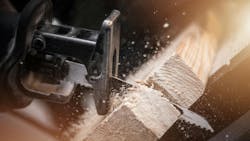
The reciprocating saw is one of the most versatile tools you can own. It can also be one of the most dangerous — and one that you do the worst workmanship with. We'll address both problems here, so you can safely make accurate cuts using this tool.
The rafter square is also one of the most versatile tools you can own. If you do not have one and do any kind of measuring and cutting (wood, steel, and other materials), get one. It was invented about 100 years ago and sold by the Swanson Tool Company as the Speed Square (a registered trademark). There are other brands of rafter squares available. Using this with your reciprocating saw will yield a better cut while improving your safety. It makes accurate marking quick and easy compared to using just a tape ruler, and it can serve as a saw guide or floor vice among other things. And, it can help you make straighter cuts with your reciprocating saw.
Best practices
Some general tips when using a reciprocating saw:
- Always use the correct blade for the material.
- Remove the battery before changing or adjusting the blade.
- If removing a blade you just used, keep in mind it may be hot enough to burn your skin.
- Secure the work. If you are using a smaller model intended for one-hand use, it's a common practice that the user holds the work with his free hand. This is generally safe, but it also increases hand fatigue.
- To reduce hand fatigue when cutting stick of raceway or strut, insert one end through the middle of your rafter square and set it on the floor. Stand on the end that you're not cutting, so you create a wedge effect with the square. The material will be secure without your needing to hold it.
- Use a firm, but not excessively tight, grip on the saw.
- To reduce hand fatigue, some users will cable-tie the trigger button in the handle and rely on the safety switch. This is dangerous. The saw should not run unless you are actively depressing that switch. If this tires out your hand, change your grip a little bit or take a break.
Pro tips
If you are cutting metal strut, stick one of those one-hole magnetic square washers on it fairly close to the cut. It will reduce the amount of metal dust that scatters. If you are cutting metal strut or raceway overhead, wear full face protection against the metal particles. Breathing them in, swallowing them, or getting them in your eyes could create serious injury. If cutting any other material, full-face protection is a good choice but you can typically get by with less protection.
If you are cutting wood, the sawdust will quickly cover your cutline pencil mark. The typical way to handle this is to cut for a bit, blow off the sawdust, correct the cut path to one side or the other, and then continue on in this way. It's time-consuming and produces a jagged cut. It also causes your saw motor to run much hotter, due to both the frequent restarting and the side torque.
If practical (depends on what you're cutting), a good way for a right-handed person to cut boards (up to 6 in. wide) with the reciprocating saw with work piece on the left is as follows:
- Line up the saw blade with the pencil mark (always on the outside edge, not down the middle or to the inside edge).
- Set your square's lip against the board, to the left of the saw.
- Slide your square over to the saw foot. Not the blade, but the foot.
- Double check that the saw blade is barely to the right side of the pencil line.
- Reach with your left hand out to the far end of your square, and clamp it in place. This keeps your free hand well away from the blade. This is also a good technique for using a circular saw.
- Make the cut, using firm pressure and keeping the blade vertical.
- If at any time you nudge something out of place, immediately stop and re-adjust.
- Reduce your pressure on the saw as the cut nears completion.
- Release the saw trigger before pulling the saw away from the cut.
A variation of this technique is to use a C-clamp to hold the square. To avoid damaging the face of your square, put a thin wood scrap or similar soft but solid item (e.g., plastic washer) between it and the clamp.
The foot on many reciprocal saws isn't shaped in a way that is conducive to using this method. So if you plan to acquire a reciprocating saw for cutting such things as 2×4 boards and metal strut, check out the foot to see if a 3/16-thick rafter square can guide it.
About the Author
 Mark Lamendola
Mark Lamendola
Mark is an expert in maintenance management, having racked up an impressive track record during his time working in the field. He also has extensive knowledge of, and practical expertise with, the National Electrical Code (NEC). Through his consulting business, he provides articles and training materials on electrical topics, specializing in making difficult subjects easy to understand and focusing on the practical aspects of electrical work.
Prior to starting his own business, Mark served as the Technical Editor on EC&M for six years, worked three years in nuclear maintenance, six years as a contract project engineer/project manager, three years as a systems engineer, and three years in plant maintenance management.
Mark earned an AAS degree from Rock Valley College, a BSEET from Columbia Pacific University, and an MBA from Lake Erie College. He’s also completed several related certifications over the years and even was formerly licensed as a Master Electrician. He is a Senior Member of the IEEE and past Chairman of the Kansas City Chapters of both the IEEE and the IEEE Computer Society. Mark also served as the program director for, a board member of, and webmaster of, the Midwest Chapter of the 7x24 Exchange. He has also held memberships with the following organizations: NETA, NFPA, International Association of Webmasters, and Institute of Certified Professional Managers.