Preventing Scaffolding-Related Citations, Part 7
Key Takeaways
- OSHA requires fall protection for scaffolding users when working more than 10 ft above a lower level, regardless of the specific height difference.
- Different types of fall protection systems are mandated depending on the scaffold type, such as personal fall arrest systems and guardrails, with specific attachment and structural requirements.
- Employers must have a competent person assess the feasibility and safety of fall protection during scaffold erection and dismantling, ensuring compliance with detailed standards.
- Guardrail systems must meet specific height and strength requirements, with clear guidelines on surface safety and load capacities to prevent injuries and violations.
- Simplifying compliance by standardizing on higher safety requirements, such as weight and height thresholds, helps prevent OSHA violations and ensures consistent safety practices.
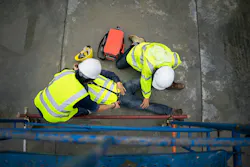
Citations for violating scaffolding requirements consistently make it onto OSHA’s annual Top 10 list. The requirements are in 29 CFR 1926.451(a) through (h). In Part 7, we look at the fall protection requirements for scaffolding users [29 CFR 1926.451(g)].
At what point does OSHA require fall protection for scaffolding users? If the level the employee is standing on is more than 10 ft above a lower level, the employee must be protected from falling to that lower level. Note the language here. It doesn’t say 10 ft above the next lower level, but 10 feet above a lower level.
What type of fall protection is required? That depends upon the application, and those requirements are laid out in 1926.451(g)(i) though (vii). For example:
(i) Each employee boatswain’s chair, catenary scaffold, float scaffold, needle beam scaffold, or ladder jack scaffold shall be protected by a personal fall arrest system.
(ii) Each employee on a single-point or two-point adjustable suspension scaffold shall be protected by both a personal fall arrest system and guardrail system.
It’s not just the users who must be protected either. The employer must have a competent person determine the feasibility and safety of providing fall protection for employees who erect or dismantle scaffolding [1926.451(g)(2)].
Those personal fall arrest systems must be attached by lanyard to a vertical lifeline, horizontal lifeline, or scaffold structural member [1926.451(g)(3)]. Notice, this list does not include fire protection piping, electrical raceway, air handling ducts, or other structures poorly trained people might use.
OSHA expands on this requirement in 1926.451(g)(3)(i) through (iv). For example, horizontal lifelines must be secured to two or more structural members of the scaffold or looped around the suspension lines above the hoist and brake attached to the scaffold. These lines cannot be attached to only the suspension ropes.
Guardrail systems must comply with 1926.451(g)(4)(i) through (xv). This is a very long list of requirements. Many of the requirements are specific to midrails (if used).
Some of the remaining requirements are obvious. For example, guardrails must be installed along all open sides and ends of platforms. Another example is they must be surfaced to prevent injury to the employee from punctures or lacerations and to prevent the snagging of clothing.
Others are not so obvious, such as when the loads specified in (g)(4)(vii) are applied in a downward direction, the top edge shall not drop below the height of the platform surface that is described in (g)(4)(ii). You are unlikely to remember that rule in the field or easily spot violations; it’s just too convoluted.
The solution for a complex, referential requirement is to go over the numbers, and then make your own site or company rules using those specific numbers. In this particular case, the toprail can’t be more than 45 in. above the platform surface, and you have two minimum heights to choose from (36 in. or 38 in.).
You also have two weights to choose from: “at least 100 lb” and “at least 200 lb.” To make this easy, find a plastic 4-ft level, and cut the last three inches off it. You now have a 45-in. “go/no go” ruler that is much stouter than a flat ruler. At the 3-ft mark on that level, mark it in some unmistakable way (depending upon where the level glass is).
Since 200 lb is, by definition, “at least 200 lb,” you could cover all contingencies by going with “at least 200 lb.” In almost any crew, there is someone who weighs at least 200lbs. That’s not a hard weight to come up with.
Do you see the principle here? One reason some employers get tripped up and commit an OSHA violation is they try to navigate through multiple references to come up with the minimum they need to do. By simplifying to — and standardizing on — the higher requirement you completely eliminate any chance of getting cited due to that confusion factor.
That said, you can simplify to and standardize on the lower requirement if you are completely sure there are no cases in which the higher requirement would apply. For example, in this specific requirement we just looked at there’s a demarcation date. The 38-in. requirement applies to scaffolds manufactured or placed in service after Jan. 1, 2000. The 36-in. requirement applies to scaffolds manufactured and (not “or” as stated before) placed in service before Jan. 1, 2000.
If you have the older scaffolding and none of the newer, you could go with the 36-in. rule. Or with the weight, if all you have are single-point adjustable or two-point adjustable systems, then you can standardize on 100 lb. Just make sure you don’t rent or purchase any other type of scaffold if you are to do that.
About the Author
 Mark Lamendola
Mark Lamendola
Mark is an expert in maintenance management, having racked up an impressive track record during his time working in the field. He also has extensive knowledge of, and practical expertise with, the National Electrical Code (NEC). Through his consulting business, he provides articles and training materials on electrical topics, specializing in making difficult subjects easy to understand and focusing on the practical aspects of electrical work.
Prior to starting his own business, Mark served as the Technical Editor on EC&M for six years, worked three years in nuclear maintenance, six years as a contract project engineer/project manager, three years as a systems engineer, and three years in plant maintenance management.
Mark earned an AAS degree from Rock Valley College, a BSEET from Columbia Pacific University, and an MBA from Lake Erie College. He’s also completed several related certifications over the years and even was formerly licensed as a Master Electrician. He is a Senior Member of the IEEE and past Chairman of the Kansas City Chapters of both the IEEE and the IEEE Computer Society. Mark also served as the program director for, a board member of, and webmaster of, the Midwest Chapter of the 7x24 Exchange. He has also held memberships with the following organizations: NETA, NFPA, International Association of Webmasters, and Institute of Certified Professional Managers.