Preventing Scaffolding-Related Citations, Part 8
Key Takeaways
- OSHA mandates the use of hardhats and protective barriers like toeboards and guardrails to prevent falling objects from injuring workers below.
- Effective communication, such as verbal alerts and signaling, is crucial for coordinating work and preventing accidents on scaffolding sites.
- Barricades using caution or do not enter tape should be standard, with clear training for workers to understand their significance and proper procedures.
- Employers should consider tool safety devices like magnetized parts and tool lanyards to reduce the risk of dropped tools and materials.
- Proactive safety measures, including barricades and communication, help avoid citations and serious injuries in scaffolding operations.
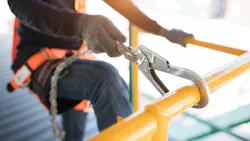
Citations for violating scaffolding requirements consistently make it onto OSHA’s annual Top Ten list. The requirements are in 29 CFR 1926.451(a) through (h). In this Part 8, we look at the falling object protection requirements for scaffolding users [29 CFR 1926.451(h)].
The first requirement isn’t specific to scaffolding: employees must wear hardhats. In addition to this precaution against falling objects, the employer must provide employees with protection from falling hand tools, materials, debris, and the like. This can be accomplished with toeboards, guardrails, screens, debris nets, catch platforms, and the like. Something OSHA does not mention is many power tools now have a magnetized portion for holding screws, bits, and blades; consistent use of this as a general habit will also reduce the risk of dropping something in the first place. Carabiner and lanyard systems for tools are also worth looking into.
Where there is a danger of tools, materials, or equipment falling from a scaffold and striking someone below, the employer must take the five precautions listed in 29 CFR 1926.451(h)(2)(i) through (v). The first of those is to barricade the area. That should be standard practice whether there is a drop hazard or not.
A typical barricade consists of either yellow CAUTION tape or red DO NOT ENTER tape. Employees should be trained (and frequently reminded) to avoid walking through an area where a scaffold is being use. They should also be trained (and frequently reminded) that yellow caution tape isn’t like a yellow traffic light. It really means to stay out of the area unless you have a specific job task in that area. And if so, proceed with caution. Supervisors need to avoid confusion by essentially treating yellow and red tape as the same, re-assigning tasks to keep people out of the affected area if unrelated to the work being done on the scaffold.
Commonly, people working on scaffolding have a ground crew. That may consist of a single helper whose job it is to enter the area to help hoist up (or down) tools or materials, then wait outside the area until called by the scaffold crew. The barrier is a passive device, it doesn’t manage these situations.
Communication is the solution. If Ted is entering the area with the power crimper that Bill needs, he doesn’t just walk up to the scaffold and set it in the bucket for Bill to haul up. Bill might be removing a heavy cover at the moment, so Ted would holler up that he’s got the crimpers and he’ll wait for a response from Bill. Bill would then stop work, secure anything that might be kicked onto Ted, and holler down that he’s ready. If Sam is also on the scaffold, he also stops what he’s doing. When Ted has retreated back out of the taped off area, he hollers up that he’s clear. Then Bill and Sam can resume work.
Ted can holler up when someone meanders into the taped off area. He can also holler at that person to exit the area. Things don’t always fall straight down. They can bounce off of nearby objects or structures, endangering people who are several feet away from the scaffolding. Bill and Sam can holler down when they drop something or kick it over the edge, and that warning could save a life.
OSHA doesn’t require this kind of communication. But by adopting such a system for your crews who work on scaffolding and/or support those who do, you avoid all kinds of situations that can lead to not just a citation or three but also to serious injury. The “set it and forget it” method is simpler, but not nearly as effective as establishing good communication. Even with all the other object protection measures in place, people can get hurt. That’s why it’s valuable for them to know to not be there when something might be about to cut loose.
About the Author
 Mark Lamendola
Mark Lamendola
Mark is an expert in maintenance management, having racked up an impressive track record during his time working in the field. He also has extensive knowledge of, and practical expertise with, the National Electrical Code (NEC). Through his consulting business, he provides articles and training materials on electrical topics, specializing in making difficult subjects easy to understand and focusing on the practical aspects of electrical work.
Prior to starting his own business, Mark served as the Technical Editor on EC&M for six years, worked three years in nuclear maintenance, six years as a contract project engineer/project manager, three years as a systems engineer, and three years in plant maintenance management.
Mark earned an AAS degree from Rock Valley College, a BSEET from Columbia Pacific University, and an MBA from Lake Erie College. He’s also completed several related certifications over the years and even was formerly licensed as a Master Electrician. He is a Senior Member of the IEEE and past Chairman of the Kansas City Chapters of both the IEEE and the IEEE Computer Society. Mark also served as the program director for, a board member of, and webmaster of, the Midwest Chapter of the 7x24 Exchange. He has also held memberships with the following organizations: NETA, NFPA, International Association of Webmasters, and Institute of Certified Professional Managers.