NFPA 70E: Key Terms Electricians Should Know, Part 7
Key Highlights
- Exposed wiring methods include surface raceways and behind-panel installations, which are safe if properly installed and maintained.
- Energized conductors are considered exposed if they are not adequately guarded, isolated, or insulated, posing shock risks especially at higher voltages.
- Safety measures, such as guards, insulation, and de-energizing equipment, are essential when working with control wiring and higher voltage systems.
- Visual inspection and risk assessment are crucial steps before working on electrical equipment to identify potential shock hazards.
- Using proper PPE and enclosures can mitigate risks when working near energized parts exceeding 480V.
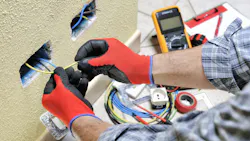
Article 100 has two definitions. One of them applies to wiring methods. An exposed wiring method is one that is on (or attached to) the surface or is behind panels designed to allow access. In an office, for example, you might have surface raceway. While perfectly safe — and often aesthetically pleasing — it’s considered exposed. That is as opposed to concealed, which might, in that same office, mean the wiring method is run between the studs behind the drywall. Either way, there is no chance (barring a bad job of installation) that a person would come into contact with electricity without deliberately making an effort to do so.
You don’t want to confuse this definition with the one that applies to energized electrical conductors or circuit parts. If somebody could inadvertently come into contact with energized electrical conductors or circuit parts, then those energized electrical conductors or circuit parts are considered exposed.
And “exposed” also applies when a person can inadvertently approach energized electrical conductors or circuit parts at less than a safe distance. Generally for the premises wiring of a typical distribution system in a typical industrial or commercial building, this is not a consideration because the highest nominal system voltage is 480V. However, even with such a limitation of the premises wiring, there may be specific utilization equipment that operates at a higher voltage. There may even be a Medium Voltage transformer far away from any exterior walls. Just because it’s inside the plant doesn’t mean it can’t zap someone who gets within a few inches of it. Which explains the big fence around such an installation at a plant in Springfield, Tenn.
The Art. 100 definition that applies to energized electrical conductors or circuit parts is applied to those that are “not suitably guarded, isolated, or insulated.” Understanding this part of the definition during enclosure selection, terminal layout, and construction of what the enclosure encloses is key to preventing the danger of exposed terminals. A terminal cabinet for incoming sensor wiring (e.g., 4mA to 20mA, which operates at 8VDC to 32VDC) can have exposed terminals with no shock hazard. Step up to the control wiring (typically 120V to 240V), and that is no longer the case. Control wiring doesn’t have a proximity hazard, but it does have a touch hazard. So a properly designed terminal strip for control wiring will have small guards around each terminal. These guards do not provide enough space for a finger to touch a terminal screw.
As you move up the scale of voltage, the requirements for making protection suitable become more stringent. It may involve a combination of various types of guards, isolation measures, and insulation measures. Isolation generally means de-energizing equipment. Not necessarily lockout/tagout, though that is one means of isolation. It could mean opening a local isolation switch and discharging a starting capacitor (for example on a 500-ton punch press).
One way to make “exposed” a part of your safety thinking is to visually critique the equipment you are about to work on and/or the enclosure you are about to enter (or stick your hands into). Look at each energized electrical conductor and each circuit part, and ask yourself if there is any way it exposes you to shock. If the nominal voltage exceeds 480V, you’re exposed by simply getting too close to it — so start with that. Maybe you need to de-energize, or maybe you can use a portable insulator such as an insulated blanket (which is PPE) to ensure you are suitably insulated against that hazard.
About the Author
 Mark Lamendola
Mark Lamendola
Mark is an expert in maintenance management, having racked up an impressive track record during his time working in the field. He also has extensive knowledge of, and practical expertise with, the National Electrical Code (NEC). Through his consulting business, he provides articles and training materials on electrical topics, specializing in making difficult subjects easy to understand and focusing on the practical aspects of electrical work.
Prior to starting his own business, Mark served as the Technical Editor on EC&M for six years, worked three years in nuclear maintenance, six years as a contract project engineer/project manager, three years as a systems engineer, and three years in plant maintenance management.
Mark earned an AAS degree from Rock Valley College, a BSEET from Columbia Pacific University, and an MBA from Lake Erie College. He’s also completed several related certifications over the years and even was formerly licensed as a Master Electrician. He is a Senior Member of the IEEE and past Chairman of the Kansas City Chapters of both the IEEE and the IEEE Computer Society. Mark also served as the program director for, a board member of, and webmaster of, the Midwest Chapter of the 7x24 Exchange. He has also held memberships with the following organizations: NETA, NFPA, International Association of Webmasters, and Institute of Certified Professional Managers.