How the 2026 NEC Is Changing Worker Safety
Key Takeaways
- The 2026 NEC clarifies that manufacturer instructions must not conflict with safety requirements, ensuring proper installation and protection measures are followed.
- Arc-flash warning labels now provide simplified, clear safety information, including voltage levels and PPE requirements, to improve worker safety during maintenance.
- Working space requirements have been refined to ensure safe egress for injured or emergency personnel, especially when doors or equipment reduce available space.
- Barriers for shock and arc flash protection must be placed on energized terminals, particularly on line-side terminals, to prevent accidental contact and arc flash hazards.
- New rules specify the placement and labeling of service disconnects, including emergency shutoffs for EVSE, to facilitate quick and safe power disconnection during emergencies.

There is little doubt that the National Electrical Code (NEC) is all about safety. The Code’s stated purpose in Art. 90, “…the practical safeguarding of persons and property from hazards arising from the use of electricity,” makes it clear that our installation work must prevent shock and fire. The NEC also has installation provisions that more directly address the safety needs of those who operate, service, and maintain equipment (Photo 1). Of great importance is the protection of first responders who often encounter electrical systems but are not qualified electrical workers.
The 2026 NEC continues to revise its electrical safety installation rules to protect everyone — from the general public in their homes to the worker in the plant electrical room to the fire personnel responding to emergencies. This article highlights some key 2026 NEC changes that directly improve safety for workers.
Manufacturers’ instructions
“Follow manufacturers’ instructions” has long been heard when discussing Code enforcement. But what if those manufacturers’ instructions conflict with the NEC and result in an installation that does not meet the safety requirements of the Code? If you follow the Code but then violate Sec. 110.3(B) [Installation and Use], which requires following the manufacturer’s instructions, where does that leave you? Revised wording now explains that manufacturer instructions are to be followed — as long as they do not conflict with NEC rules.
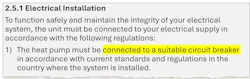
Examples of such conflicts can easily be found. For example, see the Figure for swimming pool heat pump installation instructions. The only protection requirements specified for the branch circuit is the heat pump be connected to a “suitable circuit breaker.” Sec. 680.5 [Ground-Fault Circuit-Interrupter (GFCI) and Special Purpose Ground-Fault Circuit-Interrupter (SPGFCI) Protection] requires Class A GFCI protection for pool accessory equipment. An SPGFCI may be required for certain applications. The public, pool technicians, and service personnel must be protected from electric shock. Electricians must install the required GFCI protection even if not specified by the manufacturer.
Arc flash warning labels
Sec. 110.16 [Arc Flash Hazard Marking] is a good example of a Code requirement specifically designed to protect electrical workers. When it comes to following safety procedures, workers want simplicity and conciseness: “Just tell me what I need to wear and what I need to do to protect myself — don’t complicate it for me.” Previous Code language tended to complicate arc flash information needed by the worker. It was wordy and referenced other documents rather than just stating the rules.
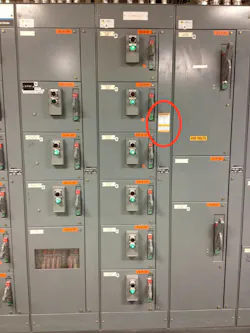
Clarifying these requirements now helps implement safe work practices. When the worker approaches the equipment, the arc flash warning label must be clearly visible (Photo 2). Information on the label is now required to provide nominal voltage levels used to establish approach boundaries and select the appropriate level of voltage-rated rubber goods. And the required arc flash protection information will allow the trained person to select the correct arc-rated PPE. The Code now provides the worker with the safety information to proceed.
Working space
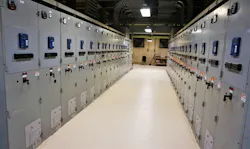
Section 110.26 [Spaces About Electrical Equipment] emphasizes a working space requirement to ensure workers can egress the work area in the event of an incident, such as a fire or arc flash. A minimum width of 24 inches has been in previous Code editions, as this width is adequate for egress in an emergency. However, consider an injured worker attempting to find their way out of a dark and smoke-filled electrical room. If 24 inches is needed, what happens to the worker if panel doors on either side of the egress route just happened to be open at 90 degrees, and that 24 inches was drastically reduced? The worker may struggle to exit the area. The wording in Sec. 110.26 was changed to clearly reflect that access or egress is impeded if the space is reduced to be less than 24 inches wide and 6½ feet high when doors are (or can be) opened 90 degrees. Photo 3 illustrates a potential situation.
Electrical contractors and designers will have to consider the effect this rule may have on future installations in smaller work areas with larger equipment. Yet an injured person in shock, in a dark room filled with smoke, must still be able to quickly exit that area, and responders must be afforded adequate access.
Barriers for safety
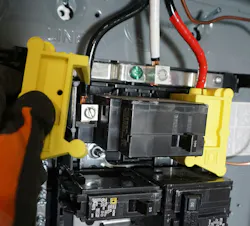
The revision to the title of Sec. 230.62 [Service Equipment — Enclosed or Guarded, and Barrier Placement] now emphasizes the need for the use of identified barriers for both shock and arc flash protection for workers by adding the words “and Barrier Placement.” The requirement now specifies that these barriers are to be placed so that “energized” terminals and bus work of service equipment cannot be inadvertently contacted. Thus, the barriers must be placed on the line-side terminals of the service equipment.
Such barriers are placed for more than just electric shock protection. Exposed live terminals also present a potential arc flash hazard should an uninsulated tool or conductor accidentally contact or come into contact with the terminals. This may occur during testing long after installation (Photo 4). Service conductors supplying a service are typically not protected by overcurrent protection on the secondary side of the serving utility transformer, and workers can be exposed to abnormally large arc flash events. Specifying the location of these identified barriers on energized terminals and bus work service equipment only increases worker safety.
Disconnects for worker safety
Numerous requirements for disconnect means appear throughout the Code. Disconnect switches serve an important function by allowing lockout/tagout of equipment. Location and labeling help workers and first responders quickly and safely remove power from energized equipment during an emergency.
For service equipment, Sec. 230.70 [General] has relocated rules for disconnect locations to make it clear that one- and two-family dwelling unit service disconnects must be readily accessible outside the building. In other than one- and two-family dwellings, service disconnects must be located readily accessible either outside the building or inside nearest the point of entrance of the service conductors. Service disconnects on other than one- and two-family dwellings must now be labeled “SERVICE DISCONNECT.” This new label requirement removes confusion, especially for the first responders. Terms such as “Mains” or “Main Disconnect” do not match the terminology in the Code for this equipment. Improper labeling could also create confusion with multiple disconnects in one location.
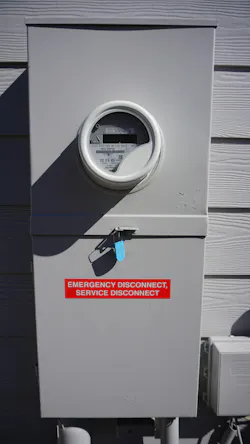
For one- and two-family dwellings, service disconnect enclosures must be marked “EMERGENCY DISCONNECT” with the marking on the outside front of the disconnect enclosure using white letters at least one-half inch high on a red background, as shown in Photo 5.
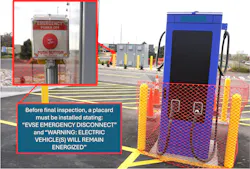
Fire personnel responding to an electric vehicle fire must safely shut off the power. Section 625.43 [Disconnecting Means] now requires an emergency shutoff for all Electric Vehicle Supply Equipment (EVSE) and Wireless Power Transfer Equipment (WPTE) in other than one- and two-family dwellings (Photo 6). The disconnect must be located between 20 feet and 25 feet from the charging equipment, thus keeping the shutoff reasonably close to the EVSE or WPTE, yet providing ample distance from the equipment to allow first responders to approach the fire from a safe distance to shut off power (Photo 5).
Damaged wiring
A new Sec. 300.4(C) requires damaged wiring to be replaced. The new provision not only gives AHJs enforcement direction, but these requirements also provide worker protection, as well. One might think using the word “repaired” would be more practical in some instances. However, it is often difficult to determine damage to insulation that cannot be seen.
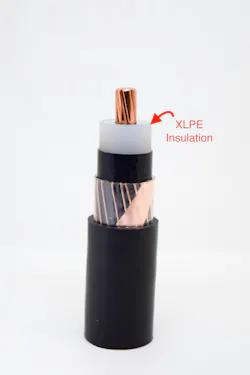
Exposing conductor insulation rated only for dry and damp locations to water damage is an obvious issue. Insulation absorbs moisture, and insulation resistance testing can often be used to determine the presence of moisture. However, medium-voltage (MV) cable has a more complex insulation system than insulation rated for 600V. This XLPE and EPR MV insulation deterioration and failure can cause catastrophic failure long after exposure to water. Even though insulation test values may indicate satisfactory values, the damage is already done (Photo 7).
Replacement of water-damaged wiring is the best alternative for protecting operations and maintenance personnel who will be operating and maintaining systems. In fact, the Code-Making Panel noted that no such code rule existed to protect the worker from this hazard, and this new requirement “enhances electrical safety and helps satisfy the practical safeguarding as required by the code purpose.” Fortunately, two Informational Notes are included, providing NEMA references to evaluate equipment and wiring for fire, heat, and water damage.
In summary
The NEC is responsible for protecting all persons, not just the general public who occupy buildings and dwelling units. In many cases, Code rules are provided specifically for those who must operate and maintain electrical systems and equipment. In most cases, these persons will not be qualified electrical workers (plant operators, mechanics, pipefitters, welders, service technicians, and so on). In the event of an emergency, it is extremely important to provide first responders with correctly marked and accessible means to disconnect power from a safe location and then respond to the emergency. The 2026 NEC did make some specific revisions to enhance worker safety — thank you to the Code-Making Panels.
Code Rules Change to Reflect Safety and Practicality
NEC rules today are promulgated based on studies, engineering data, and public input, with the idea of preventing incidents before they happen — proactive rules rather than reactive ones. Here are two examples for us to review.
Service disconnects. Fire and life safety were the considerations of the first electrical code published in 1897 by the National Board of Fire Underwriters. It stated, “Switches must be placed on all service wires, either overhead or underground, in a readily accessible place as near as possible to the point where the wires enter the building…”. By 1925, two service disconnects were permitted, since a disconnect may be required for the store on the ground floor and another for the residence located above the store. By the 1933 edition of the NEC, the six-disconnect rule had come into place based on needs. The 2020 NEC required that “up to six disconnects be in separate enclosures” for safe operation.
Temporary wiring and Installations first appeared in the 1971 NEC. Article 590 [Temporary Installations] requires guards over temporary lamps to protect them from accidental breakage and worker shock incidents. The 2026 NEC recognizes that changes in technology have produced safer lighting alternatives. Section 590.4(F) now allows listed temporary lighting strings with non-replaceable LED lamps to not require a guard. Rules are relaxed, but safety is maintained.
About the Author
 Randy Barnett
Randy Barnett
CESCP
Randy Barnett, electrical code and safety specialist, is a master electrician, ICC commercial electrical inspector, NFPA-certified electrical safety compliance professional and has worked as an electrician and technician in nuclear and coal-fired power plants, and in industrial maintenance and construction for 40 years. He is the author of Commercial and Industrial Wiring – American Technical Publishers, numerous articles, and is seen monthly on the EC&M Tech Talk video series for EC&M magazine. Randy conducts both online and in-person classes for NTT Training where he served as program manager for over 20 years. Randy’s resources can be found at www.randybarnett.net. His email is [email protected].